dropshipping-product-research
How to Do Product Research for Dropshipping
By
Kinnari Ashar
You can spend hours jumping between ad libraries, product pages, and random spreadsheets and still end up unsure about what to sell. That is where most dropshipping research starts to break down. Too many tabs, too little clarity, and decisions based on guesswork.
What you actually need is a clean way to spot patterns, verify demand, and understand what is already working before you invest time or money. When all the right signals sit in one place, product selection stops feeling random and starts feeling predictable.
This guide shows you a structured way to move from idea to validated product.
Stick with it, and you will see how quickly the process tightens up once everything connects.
Step-by-Step: How to Do Product Research Using WinningHunter
Step 1: Start With the Ad Feed to Identify Active Products
Open the ad feed in WinningHunter and pick TikTok or Facebook. Do not scroll like you would on social media. You are there to catch products that keep coming back.
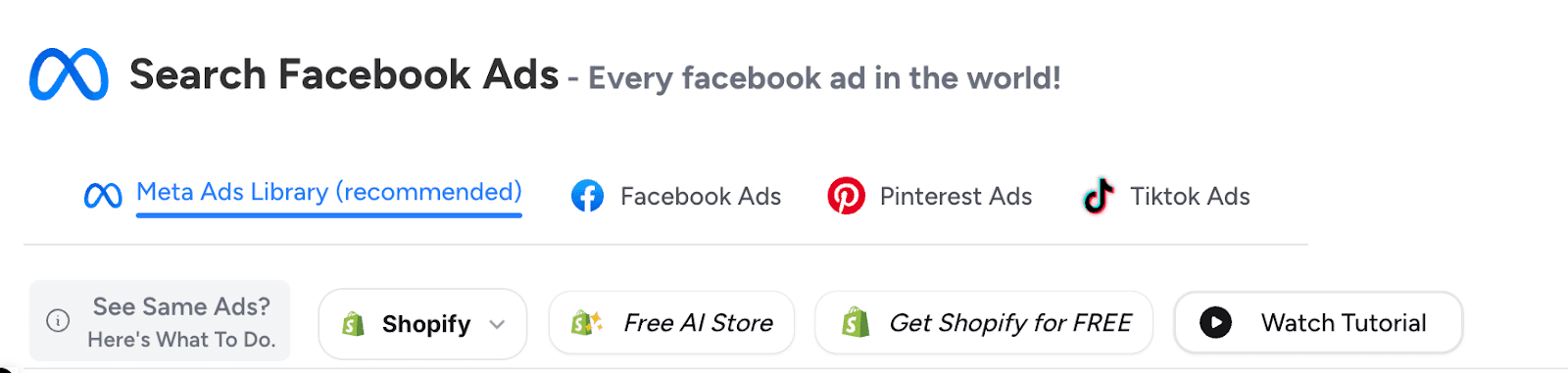
When you see a product once, ignore it. When it shows up again from another store, take notice. When it appears a third time with a different video or angle, save it. That repetition usually means someone is spending consistently and seeing enough return to keep pushing it.
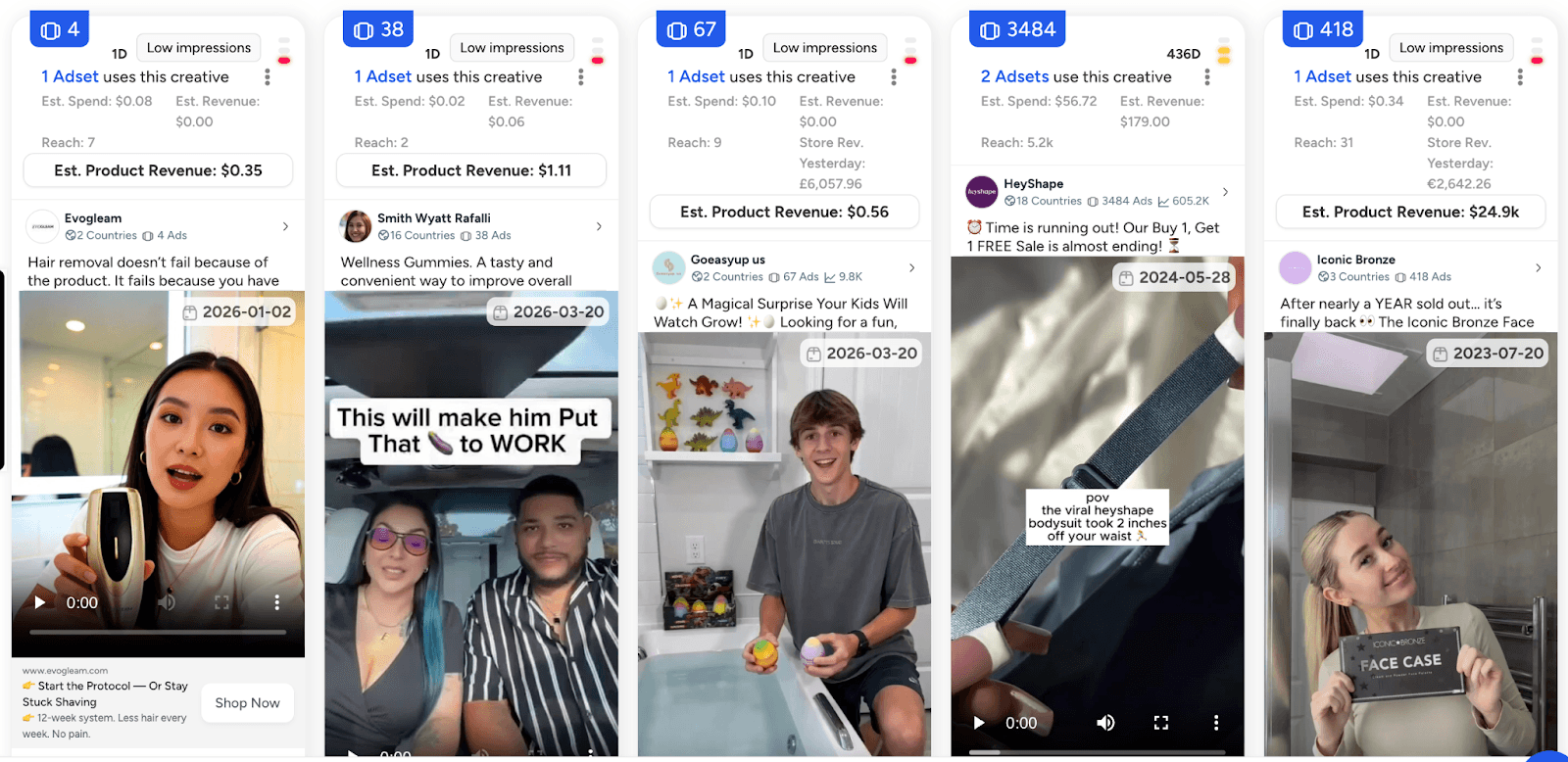
Now watch how the product is introduced. You should understand what it does almost instantly. The opening seconds need to show either the problem or the result without making you think. If you have to figure it out, move on.
Keep your filter tight while scanning:
The same product shows up across multiple ads
The hook is clear in the first few seconds
The use case is obvious without explanation
Look at the style of the ad as well. The ones that repeat are usually simple clips showing real usage. No heavy edits, no overproduction. That kind of content runs longer because it connects faster.
By the time you finish scrolling, you should have a small list of products that keep appearing and make sense immediately. You are not picking a winner yet. You are narrowing down to products that already have momentum.
If you have not used WinningHunter before, start with the free trial and go through this process yourself. You will notice how quickly patterns stand out when everything is in one place.
Step 2: Filter Ads by Duration and Spend to Find Proven Products
Once you move past raw scrolling, the filters become your real advantage.
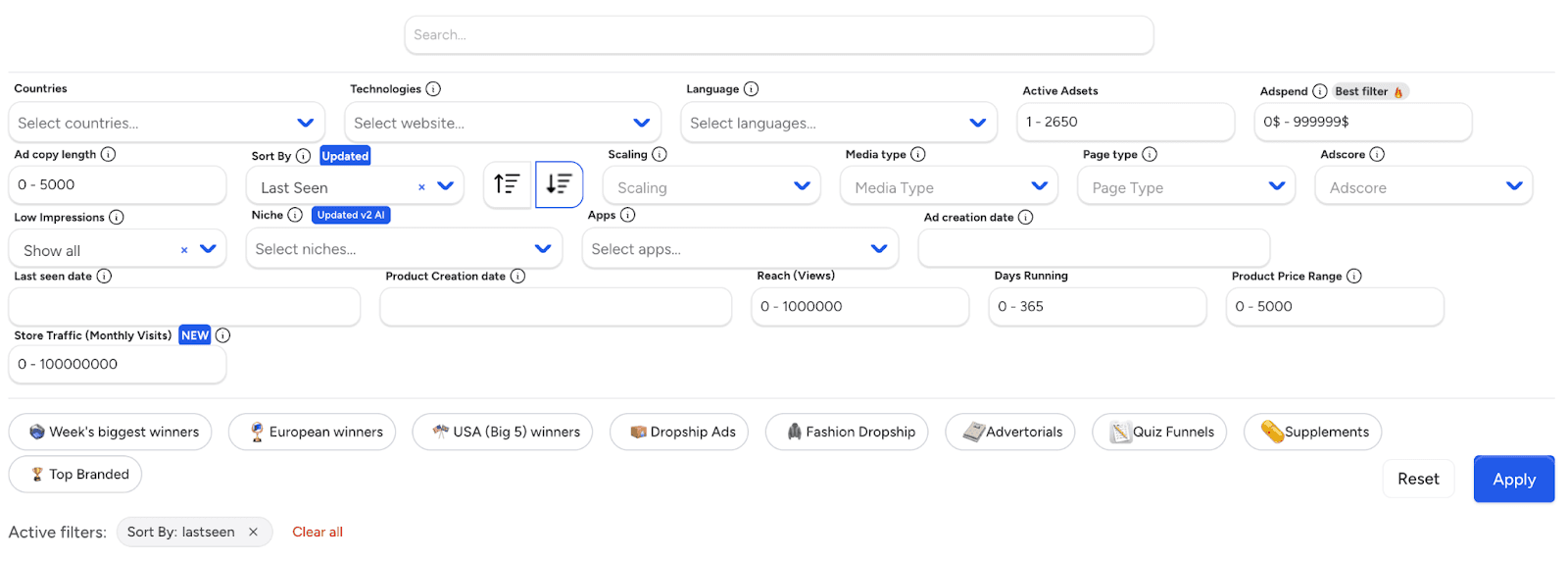
Look at the filter panel and start tightening your view. You do not need everything turned on. You need the right combinations.
Start with Days Running. Set a minimum of 7 days. If you want stronger signals, push it to 14 or 30. This immediately removes short-lived tests and leaves ads that have stayed active.
Next, use Adspend. You are not chasing exact numbers. You want ads that are not sitting at the bottom. Mid to high spend usually means the advertiser is confident enough to keep pushing.
Bring in Reach (Views) and Engagement signals. High views with no interaction tell a different story than steady engagement across multiple ads. You are looking for balance, not spikes.
Now layer in supporting filters depending on what you are targeting:
Countries to match your market
Media Type if you want video-heavy creatives
Niche to stay within a category
Product Price Range to match your pricing strategy
Store Traffic if you want to check how established the seller is
You do not need to use every filter. The goal is to narrow the feed until weak ads disappear and only serious campaigns remain.
When you apply these filters together, the list changes fast. What stays visible are products backed by time, spend, and consistent activity. That combination is what you are trying to isolate before moving forward.
Step 3: Open Product Creatives to Analyze Angles and Variations
A product only becomes interesting once you see how many ways it is being sold.
Pick one from your filtered list and open all its creatives. Do not stop at the first video. Go through several in a row and pay attention to what keeps changing.
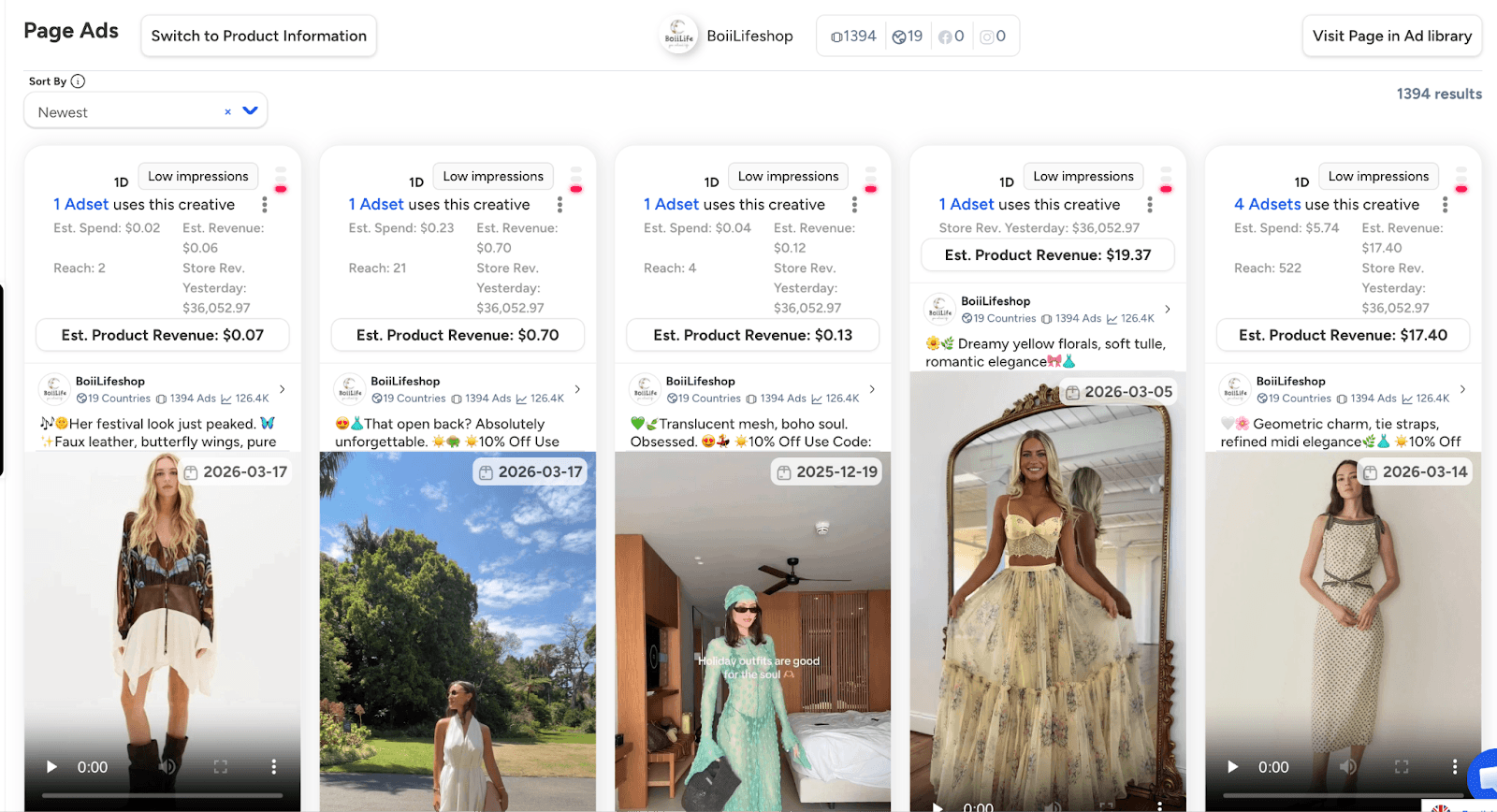
Focus on the entry point. Each creative tries a different way to grab attention. Some jump straight into the outcome. Others begin with a relatable situation. A few feel almost unplanned, like someone casually recording usage. That variation shows active testing, not random uploads.
Shift your attention to the message behind each version. The product stays the same, but the selling angle moves. One video might push speed or convenience. Another leans into a specific use case. Another frames it as something people are already using daily. When multiple directions exist, it means the product is not dependent on a single pitch.
Now look at the format choices. You will notice a mix of raw clips, simple demonstrations, and more personal style videos. When these formats repeat across creatives, it signals that the advertiser is expanding what works rather than relying on one winning ad.
Step 4: Use Store Tracking to Validate Real Sales Activity
Ad performance can look convincing on the surface. The store behind it tells you what is actually happening.
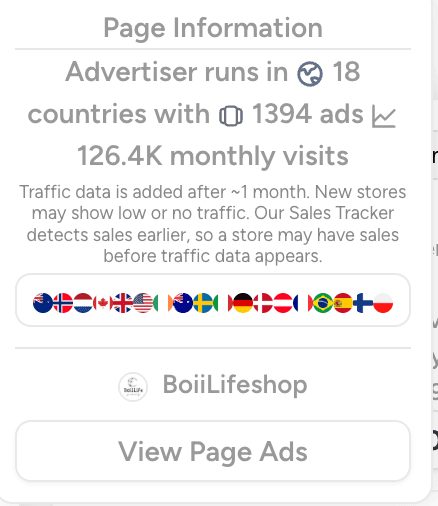
Open the linked store directly from the ad and take a closer look. You are not browsing like a customer. You are checking whether the product sits inside a store that is moving volume.
Start with the store’s overall activity. Look at how often products are updated, how the listings are structured, and whether the store feels maintained or abandoned. A store that is actively managed usually reflects ongoing sales.
Next, check the estimated revenue and traffic signals. You are not chasing exact figures. You are trying to confirm that the store is generating consistent movement, not just running ads without results.
Then look at how the product fits into the store. If it is surrounded by similar items and supported by multiple listings, it is likely part of a broader scaling strategy. If it sits alone with no depth around it, the store may still be testing.
Step 5: Identify Competition and Market Saturation
Type the same product into WinningHunter and look at what shows up around it.
You are trying to understand how crowded it feels, not just how many ads exist. There is a difference.
If the results look like clones of each other, same video style, same hook, same way of showing the product, then you are walking into a space where everyone is doing the exact same thing. That usually means the product has already peaked or is close to it.
Now compare that with a product where the ads do not look identical. Different stores are selling it, but each one is presenting it slightly differently. The core product is the same, yet the approach changes. That is a much better sign. It means the product still has room for new angles.
Pricing adds another signal. When every seller is locked into the same number, there is very little room to move. When prices vary, it shows flexibility in how the product is being positioned.
Scroll through the results and let it sink in. You will start to feel the difference between a saturated product and one that still has space. One looks repetitive and crowded. The other looks competitive, but not exhausted.
Step 6: Use Magic AI Search to Find Competitors Faster
Take the product you have been tracking and drop it into Magic AI search. You can upload an image or type a keyword. The goal here is speed. You want to uncover everything connected to that product without digging manually.
The results open up a wider view almost instantly. You will see other stores selling the same item, along with additional creatives that were not visible in your earlier search. This gives you a clearer picture of how broadly the product is being pushed.
Look closely at how different sellers are positioning it. Some may highlight a specific use case. Others may shift the audience or change the context entirely. When you see multiple directions like this, it tells you the product is being explored from different angles, not locked into a single pitch.
This step helps you move faster without missing details. Instead of piecing together competitors one by one, you get a clustered view of who is selling, how they are selling, and what variations already exist.
Step 7: Shortlist Products Based on Data Signals
Now you decide what actually deserves your time.
Go back through everything you reviewed and start trimming your list without hesitation. If a product only looked good in one place, it would not make it through. You are keeping products that stayed consistent across ads, creatives, and store activity.
The ones worth carrying forward usually check out across all angles. They keep showing up in ads, they are backed by multiple creatives, and the store behind them looks active and maintained. When all three line up, you are no longer guessing.
Here’s how to know if a product is worth testing: run every shortlisted product through four checks.
Demand validation: Check if interest holds over time, not just in one moment. Ads should stay active across days with steady engagement across multiple creatives. One strong video is not enough. You want repeated signals that people keep responding to.
Competition validation: Look at how crowded the space feels. If every seller is using the same clips and the same messaging, entry becomes harder. A mix of angles and formats shows room to position the product differently.
Profit validation: Estimate your margin after product cost, shipping, and ad spend. If pricing looks tight across competitors, you may struggle to stay profitable. Products with flexible pricing give you more room to test.
Logistics validation: Check shipping time, supplier reliability, and return risk. Slow delivery or inconsistent quality will break performance even if demand exists.
If a product clears all four, it is ready for testing.
Cut anything that breaks this pattern:
One-off viral ads with no follow-up
Products with no real store presence
Feeds filled with identical creatives from multiple sellers
What you are left with should feel tight and deliberate. A small set of products, each backed by visible data, is ready to move into testing.
Step 8: Save or Import Products for Testing
Your shortlist should not sit idle after this point.
Store each product inside WinningHunter so you can revisit it without digging through ads again. When a product looks ready for testing, use the Import Product option to move it forward and avoid rebuilding everything from scratch.
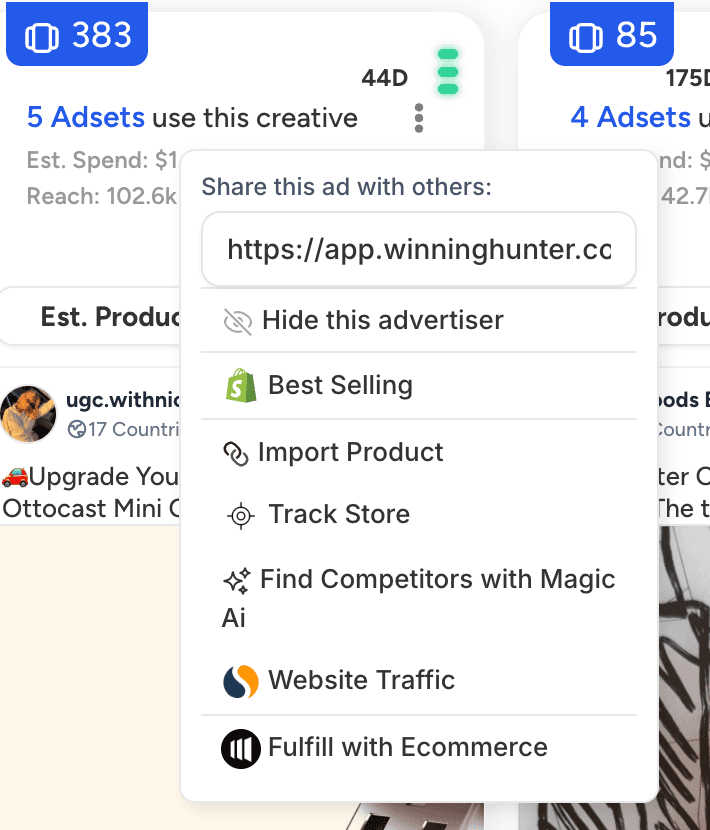
Not every product needs immediate action. Some are worth watching for a few days to see if they hold momentum. Others are clear candidates for testing right away. This step is where you separate those two.
A simple way to organize your picks:
Products ready for testing
Products worth observing
Products you may revisit later
Saving gives you structure. Importing lets you act without delay.
Once this step is done, you have a clear set of products backed by data and ready to move into testing without second-guessing your choices.
Common Product Research Mistakes
Weak results often come from small decisions made during research, not from the tools you use. These are the patterns that quietly hold people back.
Chasing viral products after they have already peaked, entering when competition is high, and margins are tight
Relying only on ads without checking store activity, leading to false signals about performance
Ignoring margins and focusing only on demand makes scaling difficult later
Copying competitors directly, using the same creatives and pricing with no differentiation
Testing too many products at once, spreading attention thin, and making it harder to track what actually works
Avoid these mistakes and your research stays grounded in real signals
Turning Product Research Into a Controlled Process
Product research stops feeling random when you rely on actual data, and not just scattered guesses. WinningHunter brings ad discovery, store tracking, and competitor insights into one place, so you are not switching between platforms or piecing together information manually.
That connected workflow makes decisions clearer. You can move from spotting a product to validating it without losing context or repeating steps. Less time goes into checking and rechecking, and more time goes into acting on products that already show signs of traction.
Follow this process consistently, and your selection improves.
Fewer weak tests, more informed decisions, and a setup that gets sharper with every product you analyze.
FAQs
What filters should I use in WinningHunter?
Start with an ad duration to remove short-lived tests. Set it above 7 days so only active campaigns remain. Add ad spend to focus on products backed by a real budget. Bring in reach and engagement to understand how people are responding. You can refine further with country, niche, or price, depending on your target market. The goal is not to use every filter, but to narrow results until only products with steady activity and visible traction stay on screen.
How do I know if a product is saturated?
Search the product and study how it appears across ads. If you see identical creatives repeated by multiple sellers, the space is crowded and harder to enter. Pricing often looks similar as well, leaving little room to position differently. A healthier scenario shows variation. Different hooks, different presentation styles, and slight shifts in messaging suggest the product is still being explored. That kind of spread gives you room to test your own angle without getting buried under copy-paste competition.
Can I rely only on ads for product validation?
Ads give you visibility only, and not confirmation. A product can look strong in the feed and still fail if the store behind it is weak or inconsistent. That is why checking store activity matters. Look at how the product sits within the store, how often listings are updated, and whether there are signs of ongoing traffic. When ad activity and store signals align, you get a clearer picture. Relying on ads alone leaves gaps that often lead to poor product choices.
How many products should I shortlist per week?
Focus on quality over volume. A small, well-filtered list works better than collecting a large number of weak ideas. Aim for a handful of products that meet all your checks across ads, creatives, and store activity. This keeps your testing process manageable and allows you to focus on performance. When you spread your effort across too many products, it becomes harder to track what is working and what needs adjustment. A tight shortlist keeps your decisions sharper.


We already know what works before you even have the chance to blink!
© 2024 WinningHunter.com