facebook-ads-library-alternatives
Facebook Ads Library Alternatives: Tools to Spy on Competitor Ads Beyond Meta
By
Kinnari Ashar
Most people start competitor research with Facebook Ads Library because it is the obvious option. It is free and gives you a quick look at what competitors are running right now. For basic checks, yes, it does the job.
But when you want more than a screenshot, it is inefficient. You cannot see if an ad performed well or what happened after it disappeared. You are also limited to Meta, which makes serious product or creative research incomplete.
If you are running ecommerce campaigns, those blind spots matter. You need proof before testing, and signals that go beyond active ads.
That is exactly why marketers look for a Facebook Ads Library alternative. And that is where this guide starts.
Key Takeaways
Facebook Ads Library is useful for transparency, but weak for competitive intelligence.
Advanced ad spy tools reveal what is actually converting.
Cross-platform ad visibility matters as brands scale beyond Meta.
Not all “ad spy tools” are built for e-commerce or dropshipping use cases.
WinningHunter stands out by connecting ads, products, and store-level performance, making it more suitable for e-commerce teams that need proof before spending.
5 Facebook Ads Library Alternatives Recommended
1. WinningHunter – Best Facebook Ads Library Alternative for Ecommerce & Dropshipping
At some point, every serious advertiser realizes that seeing ads is easy, but understanding why certain ads keep running is not.
You can scroll through Facebook Ads Library for hours and still walk away with nothing you would confidently launch tomorrow. A creative looks polished. The copy sounds sharp. But there is no way to tell whether it is driving revenue or quietly burning budget before being replaced.
WinningHunter is built for the moment after curiosity wears off. It is for when you want answers and not just inspiration for your ads.
Instead of stopping at the ad, it lets you trace what happens next. Which store is behind it? Whether that store is making consistent sales or not. How long have similar ads stayed live? It answers all these questions. Patterns begin to surface once ads and store activity are viewed together.
It brings together workflows that are usually scattered. Ad discovery, product research, store tracking, and trend analysis live inside the same dashboard. You are not exporting data or switching tabs. You see them directly.
If ten ads promote similar products, WinningHunter helps you see which store actually captures demand. You can spot whether one brand dominates sales while others struggle with conversion. That distinction changes whether you copy a creative or rethink the offer.
For a dropshipper, this matters before spending on ads. You can check whether a product tied to multiple Facebook ads is generating steady revenue or just rotating through tests. For an e-commerce brand, it helps identify which creative angles competitors keep repeating across time, not just which visuals look polished today. For agencies, it allows competitor research across regions and markets without juggling tools or accounts.
Key Features
Multi-platform ad library - You can explore ads from Facebook, TikTok, Pinterest, and other platforms in a single interface. Instead of opening multiple native libraries, you analyze cross-platform activity in one view and compare how products are promoted across channels.
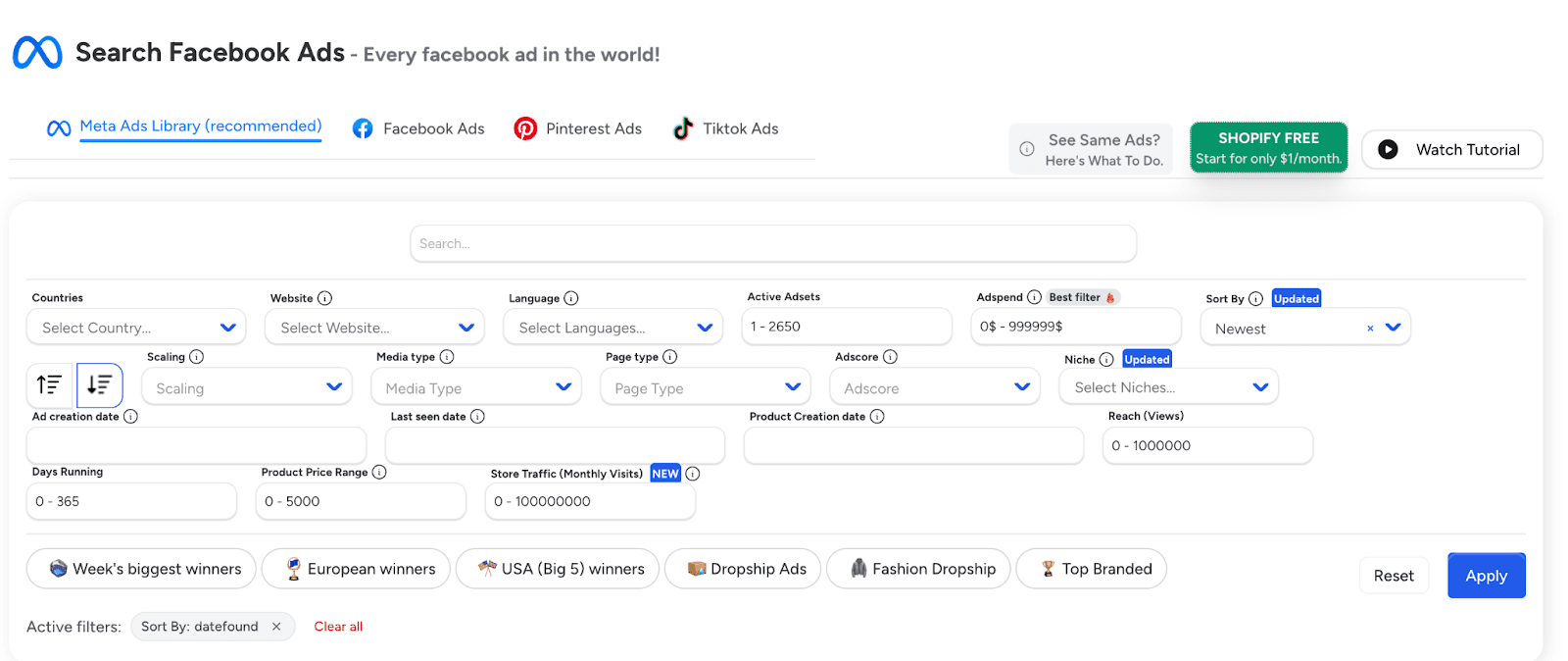
Advanced ad filters - WinningHunter lets you filter ads by spend ranges, launch timing, media format, and performance-related signals. This helps you surface ads that show signs of scaling rather than ads that just went live yesterday.
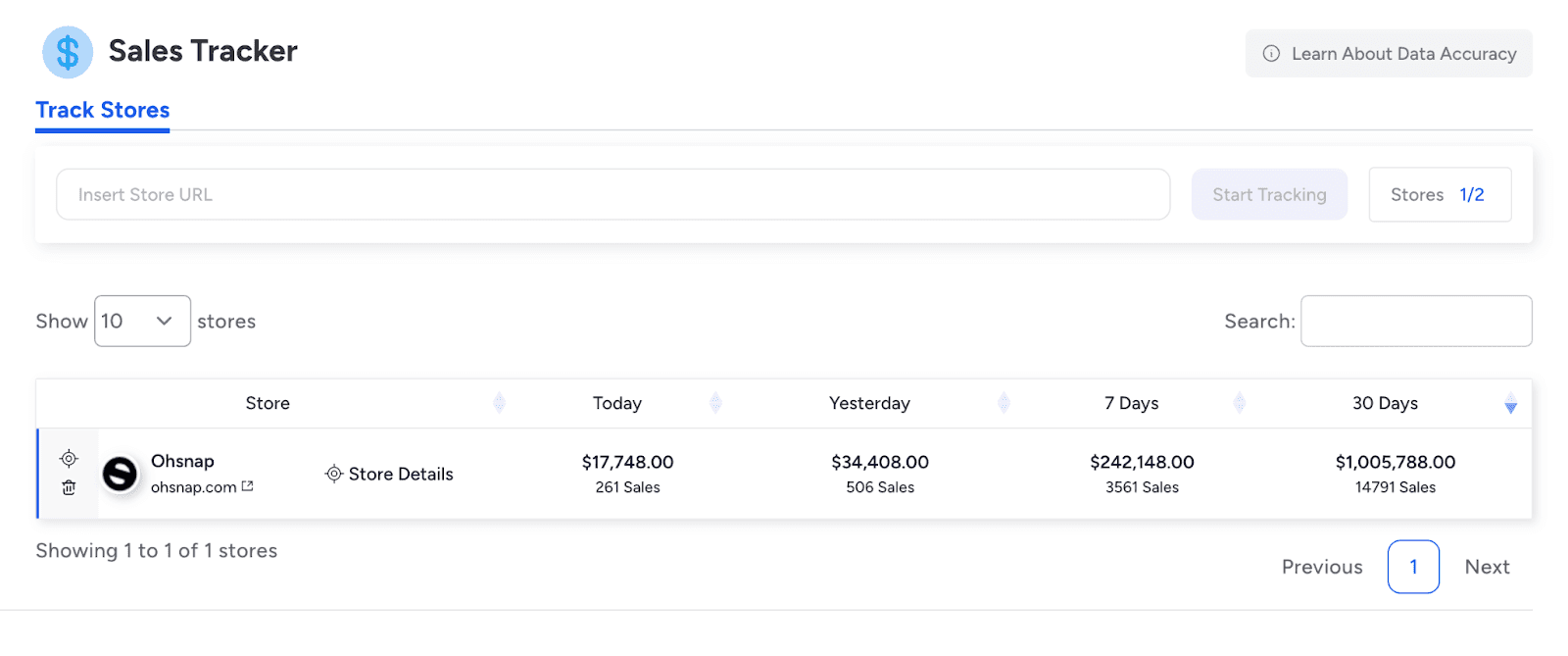
Sales tracker - The sales tracker connects ads to real store activity. You can monitor Shopify store revenue alongside estimated ad spend, which helps you understand whether a Facebook ad is tied to consistent sales or short-lived testing.
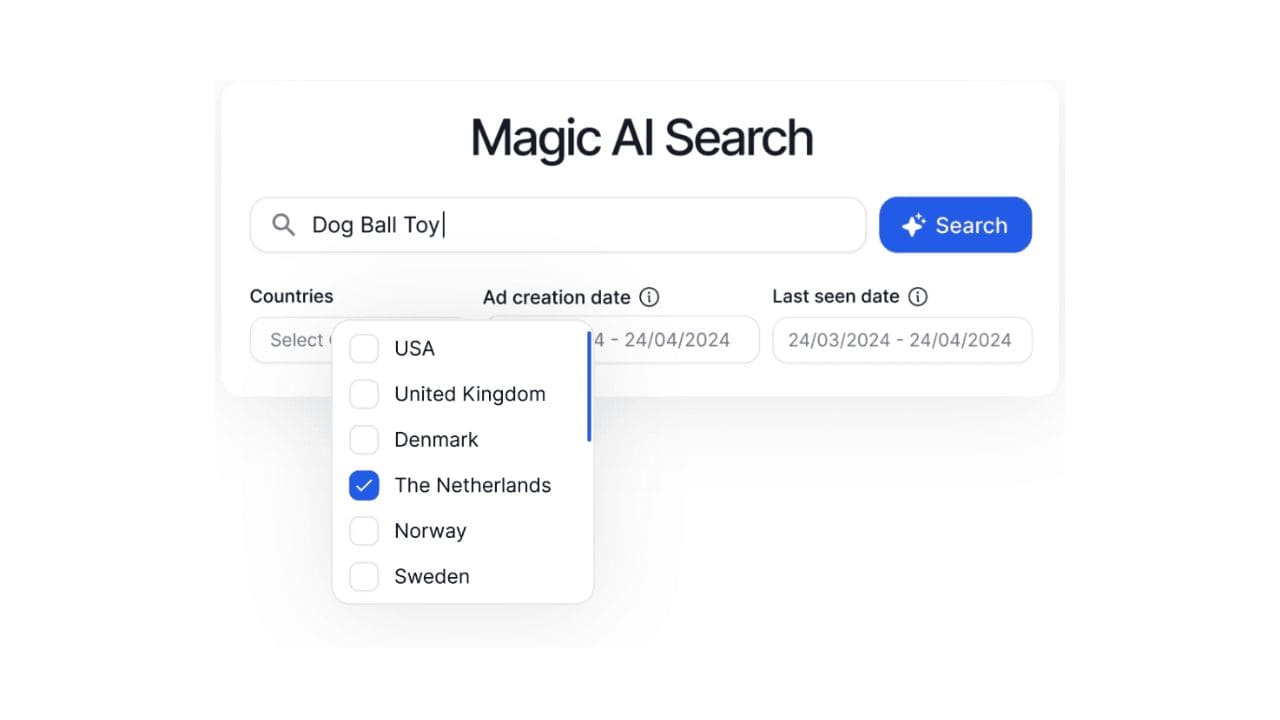
Magic AI search - You can search by keyword or upload an ad creative to discover related products, competitors, or stores. This is especially useful when you want to expand research around a niche without starting from scratch.
Reverse ad search - By uploading a Facebook ad, you can trace it back to the product page, store, and funnel structure behind it. This is valuable in competitive niches where ads look similar, but funnels and offers differ.
Beginner-friendly and agency-ready - The interface stays approachable for new dropshippers while offering enough depth for teams managing multiple stores or clients. You can move from basic exploration to detailed analysis without changing tools.
WinningHunter plans start at €49 per month, with a free trial available so you can explore the platform before committing.
2. Minea
Minea is an e-commerce research tool built mainly for ad discovery and trend spotting. Its value lies in showing a large volume of ads across Facebook, TikTok, Instagram, and Pinterest in one place.
Most people use Minea at the early stage of research. You open it to see what products are being advertised and which formats are appearing repeatedly. It is useful when you want exposure to ideas rather than confirmation of results.
The platform relies heavily on engagement signals and ad activity. That makes it easier to spot ads that attract attention, but harder to understand whether those ads lead to consistent sales. You can see what is popular, not what is profitable.
Because of this, Minea works better for discovery than validation. It helps generate directions to explore, but it does not provide clear answers about which products or ads are worth scaling.
Pros
Large and frequently refreshed ad database
Covers multiple social platforms
Filters for niche, format, and engagement
Free plan for basic exploration
Cons
Store and product insights are available, but revenue validation is limited
Engagement metrics can misrepresent real performance
Many advanced features require higher-priced plans
Limited support for evaluating long-term ad scaling
It can feel complex for beginners without guidance
Minea pricing starts at $49 per month, with higher plans at $99 and $399.
3. SpyFu
SpyFu is often mentioned in competitor research lists, but it serves a different purpose than Facebook Ads Library and e-commerce ad tools. It focuses on search marketing data, mainly SEO and Google Ads.
People use SpyFu to see which keywords competitors target and how consistently they invest in paid search. The platform shows historical keyword data, ad copy variations, and estimated spend patterns tied to search campaigns.
This makes SpyFu useful when you want to understand how a competitor approaches search traffic. You can identify long-running keywords and compare domains competing for the same terms. It works well for SEO planning and Google Ads research.
SpyFu does not help with social advertising research. There is no access to Facebook or Meta creatives, no visibility into ecommerce funnels, and no way to connect ads to products or stores. For that reason, it cannot replace Facebook Ads Library or tools used for creative or product validation.
SpyFu fits best as a secondary tool. It adds search context and not social advertising insight.
Pros
Detailed historical data for Google Ads and SEO
Clear competitor keyword overlap analysis
Reasonably priced for search-focused teams
Useful for planning long-term search strategies
Cons
No Facebook or Meta ad creatives
No insight into social ad performance
Not designed for e-commerce or dropshipping research
No product or funnel visibility
Cannot function as an ad spy replacement
SpyFu pricing starts at $39 per month, with higher plans at $59 for the first month, then $119 monthly, and a Team or Agency plan priced at $249 per month.
4. Bigspy
BigSpy is an ad spy tool built around volume. It collects a large number of ad creatives from Facebook, Instagram, TikTok, and other networks, with a focus on images and video ads.
Most users rely on BigSpy to review creatives rather than analyze performance. The platform makes it easy to browse how ads are designed and how visual formats differ across platforms and regions. This approach suits teams that want exposure to a wide range of ad styles instead of narrow performance insights.
Filtering plays a central role in how BigSpy is used. Ads can be sorted by platform, country, language, format, and creative type. These filters help reduce noise and allow side-by-side comparisons of how similar products are promoted in different markets. The emphasis stays on presentation.
BigSpy does not provide information about store revenue or conversion behavior or funnel structure. Ads appear based on availability and engagement-related signals, which do not reliably indicate profitability. The platform offers limited support for e-commerce validation or dropshipping research without additional tools.
Pros
Very large and frequently refreshed ad database
Supports multiple platforms and creative formats
Useful filters for market and format comparison
Helpful for reviewing and collecting ad creatives
Cons
No visibility into store-level revenue or sales
Engagement metrics often fail to reflect performance
Weak support for e-commerce and dropshipping validation
No insight into whether ads are scaling or testing
Commonly requires another tool for profitability checks
BigSpy pricing starts at $19 per month for the Basic plan, with Pro plans at $149 per month, Group access at $75 per seat monthly, and Enterprise plans starting above $3000 per year.
5. Adspy
AdSpy is one of the earlier Facebook-focused ad search tools and is still used for manual competitor research. Its primary function is search, you use it when you already know what you are looking for.
You can use it for searches based on keywords, advertiser names, landing page URLs, media type, and basic engagement signals. This makes it useful for tracking down specific ads, reviewing them, or studying copy patterns within a niche. It works best when the research question is narrow and well-defined.
AdSpy does not aim to surface trends or validate products. It does not connect ads to store performance or revenue outcomes. You can find ads and analyze how they are written, but you cannot tell whether they are driving meaningful results. For this reason, it functions more as a lookup tool than a decision support system.
Pros
Strong Facebook and Instagram ad search capabilities
Keyword, advertiser, and landing page-based lookup
Useful for niche-specific ad and copy analysis
Cons
High pricing compared to depth of insight
No product performance or revenue validation
No store-level tracking or sales visibility
Limited value for dropshippers testing products
Cannot replace Facebook Ads Library for scaling decisions
The starting price is about $149 per month.
Here’s a quick comparison:
Tool | Primary Focus | Platforms Covered | Store or Product Data | Revenue or Sales Validation | Best Use Case | Starting Price |
WinningHunter | E-commerce ad and product validation | Facebook, TikTok, Pinterest, others | Yes, store and product tracking | Yes, sales and revenue signals | Dropshippers, ecommerce brands, and agencies validating what works | €49 per month, free trial available |
Minea | Ad discovery and trend spotting | Facebook, TikTok, Instagram, Pinterest | Yes, store and product insights | Limited, not revenue verified | Early product ideas and creative trend discovery | $49 per month |
SpyFu | SEO and Google Ads intelligence | Google Search and Google Ads | No | No | Keyword research and search-based PPC strategy | $39 per month |
BigSpy | Ad creative browsing | Facebook, Instagram, TikTok, others | No | No | Creative inspiration and swipe file building | $19 per month |
AdSpy | Manual Facebook ad lookup | Facebook and Instagram | No | No | Finding specific ads, brands, or copy examples | About $149 per month |
When is Facebook Ads Library Still Useful?
Facebook Ads Library is not useless. It just has a very limited role.
It works when you want a quick check. If you are trying to see whether a brand is running ads right now, which countries they are targeting, or whether they are actively changing creatives, the library gives you that answer fast and is the best in this case, as it’s also free.
It is also fine for a first look at messaging. You can scan how a brand talks about its product and what kind of visuals they rely on. For surface-level context, that is usually enough.
Problems start when decisions depend on outcomes. Facebook Ads Library does not show whether they made money or why they disappeared. Once you are planning tests or deciding what to scale, that missing information matters, you need in-depth details and research, which it lacks.
Who Should Use a Facebook Ads Library Alternative?
Facebook Ads Library works when you only need to confirm that ads exist. It starts to fall short when decisions depend on patterns and outcomes. If your research goes beyond casual observation, a dedicated alternative becomes useful.
You should use Facebook Ads library alternatives if you:
Dropshippers testing new products - You need more than live ads. Seeing how long similar products stay active and whether they are supported over time helps reduce wasted tests.
E-commerce brands scaling creatives - Scaling requires understanding which formats survive, and which creatives competitors continue to fund instead of rotating out.
Agencies running competitor research for clients - Clients expect evidence, not screenshots. Tools make it easier to justify strategy, pricing, and recommendations across markets.
Marketers are tired of guessing what converts - You want a better idea of what is worth testing instead of relying on assumptions.
Also, always make sure that you use these tools to validate ideas and not copy ads.
Move Beyond Facebook Ads Library With WinningHunter
Facebook Ads Library was created to make advertising more transparent. It was not built to help you decide what to test or what to scale. It shows active ads, but it stops short of answering the questions that actually matter once money is on the line.
You still do not know which ads are scaling, which products are bringing in revenue, or which stores are growing and which are running short tests. That gap is why many advertisers start looking elsewhere.
Most alternatives only solve part of the problem. Some focus on creatives without showing outcomes. Others lean on engagement numbers that rarely match sales. Many tools split research across ads, products, and stores, forcing you to understand and evaluate them on your own.
WinningHunter connects ads, products, and store-level performance inside one workflow. You are no longer browsing ads in isolation. You are evaluating what is actually working.
If Facebook Ads Library feels limiting, it may be time to switch from browsing to validation. With WinningHunter, you can identify profitable ads before testing and validate products using real store signals without wasting time or ad spend.
FAQs
What are the best Facebook Ads Library alternatives for dropshipping?
WinningHunter, Minea, BigSpy, and AdSpy are commonly used. WinningHunter is chosen when product validation matters. Minea and BigSpy are mainly used for creative and trend discovery. AdSpy is used for manual Facebook ad lookup.
Can Facebook Ads Library show ad performance or revenue data?
No. Facebook Ads Library only shows currently active ads and basic metadata. It does not show ad spend, conversions, or revenue.
Is WinningHunter better than Facebook Ads Library?
WinningHunter is built for e-commerce research. Facebook Ads Library is built for ad transparency. If you need to validate products or ads before spending, WinningHunter provides more useful data.
Do ad spy tools show real sales data?
Most do not. Many tools rely on engagement or ad activity. Some e-commerce tools provide store-level signals, but they do not show exact revenue numbers.
Are Facebook ad spy tools legal to use?
Yes. They use publicly available ad data. Using them for research and analysis is legal. But copying ads is not legal and you will face consequences.
Which ad spy tool is best for e-commerce product research?
Tools like WinningHunter, which connect ads with products and store activity, are more useful for e-commerce research than tools that only show creatives.


We already know what works before you even have the chance to blink!
© 2024 WinningHunter.com