facebook-ads-spy-tools
Best Facebook Ads Spy Tools for Spying on Competitors in 2026
By
Kinnari Ashar
Facebook ads no longer reward curiosity, they reward preparation. Faster creative fatigue and high CPMs make learning by spending really harmful, as it turns out to be an expensive habit.
Most advertisers fail in the same place. They test products without knowing whether anyone else is already scaling them. They launch creatives without understanding which angles survived more than a few days. The platform won’t care about your loss and charge full price for those lessons.
Facebook ad spy tools help in such situations. Instead of guessing, you start by watching. You see which ads keep running, which creatives get refreshed, and which products attract consistent spend.
This guide lists the tools that help you do that well, and filters out the ones that only show noise.
11 Best Facebook Ads Spy Tools We Compared for Competitor Research
1. WinningHunter (Best Overall Facebook Ads Spy Tool)
WinningHunter is built around one idea that Ads alone do not tell the full story. You need to see ads, products, and store performance together to make useful decisions.
Instead of showing raw Meta ad library results, WinningHunter layers in signals that matter. You see estimated ad spend, an internal ad score that reflects consistency, and scaling indicators like spend bursts, creative rotations, and extended runtimes. This helps you separate short tests from ads that are actively being pushed.
WinningHunter’s Magic AI Search supports discovery in three ways. Keyword search helps you find proven angles and product categories quickly. Creative search groups ads with similar hooks or formats so patterns stand out. Reverse image search reveals competitors running the same product or very similar creatives, even when copy changes.
The store explorer feature covers what most spy tools ignore. It tracks store revenue estimates, surfaces top-selling products, and tags newly discovered stores as rising, stable, or declining. You can also inspect which ads send traffic to each store and how offers are structured.
Usage is designed for heavy research. The no credit-based limits on ad views or searches are really helpful in case of heavy research, and creatives are available without watermarks for testing, briefs, and internal swipe files. A free unlimited trial with limited features is available, allowing you to explore the platform before upgrading.
WinningHunter offers three paid plans, each built around different research needs:
Basic Plan at 49$ per month - Includes Magic AI, Facebook ad library, and post ads, access to premium shop explorer credits, and tracking for up to 25 additional stores.
Standard Plan at 79$ per month - Expands coverage to Pinterest and TikTok ads, includes ad score, days running, reach, ad spend, store traffic filters, unlimited premium shop explorer credits, and tracking for up to 50 additional stores. This is the most commonly chosen plan.
Premium Plan at approximately 269$ per month - Designed for advanced users and teams, with access to trends, weekly private strategy calls, unlimited premium shop explorer usage, and tracking for up to 500 additional stores.
WinningHunter works for every experience level. Beginners can validate ideas faster, growing sellers can manage multiple stores from one dashboard, and agencies scan entire niches and focus only on products backed by real spend and sales signals.
Most Facebook ad spy tools stop at ads and engagement, but WinningHunter adds spend and store revenue, so decisions are based on money, and not likes.
Benefits of Using WinningHunter
Real-time ad spend data and scaling signals help you identify ads that competitors actively push, rather than short tests with no follow-through.
Integrated store revenue estimates and product tracking show what actually sells, reducing reliance on likes, comments, or surface-level engagement.
Unlimited searches and downloads support deep research without interruptions, making it suitable for heavy workflows, multiple stores, and agency use.
2. PowerAdSpy
PowerAdSpy is a multi-platform ad intelligence tool built for marketers who want visibility across channels rather than deep ecommerce validation.
It works with most of the platforms, like Facebook, Instagram, Google, YouTube, native networks, Reddit, and Quora, which makes it useful when comparing how different industries like to advertise on different platforms.
You can filter ads by keywords or niches, track individual advertisers or domains, and narrow down the results by any engagement signal, such as likes, shares, and comments.
There are Basic demographic filters, such as age and gender, available, along with placement options like feed or sidebar positions. These tools help surface creative patterns but stop short of validating sales performance.
What you get is visibility, not confirmation. You can see what ads exist and how they look. You cannot see whether those ads scale, how much is being spent, or whether they lead to sales.
Pricing follows a tiered model that becomes more expensive at higher levels:
Basic plan starts at 69$ per month after a low-cost three-day trial
The standard plan is priced at 129$ per month
Premium plan costs 179$ per month
Advanced tiers such as Platinum, Titanium, and Palladium range from 279$ to 399$ per month
Pros
Broad platform coverage beyond Facebook, useful for agencies working across multiple channels
Advanced filters that allow slicing ads by niche, engagement signals, and placements
Helpful for creative inspiration when exploring angles, formats, and messaging styles
Cons
No real ad spend or scaling signals, making it difficult to judge whether ads are profitable
No store-level revenue tracking, which leaves e-commerce users guessing what actually sells
Higher-tier plans become expensive for solo users and small teams
Limited product research workflows compared to tools built for dropshipping and e-commerce
Slower discovery and weaker trend surfacing when compared to WinningHunter
Interface feels dated and can slow down repeated deep searches
3. AdSpy
AdSpy is built around one main advantage that is Scale. It competes almost entirely on how many Facebook ads it can show you, and the numbers are large. The database includes tens of millions of ads, with especially heavy coverage in the e-commerce and dropshipping niches.
Because of this large database, AdSpy is useful when you want to see many versions of the same idea.
You can search ads using keywords or phrases, filter by landing page or domain, and sort results by engagement metrics such as likes, shares, and comments. Basic demographic filters for age, gender, and location help narrow results further. This setup makes it easy to spot repeated angles, headlines, and product presentations.
The focus stays on Facebook as coverage outside the Meta ecosystem is limited, so the value comes from depth on a single platform rather than cross-channel insight. For some users, that depth matters more than variety.
AdSpy carries a higher entry price than many tools in this category, its subscription is flat 149$ per month. That cost is because of the database size, not because of insight into performance or outcomes. It tends to attract users who believe access to more ads leads to better decisions.
Pros
An extremely large Facebook ad database that returns a high volume of results for most searches
Strong filtering options for keywords, engagement signals, and landing pages
A familiar tool among dropshippers who prefer volume-driven ad discovery
Cons
No ad spend or scaling indicators, so winning ads and failed tests look the same
No store revenue or product sales tracking, which forces users to rely on separate tools for validation
Higher monthly cost compared to platforms that combine ads with store intelligence
Limited reach outside the Facebook ecosystem, restricting cross-platform planning
Interface encourages manual sorting through large result sets, slowing decision making
Less suitable for beginners who need guidance instead of raw data volume
4. Minea
Minea targets e-commerce sellers who want visibility on more than one platform. Its focus is on Facebook, TikTok, and Pinterest, which makes it useful when you want to compare how products move across short-form video and feed-based environments.
The tool depends heavily on scale. Minea promotes a large ad database with frequent updates, and that positioning shapes how it is used. Rather than focusing on individual offers, it helps you spot patterns early and track what starts appearing more often across platforms. Many users treat it as a trend radar instead of a confirmation tool.
Its ad library includes filters for engagement levels, countries, reactions, and media types, which help narrow down fast-moving creatives. Product research tools surface offers that gain visibility across placements, while influencer tracking highlights products pushed by creators.
AI features add idea prompts, copy suggestions, and basic analysis to speed up brainstorming.
Pricing sits somewhat at middle of the market. It offers a free tier with limited credits, which works mainly as a way to explore the interface before upgrading. Entry plans start at 49$ per month with a limited credit allowance, while higher plans move toward 99$, which gives access to more platforms and higher search limits. Business-level plans are around 399$ per month, built for users who rely heavily on trend scanning.
Pros
Multi-platform coverage across Facebook, TikTok, and Pinterest is useful for comparing how products appear on different networks
Large ad database with engagement-focused filters that support early trend hunting
Influencer tracking helps brands that mix paid ads with creator-led promotion
Cons
Credit-based usage on lower plans slows heavy research and creates friction when running multiple searches
No clear real-time ad spend data, making it hard to judge how aggressively competitors push each ad
Store and revenue signals are less accurate and less central than in WinningHunter
The interface can feel crowded, which often overwhelms beginners
AI features can add noise instead of clarity when focus is already an issue
Not a strong fit for teams that prioritize precise validation over broad trend browsing
5. Dropispy
Dropispy is a Facebook-focused ad spy tool built mainly for beginner and intermediate dropshippers. Its goal is simple to help users find trending products and ads without overwhelming them with complex data or workflows.
The platform stays centered on e-commerce. You browse a Facebook ad database using keyword searches and basic engagement filters, then sort results by likes, comments, or how long an ad has been running. This setup works well when you are trying to understand what types of products attract attention or which creatives keep appearing in your feed.
Shop Spy is one of the Dropisy’s features, which makes it more helpful. This feature lets you view competitor stores, see basic product details, and connect ads to storefronts at a surface level. For new sellers, this creates a clearer picture of how ads and stores fit together, even if the data remains limited.
Dropispy attracts beginners because of its free plan. Basic access feels generous at first and lowers the barrier to entry, which makes it a common starting point for people learning how ad research works. But the free version doesn’t have advanced filters, for that the pricing starts at 29$ and goes upto 249$.
It does not show reliable ad spend, revenue signals, or scaling quality. Because of this, it becomes harder to separate ads that look popular from ads that actually perform.
Pros
Easy entry point for new dropshippers who want straightforward Facebook ad research
Shop Spy adds basic store context on top of ad discovery
Free access lowers the barrier for users who want to explore without committing
Cons
No real ad spend data, which makes it hard to separate casual tests from serious scaling campaigns
Store revenue and performance insights remain shallow compared to WinningHunter
Limited platform coverage with a heavy focus on Facebook
Minimal automation around trends and scaling signals, requiring more manual work
Not well-suited for users managing multiple stores or agency-level research
Interface and feature depth feel restrictive once users move beyond basic product hunting
6. BigSpy
BigSpy is mostly chosen for one simple reason that it shows a lot of ads. Instead of narrowing research around performance or outcomes, it gives you access to a very large pool of creatives across multiple platforms.
The tool covers Google, Instagram, Facebook, YouTube, and several others. Because of this, it works well when you want to compare how advertisers adjust messaging, formats, and visuals from one channel to another.
Inside the platform, research starts with a large creative library. You can filter ads using keywords, engagement levels, demographics, or landing pages to cut down the volume. On higher plans, query limits are removed, and the database refreshes daily, which helps if you check for new ads regularly.
Getting started is easy. BigSpy offers a 3-day trial for 1$. After that, access shifts to paid plans where higher tiers mainly increase how many ads you can view and track each day.
Pros
Very large ad database that spans multiple platforms and industries
Low entry pricing makes it easier for solo users and small teams to test the tool
Team collaboration features in higher plans support agency and group workflows
Cons
A large database introduces significant noise, requiring heavy filtering to find useful ads
No reliable spend data, which makes scaling behavior difficult to assess
No store revenue tracking limits its usefulness for e-commerce validation
Free and lower tiers are restrictive, pushing active users toward higher-priced plans
Lacks focused product research workflows.
Interface can feel overwhelming when managing several projects at once
7. Facebook Ads Library (free option)
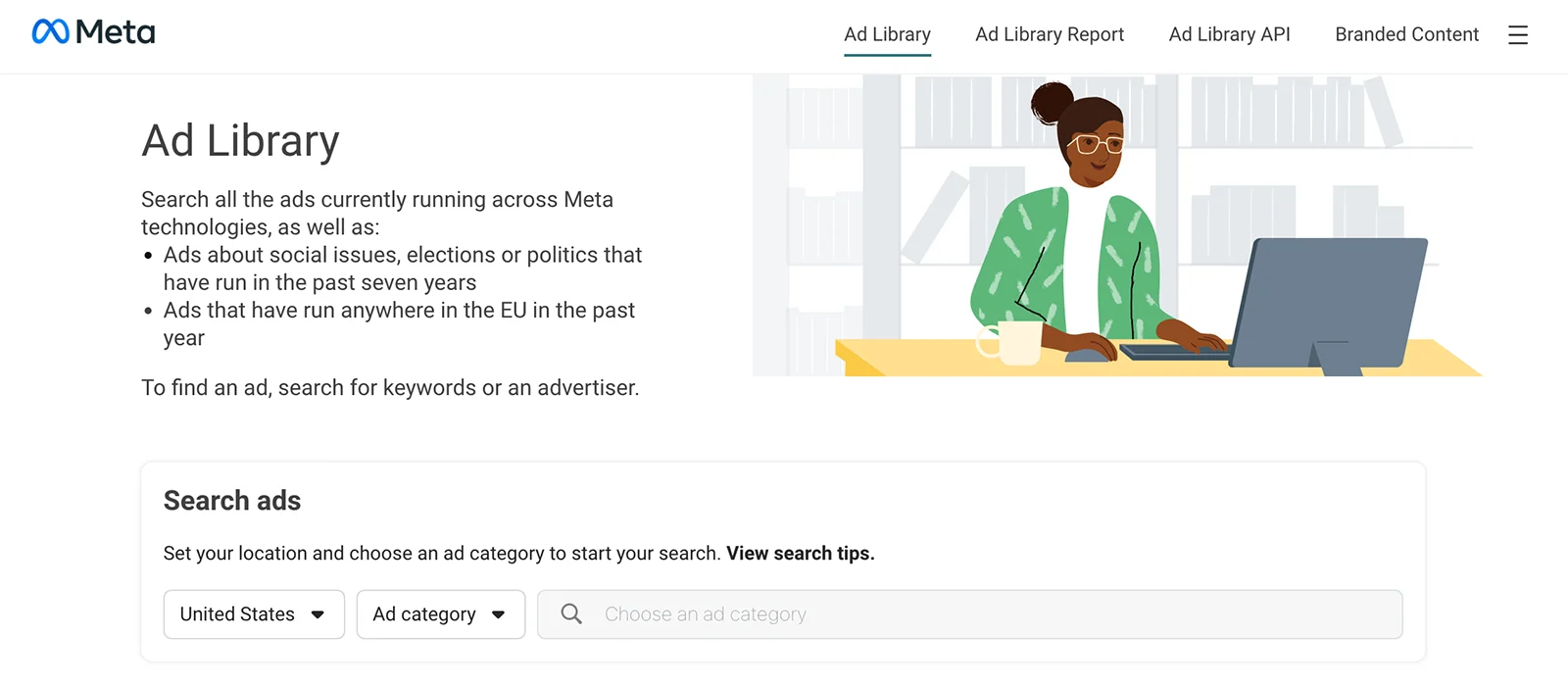
Facebook Ads Library is Meta’s official transparency tool. It shows active ads and some historical ads running across Facebook, Instagram, Messenger, and the Audience Network. It only provides visibility, not competitive intelligence.
The tool is completely free and does not require a login for basic use. You can open it and start searching right away, which makes it a common first stop for people new to ad research.
Using it is simple, you can search by brand name, keyword, or page, then narrow results using country, platform, and ad status, such as active or inactive. You can view the creative, copy, formats, and placement distribution.
What you do not get is only the performance context. There is no spend data, no scaling signals, and no way to judge whether an ad is profitable or barely running.
Because of this, Facebook Ads Library works best as a reference tool. It helps confirm whether a brand is advertising, check how an ad looks in different formats, or review messaging changes over time. On its own, it is not a spy tool, and it does not support decision-making around products or scaling.
Pros
Completely free and open to everyone, which makes it a common starting point for ad research
Direct visibility into ads running across Meta platforms without third-party interpretation
Useful for quick checks on what a specific brand promotes at a given time
Cons
No insight into ad spend or profitability, limiting its strategic use
No store or revenue tracking, leaving ecommerce decisions based on guesswork
No built-in way to download creatives, which slows swipe file creation
Search and filtering options are basic compared to dedicated spy tools
No trend analysis or winner surfacing, requiring manual tracking outside the platform
Not suitable for dropshippers or agencies that rely on repeatable research workflows
8. Panoramata
Panoramata is not a typical ad spy tool as it is built for e-commerce brands that already run full marketing funnels and want to keep track of what competitors are doing across those funnels.
Instead of stopping at ads, Panoramata follows what happens after the click. It tracks Facebook and Instagram ads, but also watches landing pages, email campaigns, SMS messages, and visible changes on competitor websites. This gives a broader picture of how brands push offers over time.
The platform works through continuous tracking. Once competitors are set up, Panoramata updates dashboards that show how often discounts appear, which selling points get repeated, and how creative themes change across campaigns, as well as compares ad frequency and campaign intensity, which helps teams understand how aggressive competitors are at different points in the funnel.
Pricing starts higher than most ad-focused spy tools at 99$ and goes upto 399$ per month. That reflects who it is built for. Panoramata fits teams and brands with steady revenue, multiple campaigns, and longer planning cycles. It is not designed for quick product testing.
Pros
Tracks the full funnel, including ads, emails, landing pages, and visible website changes
Clean reports that help teams understand how competitors structure and rotate offers
Benchmarking views work well for brands running ongoing campaigns at scale
Cons
Pricing is high for solo dropshippers and small stores
No true free plan, only limited trials, which restrict access for budget-focused users
Ad-level detail takes a back seat to funnel-level analysis, which does not suit product hunting
Primarily built for ecommerce brands, with limited relevance for SaaS or info products
Lacks fast, simple workflows for testing individual products
Works better as a supporting tool than as a main research platform for hands-on media buyers
9. MagicBrief
MagicBrief is not where you go to find ads, it is where you work with ads after you have already found them.
The tool works on top of existing ad libraries. By using a Chrome extension, you can save ads directly from Meta libraries and a few other sources. After that, everything happens inside MagicBrief. Ads get stored, grouped, and reviewed instead of being lost in bookmarks or folders.
A large part of the tool focuses on video ads. MagicBrief breaks videos into scenes, generates transcripts, and highlights repeated elements such as hooks, pacing, and calls to action. This helps teams study structure without having to replay the same ad over and over.
Organization is the primary focus here. Ads can be sorted into boards for swipe files, moodboards, or creative briefs. Teams use these boards to discuss direction and align before producing new creatives. Slack integration and ad account connections add internal context by showing how similar creatives perform inside your own accounts.
There are lower-tier plans for small teams, but most features unlock at higher levels tied to ad spend. Because of that, MagicBrief fits agencies and creative teams better than solo store owners.
Pros
Strong system for saving and reviewing creatives, useful for teams that focus on messaging details
Boards and collaboration features work well for agencies and in-house creative teams
AI breakdowns help analyze structure, hooks, and pacing in high-performing ads
Cons
High cost for solo sellers and small teams compared to the practical return
Depends on external ad libraries for discovery, so a separate spy tool is still required
Limited store and revenue insight, which weakens product validation
Spend-based and sales-assisted pricing adds friction for users who prefer simple plans
Slower for quick competitor or product research
Heavy focus on creative analysis does not answer what actually sells
10. AdvertSuite
AdvertSuite has been around for a long time and has mostly attracted affiliates and dropshippers looking for something slightly better than free ad libraries. It is somewhere between basic tools and more advanced platforms, both in features and expectations.
The tool pulls ads from Facebook, Instagram, Google, and YouTube. The idea is simple. You get access to a wide range of ads without having to rely on Meta’s library alone. Instead of pushing volume or trends, AdvertSuite leans toward showing how ads are set up and who they are meant to reach.
Most research happens through basic filters. You can even narrow ads by niche, country, demographics, or call-to-action buttons like Shop Now or Learn More. One useful addition is the landing page preview. It lets you see what kind of funnel is working behind an ad and whether it runs on Shopify, ClickFunnels, or a similar setup.
Pricing has always been part of AdvertSuite’s appeal. It is often sold through one-time payment deals or lower monthly plans. That makes it attractive to users who want more than free tools offer, but who are not ready to commit to higher-priced platforms.
Pros
Targeting and call-to-action filters help explore audience angles and messaging ideas
Lower cost entry compared to many premium ad spy tools
Simple feature set that beginners and affiliates can understand quickly
Cons
Smaller database that updates less often than newer, high end platform
No ad spend data, which makes scaling analysis unreliable
No store revenue or sales estimation for e-commerce research
Limited trend detection and automation
Funnel and landing page insights still require manual checks in other platforms
Interface and data feel dated for marketers used to real-time performance signals
11. Foreplay
Foreplay focuses on what happens after ads are found. Instead of helping you search for competitors or products, it helps teams keep track of ads they already care about and turn scattered saves into something usable.
It works with ads from Meta, TikTok, and LinkedIn libraries. Once an ad is saved, it stays available inside the platform. Teams can come back to it later, search for it, or group it with similar creatives instead of losing it in browser bookmarks or chat threads.
The Ads are saved through a Chrome extension. One click captures the creative along with its text and basic details. Foreplay also lets you follow specific competitors and sends alerts when they launch something new, which removes the need to check libraries manually. If you want ideas without searching, the Discovery section shows a curated feed of ads that can be filtered by format or niche.
Along with these features, Foreplay also adds AI tools that help with creative planning. Teams can generate briefs, outline storyboards, and review emotional tone to speed up alignment before production starts.
The basic plan starts from 49$ per month with limited features, and agency level package is for 389$ per month. Every plan has a 7-day trial to see if it works for you or not.
Pros
Works well for long-term archiving and organizing competitor ads inside shared team boards
Supports creative strategists with tools for briefs, story structure, and concept planning
Automated alerts make it easier to keep track of selected competitors and brands without manual checking
Cons
Covers fewer platforms than broader ad spy tools
No visibility into store revenue or product-level sales, which limits the usefulness for dropshippers
Pricing sits above entry-level tools while still requiring another platform for discovery and validation
Some workflows depend on manual tagging and organization, which adds overhead
Less practical for solo users who care more about validation than creative management
Here’s a table of comparison for all the ads spy tools we have listed above:
Tool | Primary Focus | Platforms Covered | Spend and Revenue Insight | Best Fit For | Key Limitation |
|---|---|---|---|---|---|
WinningHunter | Ad plus product plus store validation | Facebook, TikTok, Pinterest | Yes, ad spend estimates and store revenue signals | Dropshippers, ecommerce brands, agencies | Focused specifically on e-commerce and product-led research |
PowerAdSpy | Cross-channel creative visibility | Facebook, Instagram, Google, YouTube, native, Reddit, Quora | No | Agencies needing broad creative ideas | No store or revenue validation |
AdSpy | Large Facebook ad database | No | Volume-focused dropshippers | No spend or sales context | |
Minea | Trend spotting across platforms | Facebook, TikTok, Pinterest | Limited and indirect | Sellers tracking early trends | Credit limits and weak revenue accuracy |
Dropispy | Beginner-level Facebook spying | No | New dropshippers learning basics | Shallow validation and scaling insight | |
BigSpy | Massive multi-platform ad volume | Facebook, Instagram, TikTok, Google, YouTube | No | Users browsing large ad libraries | High noise and no performance proof |
Facebook Ads Library | Official ad transparency | Facebook and Instagram | No | Brand checks and ad confirmation | No intelligence or validation |
Panoramata | Full funnel competitor tracking | Ads, emails, landing pages, SMS | No | Established ecommerce brands | Not suited for fast product testing |
MagicBrief | Creative breakdown and collaboration | Meta and limited sources | No | Agencies and creative teams | Requires other tools for discovery |
AdvertSuite | Funnel and targeting visibility | Facebook, Instagram, Google, YouTube | No | Affiliates and budget users | Dated data and weak trends |
Foreplay | Ad saving and organization | Meta, TikTok, LinkedIn | No | Creative strategists and teams | No product or revenue validation |
Choosing the Right Facebook Ads Spy Tool in 2026
Facebook ads in 2026 punish slow decisions. Costs rise quickly, testing cycles are shorter, and weak assumptions get expensive before results show up. That is why ad spy tools are no longer used just for ideas. They are used to reduce risk.
Most tools still operate like extended ad libraries. They show creatives, formats, and engagement, but leave out what matters most. There is no clear spend context, no connection to stores, and no way to tell whether an ad is being tested or actively scaled. As a result, users collect inspiration but still make decisions in the dark, which might work or not.
Only a small group of tools moves past browsing. These tools focus on validation by showing how long ads run, how aggressively they are pushed, and which stores sit behind them. That shift changes how research works.
WinningHunter stands apart because it combines real-time spend signals, AI-based competitor and product discovery, and store-level revenue tracking without usage limits or credit systems.
When choosing a Facebook ads spy tool in 2026, look past ad volume because volume means nothing if it doesn’t provide anything useful. The right choice is the one that helps you decide faster and with fewer assumptions.
FAQs
Is it legal to use Facebook ads spy tools to research competitors?
Yes. Facebook ads spy tools work with public data. They collect ads that are already visible on Facebook and other Meta platforms and organize them for research. The tools do not access private ad accounts, targeting settings, or business data. Using these tools to study market trends, ad formats, or competitor positioning is common practice among advertisers.
How is a paid Facebook ads spy tool different from the free Facebook Ads Library?
The free Facebook Ads Library only shows which ads exist. Paid tools add context. They organize ads, surface patterns, track how long ads run, and often estimate spend or scaling behavior. Some also connect ads to stores or products. The free library helps you confirm ads, while paid tools help you interpret them and decide what is worth testing.
Which data points matter most when choosing a Facebook ads spy tool, ad volume or spend and revenue signals?
Ad volume alone won’t lead to good decisions. Large libraries show many ads, but they do not explain intent. Spend signals, runtime, and store-level revenue context matter more because they indicate commitment. An ad running for weeks with consistent spend tells a different story than a fresh ad with high engagement. Tools that prioritize spend behavior and sales context help you avoid guessing and focus on ads backed by real outcomes.
Can a single tool like WinningHunter replace multiple apps for product research, ad spying, and store tracking?
For many e-commerce sellers, yes. WinningHunter brings ad discovery, spend signals, competitor analysis, and store tracking into one system. Instead of checking an ad library, then switching to a product research tool, and then opening a separate store tracker, the data stays connected. This reduces setup time and cuts out manual cross-checking. For dropshippers and teams focused on speed and validation, one integrated tool often works better than managing several separate apps.


We already know what works before you even have the chance to blink!
© 2024 WinningHunter.com