facebook-political-ad-library
Facebook Political Ad Library: How It Works, What Data You Can Access, and How to Use It for Research
By
Kinnari Ashar
Isn’t it common to see political ads on Facebook that clearly favor a certain politician or party? This is certainly not random, political campaigns are very well aware of how these ads influence elections and shape opinions.
Facebook Political Ad Library exists to bring transparency to that influence. It’s a public database that lets you see who is paying for political ads and how those messages are delivered.
These ads do follow stricter disclosure rules and remain accessible long after campaigns end, so that anyone can review messaging strategies and funding sources over time. So let’s explore what counts as a political or issue ad, what data is available, what the limits are, and how you actually use this information.
Key Takeaways
The Facebook Political Ad Library exists to make political advertising visible after it runs.
It covers more than elections. Ads tied to public policy and social issues are included even when no candidate or party is named.
Spend and impressions are shown as ranges, which limits precision but still allows pattern and scale analysis.
Targeting details and conversion data are intentionally excluded, so the library cannot explain why an ad performed a certain way.
Manual browsing works for spot checks, while reports and the API are better suited for larger research questions.
It is designed for transparency and review, not reuse or campaign building.
What Is the Facebook Political Ad Library?
The Facebook Political Ad Library is a public database run by Meta that shows political and issue-related ads published on its platforms.
The library doesn’t contain only election campaigns. It covers a wider range of paid messaging that can influence public opinion, such as:
Ads promoting or opposing candidates and political parties
Messages related to elections and voting processes
Paid content around public policy, such as healthcare or environmental regulation
Social and political issue advertising from advocacy groups or organizations
For example, a sponsored post encouraging support for a proposed voting law or an ad opposing changes to climate policy would both appear in the library, it doesn’t have to mention ‘election’.
Ads shown on Facebook and Instagram are stored in the same system. This makes it possible to review how a message was distributed across platforms and which entity paid for it.
It allows anyone to verify political ad activity without relying on screenshots, third-party claims, or incomplete reporting.
How the Facebook Political Ad Library Differs From the Regular Ad Library?
1. Transparency and Disclosure Requirements
Political ads are subject to disclosure rules that do not apply to standard commercial advertising.
Any ad classified under this category must show:
The name of the individual or organization that paid for the ad
A spend range
An impression range that shows how widely the ad was shown
We already know that political ads have social and legal consequence hence these disclosures become important.
2. Manual and Automatic Review Process
Ads flagged as political go through several layers of review before they get a green signal.
Advertisers must first self-declare the nature of the ad. Automated systems then scan the content for political signals, after which human reviewers at Meta confirm whether it meets the criteria.
Whereas standard commercial ads may be approved automatically and never appear in a public archive. Most product or brand ads are reviewed only for policy compliance and are not preserved for long-term access.
3. Long-Term Archiving Rules
Political ads follow strict archiving rules. Once these are approved and published, they remain accessible for up to seven years, even if the advertiser deletes the ad or the page becomes inactive.
Once regular ads stop running or are removed, they usually disappear from public view, leaving no long-term record behind.
What Data Can You See in the Facebook Political Ad Library?
1. Ad Creative and Messaging
You can see exactly how the ad appeared to users, which makes this section especially useful for message analysis.
Images and videos used in the ad
Full ad copy and headline text
Call to action buttons and format choices
Variations in tone, framing, or emotional appeal across similar ads
This helps identify how campaigns position the same issue differently depending on timing or audience context.
2. Spend and Impression Ranges
Instead of precise numbers, Meta displays ranges to balance transparency with advertiser privacy.
Estimated spend shown as a range, not an exact figure
Impression counts are presented in brackets rather than totals
Consistent formatting that allows comparison across ads
3. Funding and Disclaimer Information
Every political ad includes clear attribution details so funding sources are not hidden.
“Paid for by” disclosure text
Name of the page or organization responsible
Branded content indicators when applicable
This makes it easier to trace messaging back to the entity behind it.
4. Demographic and Regional Breakdown
Audience data is limited but still useful at a high level.
Aggregated age and gender distribution
Country-level reach information
Interest-based targeting and custom audience data are not shown, unlike what advertisers see inside internal dashboards.
How to Access the Facebook Political Ad Library Step-by-Step
Using the Web Interface
This method is best when you want to manually review ads without exporting data.
Visit facebook.com/ads/library in your browser.
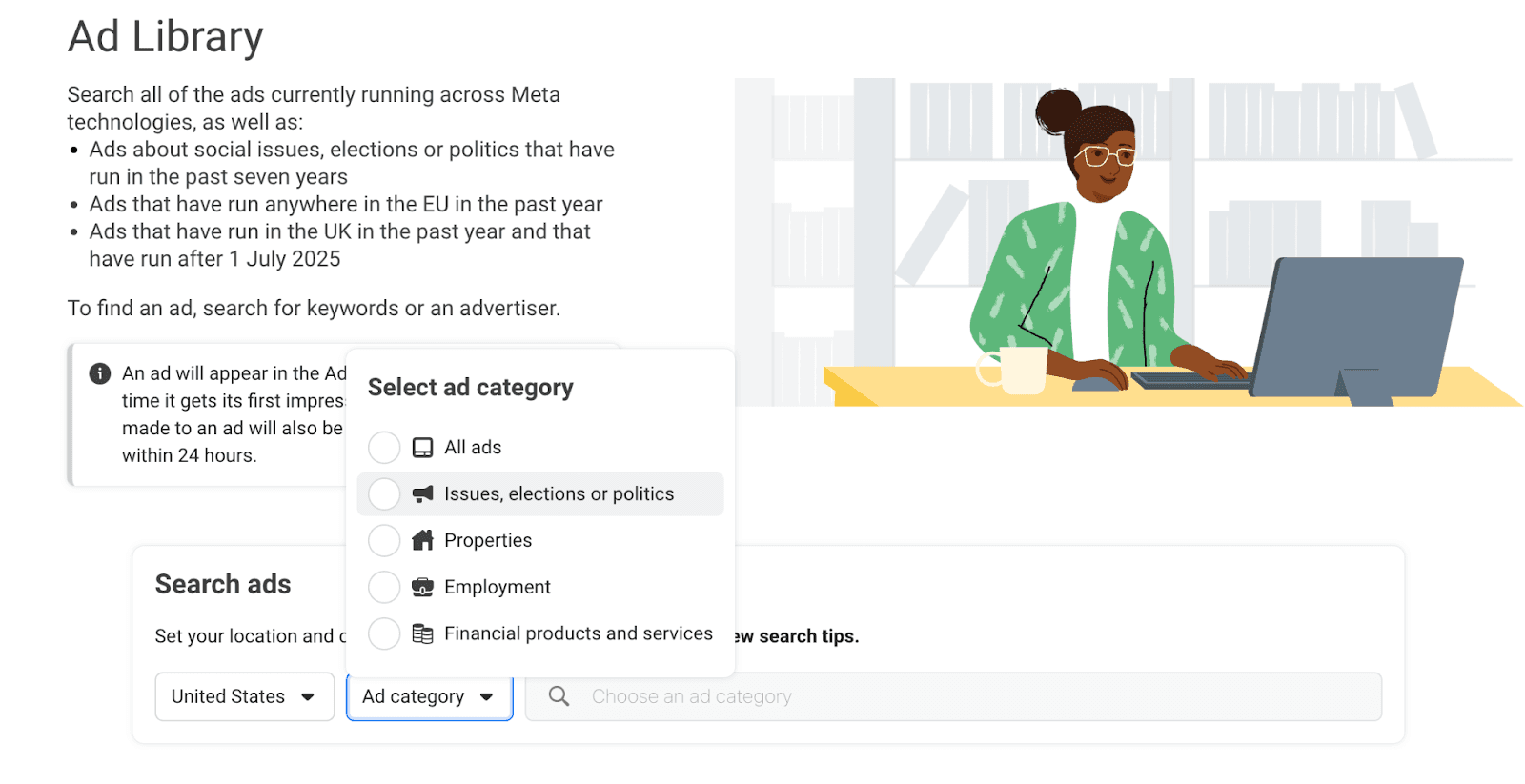
Open the Special Ad Categories menu and select issues, elections or politics. This ensures you are viewing only political and issue-based ads.
Choose a country to focus on a specific market or election.
Enter a keyword related to a candidate, political party, policy, or issue.
Filter results by ad status to view active ads, inactive ads, or both.
Use the media type filter to narrow results to image or video ads.
This works well for quick checks and creative inspection.
Downloading Ad Library Reports
Process follows the same steps inside the ad library. After that, scroll to the bottom of the page, and there you will find the download report option.
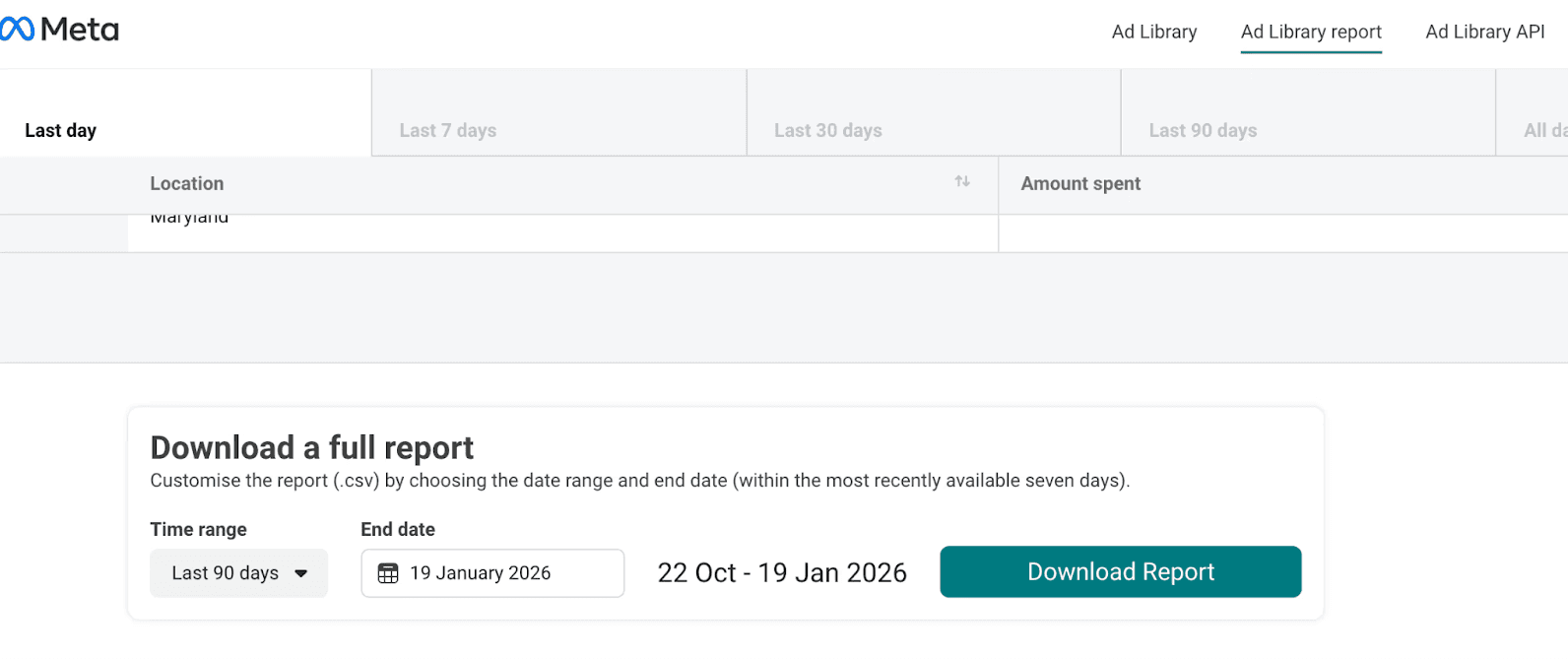
Instead of listing individual ads, this section lets you download a file that summarizes activity for the selected period. The report focuses on totals and volume rather than creatives.
You can use these downloads to review:
Overall spending levels by country
Ad volume across a specific time range
Issue-level activity without opening individual ads
This method works best when you want a broad view of political advertising activity rather than creative level analysis. It is commonly used for trend analysis and long-term research.
Using the Facebook Ad Library API for Political Ads
The Facebook Ad Library API is part of the Meta developer ecosystem and exists for one reason that is, access at scale. Instead of clicking through ads one by one, the API lets you pull political and issue ad data in bulk.
It is typically used when manual browsing stops being practical. Researchers use it to track trends across countries.
Key API Parameters for Political Ads:
Political ads are not returned by default. Requests must explicitly target them.
ad_type must be set to POLITICAL_AND_ISSUE_ADS
search_terms narrow results by names, topics, or phrases
ad_reached_countries restrict results to specific regions

You also choose which fields are returned. Common examples include:
page_name to identify the advertiser
spend and impressions shown as ranges
demographic_distribution for aggregated audience data
The API does not expose targeting logic or exact numbers. It is designed for visibility and pattern analysis, not advertiser-level optimization.
Common Use Cases for the Facebook Political Ad Library
There are many ways in which you can use this data.
If you are:
Journalists and watchdog organizations, you can use the library to identify coordinated messaging across multiple advertisers. They trace funding patterns and monitor how narratives shift during elections or major political events.
It is also used to flag potential misinformation or unusual activity without relying on leaked data or private sources.
Researchers and academics, you can rely on the library as a large-scale dataset for studying political communication.
Common uses include analyzing how messages are framed and examining aggregated demographic reach to understand who political ads are intended to influence.
Marketers and advertisers, you can use the library to observe how issue-based narratives are presented under strict compliance rules.
Agencies and ad analysts, you can look at the library to compare creative approaches across campaigns, and spot signs of creative fatigue in long-running issue-based advertising.
Limitations of the Facebook Political Ad Library
The Political Ad Library is useful, but it has clear gaps that matter if you are doing serious analysis.
It depends heavily on advertisers flagging their own ads. When an advertiser fails to label an ad correctly or uses vague language, that ad may never appear in the library at all.
Spend and impression numbers are shown only as ranges. This makes it possible to compare relative scale, but not to calculate exact costs, efficiency, or returns.
Several key data points are not available. You cannot see interest targeting or any conversion data tied to outcomes like clicks or signups.
Because of these limits, experienced marketers rely on external tools to complete their research.
How WinningHunter Complements the Political Ad Library
The Facebook Political Ad Library is useful for transparency, but it focuses only on political ads and is not built for broader analysis. WinningHunter works alongside it as an additional research layer.
WinningHunter makes it easier to analyze creative patterns across all Meta Platforms and Pinterest in one place. This allows you to compare political style messaging with commercial ads and see how similar emotional triggers or visuals are reused across different categories.
The platform also reduces the amount of manual work involved in research. Advanced ad filters and AI-based competitor discovery help surface patterns quickly without scrolling through large volumes of ads. Instead of collecting screenshots or notes by hand, you can focus on analysis.
When both the Facebook political ad library and WinningHunter are used together, it increases research efficiency and fills the gaps that are in the former.
Final Thoughts
The Facebook Political Ad Library makes political advertising easier to examine after campaigns end. Ads stay visible even if inactive, and messaging can be reviewed without relying on claims or screenshots.
That visibility is useful, but working through it manually has limits and fatigue. Once you start comparing patterns or narratives across time and platforms, the process slows down quickly.
To manage this, WinningHunter is really helpful, not as a replacement for the political ad library, but as a way to move faster from raw ads to actual patterns. Instead of collecting data ad by ad, you can focus on how messaging is reused and scaled across platforms.
If your goal is to understand political style messaging rather than just browse it, combining transparency with structured ad analysis is the practical step.
FAQs
Can I download political ad videos from the library?
Videos are viewable and can be reviewed in the Ad Library, but there is no built-in option to download them on Facebook. The advertisements are posted because of transparency, and not for reuse. Saving or redistributing videos outside research or documentation can raise copyright and policy concerns, especially if used in advertising or promotional material.
Does the Political Ad Library show exact ad spend?
No, it does not. Facebook shows spending and impressions as ranges rather than exact numbers. This limits precise calculations, but it still gives a sense of scale. You can see whether an advertiser spent thousands, or more, which is usually enough to compare activity levels or spot unusually aggressive campaigns.
Is the Facebook Political Ad Library available globally?
The Ad Library is available in many countries, but coverage is not identical everywhere. Some regions have more detailed issue categories or larger volumes of data due to local regulations and ad activity. Even so, the core features work the same way, making it possible to review political ads across different markets.
Can marketers legally analyze political ads for research?
Yes. Marketers can study political ads to understand structure and compliance rules. The restriction is on usage, not analysis. Ads should not be copied or reused. The library exists for observation and research, not for borrowing political creatives or republishing content.


We already know what works before you even have the chance to blink!
© 2024 WinningHunter.com