how-to-dropship-on-amazon
How to Dropship on Amazon in 2026: Complete Step-by-Step Guide
By
Kinnari Ashar
Selling on Amazon sounds straightforward until your first order exposes a gap you did not see coming. A product sells, the supplier ships it, and then Amazon asks a simple question. Who is the actual seller here?
That single detail decides whether your setup holds or collapses under real orders. It shows up in packaging, invoices, and every message your customer receives.
Most guides skip this part. You won’t.
What follows will show you how to build this the right way from the start.
How Amazon Dropshipping Works in 2026?
Amazon dropshipping follows a simple structure, but the responsibility does not move with the product.
Here’s how the flow works:
The customer places an order on your Amazon listing.
You send that order to your supplier.
The supplier ships the product directly to the customer.
That is the visible process.
Behind it, Amazon treats you as the seller for the entire transaction. The order is tied to your account, your name appears on the experience, and your performance metrics are affected by how that order is handled.
This creates a clear difference from a Shopify setup. There, growth depends heavily on how well you bring in traffic and convert it. On Amazon, what happens after the purchase carries equal weight. Delivery timelines, tracking accuracy, and return handling all feed into how your listings perform.
Because of that, product selection alone does not determine results. A product can generate steady demand and still damage your account if fulfillment is inconsistent.
Once you look at the model through that lens, the priority becomes operational control, not just finding something to sell.
Step-by-Step: Setting Up Your Amazon Dropshipping Operation
Step 1: Account Setup and Verification
Before you even think about products or suppliers, Amazon wants to confirm one thing. You are a real, consistent business entity.
You will be asked for a government ID, bank account details, and tax information. The documents themselves are simple. The problem usually starts when those details don’t line up perfectly.
An address written one way on your ID and slightly differently on your bank record can hold things up. A business name that varies across documents can trigger additional checks. These are small details, but Amazon treats them seriously.
Approval depends on how clean your information looks as a whole, not on individual documents. If everything aligns, verification moves quickly. If it doesn’t, you end up going back and forth without clear answers.
Getting this right early removes a lot of friction later when you start listing and fulfilling orders.
Step 2: Choosing the Right Selling Plan
Most sellers don’t notice the impact of this choice until something starts slipping.
An order comes in while you’re updating another listing. Stock changes but doesn’t get reflected in time. A second order follows before you’ve processed the first. Nothing feels broken, just slightly off. That “slightly off” starts stacking.
That’s what the Individual plan feels like once activity picks up. Everything depends on you being present at the right moment.
The Professional plan removes that dependency. It lets your store keep moving even when you’re not handling each action yourself. Listings can be managed in batches, systems can take over repetitive tasks, and orders don’t wait on manual steps.
The difference isn’t visible at the beginning. It shows up when you stop being able to keep up manually and need the operation to carry itself.
Step 3: Setting Up Operational Foundations
Before listing anything, lock these two areas. If they’re unclear, problems start from the first few orders.
Shipping configuration
Set your delivery estimate based on your supplier’s real handling time plus transit.
If your supplier takes 2 to 4 days to dispatch and shipping takes 5 to 7 days, your listing should reflect a realistic range like 8 to 12 days. Do not copy fast delivery timelines just to improve conversion. That creates complaints the moment delays happen.
Add a buffer. Delays will happen, especially with third-party fulfillment. Your timeline should absorb them, not expose them.
Returns setup
Decide where returns will go before you get your first request.
If your supplier accepts returns, confirm the process and address in advance. If they don’t, you need a fallback, either a local return address or a refund without return policy for low-cost items.
Also, define how refunds will be issued and in what cases. Waiting until a dispute shows up usually leads to inconsistent decisions.
This step is about making sure your operation does not break under basic order flow.
Step 4: Listing Products Correctly
A listing is not just a page. It is a commitment. Whatever you show here is what Amazon expects you to deliver without variation.
Start with access. Before writing anything, check whether the product can actually be sold in that category. Some listings require approval, others are restricted entirely. If this step is skipped, the listing may go live for a short time and then disappear, taking your effort with it.
Once eligibility is clear, build the listing around how the product is searched and understood.
The title should follow a clean structure: product type, key feature, and relevant qualifier such as size or use case. It needs to read naturally while still matching search intent. Copying supplier titles usually leads to cluttered, hard-to-read listings that don’t convert well.
Images should remove uncertainty. Use visuals that show the actual product, not edited versions that create false expectations. Include multiple angles and, if possible, the context of use. When the product that arrives looks different from the images, returns follow quickly.
Pricing needs to sit in a range that makes sense for the category while still covering your costs. Dropping too low to compete often leads to problems later when margins cannot absorb refunds or delays.
Each part of the listing should align with what the customer will receive.
Amazon Dropshipping Policy Explained (Non-Negotiable Rules)
Understanding the Seller-of-Record Requirement
Most sellers do not get suspended because of what they sell. They get suspended because of what shows up in the box.
A customer opens a package and finds a different brand name on the invoice. The price looks off. The seller's name does not match what they saw on Amazon. That single moment is enough to trigger a complaint.
From your side, it feels like a supplier mistake. From Amazon’s side, it looks like you failed to deliver a consistent buying experience.
That gap comes from misunderstanding one rule. When you sell on Amazon, you are the only visible business in that transaction. Pricing, payment, taxes, communication, packaging, returns, all of it sits with you, even if someone else ships the product.
Nothing in the order flow should reveal that a third party was involved. No supplier logos. No external invoices. No packaging that points somewhere else.
The same applies after delivery. If a customer wants to return the product or raise an issue, it comes back to you. Refunds, responses, resolution are all handled under your name.
Once you see how tightly Amazon connects every part of the experience to your account, the risk becomes easier to understand. The model does work, but only when you control what the customer sees at every step.
What Amazon Explicitly Prohibits
Amazon flags certain actions immediately, even if the rest of your setup looks fine.
Buying products from another retailer and shipping them directly to customers
Sending orders that include another seller’s branding, packaging, or identity
Using supplier invoices that do not represent your business
Each of these breaks a single requirement. You must remain the only visible seller throughout the transaction.
Once an order reflects a different business, the system treats it as a policy violation. Repeated cases can lead to listing restrictions or account action.
How Amazon Detects Violations
Amazon does not rely on a single trigger to flag issues. It builds a view of your account through repeated signals tied to actual orders. Customer complaints about packaging differences often act as the first visible sign, especially when buyers point out details that do not match what they expected. Those reports get linked to how your orders are being fulfilled.
A to Z claims tied to delivery or order quality add further weight, since they indicate that the experience promised on the listing did not hold up after purchase. Returns marked as “not as described” reinforce the same pattern from another angle, showing that the gap is not isolated to one type of issue.
When these signals begin to align across multiple orders, Amazon treats it as a consistent problem within your setup. At that point, enforcement tends to follow a clear progression from warning to listing suppression, then account restriction, and eventually suspension if the pattern continues.
Business Models That Work for Amazon Dropshipping
1. Wholesale Dropshipping (Most Stable Setup)
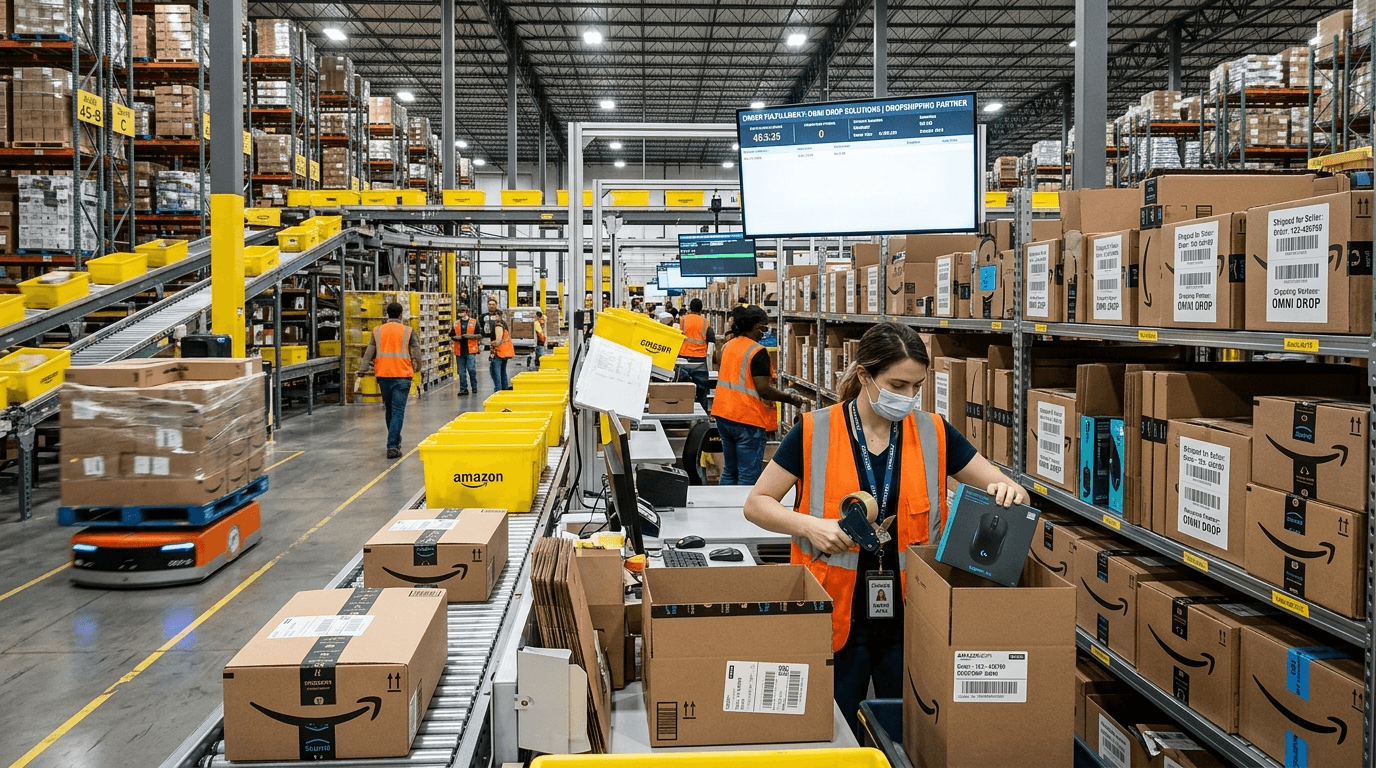
Wholesale runs on predefined terms and not reactive decisions. You are not figuring things out order by order. The way products are packed, labeled, and shipped is already agreed upon before anything goes live.
That upfront clarity is what keeps the model stable.
From a fulfillment perspective, suppliers in this category are used to working with businesses. They can ship without exposing their own identity, which keeps packaging clean and consistent. Invoices can be aligned with your store, so nothing inside the box creates confusion for the buyer. Delivery timelines also follow a more predictable pattern, which helps you maintain accurate expectations on your listings.
On the operational side, the relationship carries more weight than the product itself. You are not placing one-off orders. You are working with suppliers under defined terms. That includes agreements on how orders are handled, visibility into inventory so you are not selling out of stock items, and clear handling times that match your listing promises.
When these two sides come together, fulfillment and operations, the entire setup becomes easier to manage. Orders move in a consistent way, and your account is not exposed to avoidable issues tied to mismatched packaging or unreliable delivery.
Without that structure, even a good product can create problems. With it, the model holds steady as volume increases.
2. Print on Demand
Print on demand works best when your priority is staying compliant without constantly checking what goes out with each order.
Since the product is created after the order is placed, your branding is part of the production process itself. There is no separate supplier identity to manage, no invoices to replace, and no packaging surprises that can trigger complaints. The order leaves the facility already aligned with how it should reach the customer.
That makes it a cleaner option for sellers who do not want to deal with supplier-level inconsistencies.
Where it gets difficult is on the demand side. You are not selling a unique product, you are selling a variation of something widely available. That puts pressure on what you put on the product. If the design feels generic, it gets ignored. If it connects, it carries the entire listing.
Production time also needs to be accounted for early. Since items are made after purchase, delivery timelines are longer. If your listing does not reflect that clearly, it creates expectation gaps that lead to complaints.
This model works when you want control over how orders are presented, but it expects you to win through design and positioning.
3. International Supplier Model (Margin vs Risk Trade Off)
This model makes sense only when the price gap is large enough to absorb what comes with it.
Sourcing internationally gives you access to products that are either cheaper or not widely available on Amazon. That creates room for better margins and less direct competition. It can work well when you are testing items that do not already have heavy seller saturation.
The trade off shows up in how predictable your operations are:
Delivery timelines are longer, but the real issue is variability. Two orders placed on the same day may not move the same way. That makes it harder to set clear expectations on your listings without risking complaints.
Tracking is not always reliable. Updates can lag or appear incomplete, which leaves you in a position where you cannot give precise answers when customers ask about their order status.
Returns require a decision early. Sending products back internationally is slow and costly, so most sellers either offer refunds without returns or route items to a local address. Without a defined process, returns quickly become unmanageable.
This model works when you are testing unique products with enough margin to cover delays, refunds, and communication gaps. It starts breaking down when you try to run it like a fast moving, high volume setup.
Models That Break on Amazon
Some setups look fine during testing and even generate early sales, but they start collapsing as soon as volume builds. The problem is not demand. It is how the orders are being fulfilled behind the scenes.
Retail arbitrage disguised as dropshipping: Orders are sourced from marketplaces or local stores, which means you have no control over packaging, invoices, or pricing visibility. The moment a mismatch shows up, the setup is exposed.
Automation setups using unverified suppliers: Systems handle order routing, but supplier quality is never fully checked. You lose control over how orders are packed and shipped, and issues surface only after customers start reporting them.
Viral product chasing without supply chain validation: A product gains traction and gets listed quickly without checking inventory depth or fulfillment capacity. Orders spike, but the supply side cannot keep up, leading to delays and inconsistency.
Each of these models fails for the same reason. They rely on speed to get started, but lack the control needed to sustain orders over time.
Product Research Framework for Amazon Dropshipping
A product can look promising from the outside and still create problems once orders begin. The gap usually shows up after fulfillment, when delivery, packaging, and customer expectations come into play.
Start by judging how the product behaves physically. Items that are easy to ship and less prone to damage tend to move without creating extra work. Products that need careful handling or special packaging often introduce issues that are hard to control at scale.
Customer interaction adds another layer. When a product depends on sizing, compatibility, or instructions, confusion tends to follow. Straightforward items reduce back and forth and keep returns lower.
To understand demand, look at how long a product keeps getting promoted. WinningHunter helps surface products that sellers continue to push, which usually signals that performance is holding over time.
Before listing, review how the product behaves on Amazon. Pricing spread, competition, and repeated complaints in reviews reveal whether the opportunity is stable or already strained.
Supplier Sourcing and Validation
Supplier choice shows its impact after the sale, not before. It affects how orders arrive, how returns are handled, and how often issues show up.
Most setups fall into one of two paths:
Domestic suppliers: Shorter delivery timelines, simpler return handling, and fewer compliance concerns
International suppliers: Better pricing and access to less saturated products, with added pressure on shipping and post-purchase handling
Location alone does not decide reliability. What matters is whether the supplier can support your setup without exposing gaps.
Focus on three checks before moving forward:
Packaging compliance: Orders must ship without supplier branding, and any documentation should reflect your business
Tracking reliability: Shipments should move through recognised carriers with consistent updates that customers can follow
Return handling: There should be a defined process for defects and a clear fallback if returns cannot go back to the supplier
Fulfillment Workflow and Order Management
Once orders start coming in, the goal must be consistency. Every order should follow the same path without delays or gaps between steps.
A typical flow moves like this:
Order placed on Amazon
Order details sent to supplier
Supplier begins fulfillment
Shipment dispatched
Tracking uploaded
Most issues happen in the handoff stages. Delays in sending order details, incorrect customer information, or late tracking updates are common points where things start breaking.
Returns need a defined route as well:
Customer requests return
You approve and process
Item is sent to supplier or a return address
If this flow is not clearly set early, small issues begin stacking as order volume increases.
Inventory and Pricing Strategy
Stock looks simple until it isn’t. Most issues don’t come from running out, they come from selling what you can’t fulfill on time.
When you don’t hold inventory, control comes from restraint. Never mirror your supplier’s full stock on your listing. Keep a buffer so you’re not caught off guard if their inventory shifts without notice. Regular updates matter here. If stock levels aren’t synced frequently, you end up accepting orders you can’t process smoothly.
Pricing works the same way. It needs to be built, not guessed.
Your floor price should cover:
supplier cost
Amazon fees
shipping
a margin for returns or unexpected issues
Once that baseline is set, stability matters more than squeezing extra margin. Sudden price jumps can disrupt conversions and trigger pricing flags. If costs increase sharply, it’s safer to pause the listing than push the price beyond what the market expects.
Shipping, Tracking, and Returns Management
Once orders start moving consistently, the focus shifts from setup to control. Small gaps in shipping and returns begin to show up faster as volume increases.
Tracking needs to hold up after dispatch. Each order should have a valid carrier scan and a tracking number that updates without delays. If tracking lags or fails to update, customer queries increase quickly.
Delivery timelines should reflect how orders actually move, including processing time and transit variability. Tight estimates create pressure. Slight buffers give you room to handle delays without affecting the experience.
Returns should follow a fixed process. A dedicated return address, a simple inspection step, and clear refund rules keep decisions consistent. Without that, handling returns becomes slower and harder to manage over time.
Performance Metrics That Control Your Account
Amazon evaluates your store through a small set of signals that reflect how well orders are handled from the customer’s perspective.
Order Defect Rate carries the most weight. It combines negative feedback, A to Z claims, and chargebacks into one metric. Since all three are tied to customer dissatisfaction, even a few incidents can push this number up quickly. Keeping it below one percent is critical to maintaining account stability.
Beyond that, Amazon tracks how reliably orders are processed and delivered.
Valid Tracking Rate: Confirms that each order includes a tracking number that updates correctly
Late Shipment Rate: Measures how often orders are dispatched later than your stated handling time
These metrics don’t operate in isolation. When they begin to decline, it usually points to issues in fulfillment timing or supplier coordination. Keeping them within acceptable limits ensures your listings continue to perform without interruption.
Taxes and Compliance (US, UK, EU, India)
Tax handling changes based on where you sell, and each region follows a different system. Instead of treating this as a single rule, it’s easier to look at how each market works.
Region | Tax Handling | Key Requirements |
United States | Marketplace tax collection handled by Amazon | Maintain bookkeeping for revenue, fees, and payouts |
European Union | OSS VAT system for multi country sales | Ensure VAT compliance and CE marking where required |
United Kingdom | VAT applies after threshold | Follow VAT rules and product safety regulations |
India | GST with TCS deductions via marketplace | Reconcile GST, TCS, and payout records accurately |
This is not a one time setup. Each region requires ongoing tracking to keep records aligned and avoid issues during audits or account reviews.
Where Amazon Dropshipping Actually Works
Amazon doesn’t reward speed. It exposes weak setups.
Products fail less because of demand and more because the backend can’t support what’s being sold. Listings go live, orders come in, and then small gaps in fulfillment, tracking, or returns start showing up. That’s where most setups fall apart.
A better approach is to reverse the order of decisions. Look at products that are already being pushed consistently in the market. WinningHunter makes it easier to spot patterns where sellers continue spending, which signals that something is holding over time.
From there, pressure test the basics before listing. Can it be fulfilled cleanly? Can it move without delays or confusion? If those answers are unclear, the product is not ready.
This model works when each part is defined before the scale begins. When that structure is in place, results stop depending on luck and start following a repeatable path.
FAQs
Is dropshipping allowed on Amazon in 2026?
Yes, but only when you act as the seller throughout the transaction. Orders must reflect your business, not the supplier, across packaging, invoices, and customer communication.
Can you dropship from Walmart to Amazon?
No. Orders fulfilled from other retailers expose third-party branding and pricing, which violates Amazon’s requirements and can lead to account action.
Do you need a company to start?
Not always. You can begin as an individual seller, but having a registered business helps with tax handling, supplier agreements, and long-term operations.
What causes Amazon suspension in dropshipping?
Most suspensions come from mismatched packaging, invalid tracking, late shipments, and repeated customer complaints tied to fulfillment issues.
How much can you earn with Amazon dropshipping?
Income varies based on product choice, margins, and how well your operations hold up under volume. Consistent results usually come from stable supply chains and controlled execution.


We already know what works before you even have the chance to blink!
© 2024 WinningHunter.com