tiktok-marketing-api
TikTok Marketing API: A Complete Guide
By
Kinnari Ashar

TikTok advertising moves quickly. New creatives appear daily, product trends shift overnight, and campaigns scale the moment a video starts gaining traction. When you manage advertising for a brand, agency, or e-commerce platform, running every campaign manually inside TikTok Ads Manager soon becomes difficult once campaign volume grows.
The TikTok Marketing API solves this problem by giving developers and marketing platforms direct programmatic access to advertising functions. Campaigns, ads, reporting data, and creative assets can all be managed through software.
These capabilities quietly power automation tools, e-commerce ad platforms, reporting dashboards, and creative testing systems.
This guide explains how the TikTok API ecosystem works and how real advertising tools build automation on top of it.
What Is the TikTok Marketing API?
The TikTok Marketing API acts as a developer gateway into TikTok Ads Manager. It allows software platforms, internal tools, and marketing systems to interact with TikTok advertising infrastructure through code.
Tasks that advertisers usually perform manually in Ads Manager can be triggered automatically through API requests.
For example, a platform can create campaigns, adjust budgets, upload ad creatives, or pull reporting data without requiring a user to click through the interface. This programmatic control allows advertising platforms and analytics tools to manage large volumes of campaigns far more efficiently.
TikTok advertising follows a structured hierarchy that the API also reflects.
A campaign sits at the top level. Each campaign contains ad groups that define targeting, budgets, and placement settings. Ads live inside these ad groups and represent the creative content viewers see in the feed. The API provides dedicated endpoints for each level, allowing developers to create, update, activate, pause, and retrieve reporting data.
The TikTok API System Explained
The TikTok Marketing API does not exist on its own. It belongs to a larger developer environment created by TikTok. Several APIs operate inside this system, each designed for a different type of interaction with the platform.
Most explanations focus only on the Marketing API. That creates confusion because several other APIs operate alongside it. Each one handles a different part of the platform, from ad automation to conversion tracking and creator collaborations. Looking at the full system makes it clear how these pieces connect.
1. Marketing API
The TikTok Marketing API handles advertising automation. It allows developers and marketing platforms to interact with TikTok Ads Manager programmatically.
Software can create campaigns, organize ad groups, upload creatives, change budgets, pause ads, and retrieve reporting data through API requests. This replaces the need to manage every campaign manually inside the interface.
Platforms that manage large advertising accounts depend on this capability. E-commerce advertising tools, marketing automation systems, and agency dashboards use the Marketing API to launch campaigns, monitor performance, and update ads across multiple accounts without constant manual work.
2. Events API
The TikTok Events API supports server-side conversion tracking. Websites and backend systems send user actions directly to TikTok servers rather than relying entirely on browser-based tracking scripts.
Events commonly transmitted through this system include purchases, add to cart actions, sign-ups, and product page views. Sending events from the server improves reliability because browser restrictions and ad blockers have less impact on the data.
Accurate event tracking plays a major role in advertising performance. When TikTok receives reliable conversion data, the platform can attribute results more precisely and improve campaign optimization for advertisers running conversion-focused campaigns.
3. Commercial Content API
The TikTok Commercial Content API powers advertising transparency tools across the platform. It provides structured data about active advertisements running on TikTok.
Information returned through this system includes advertiser identity, creative assets, ad copy, and campaign-level metadata. This is the same type of data that appears in the TikTok Ads Library when users search for active advertisements.
Unlike the Marketing API, this system does not allow advertisers to manage campaigns. Its role focuses on ad discovery and transparency. Researchers, analysts, and advertising intelligence tools often rely on this dataset to monitor advertising activity across the platform.
4. Research API
The TikTok Research API was created for academic institutions studying public activity on the platform. Universities and approved research organizations can request access to datasets related to TikTok content.
The API provides information such as public video metadata, engagement signals, hashtag usage, and distribution patterns. Researchers use this data to examine cultural trends, information flows, and social media behavior.
Access is controlled through an application process, and datasets may include limitations depending on the type of research being conducted. Request quotas and incomplete coverage are commonly reported by developers working with this interface.
5. Creator Marketplace API
Influencer marketing platforms connect with TikTok through the TikTok Creator Marketplace API. This interface links software systems with TikTok’s creator collaboration environment.
Agencies and marketing platforms use it to discover creators, evaluate audience demographics, and organize brand collaborations. The API also helps track campaign performance across influencer partnerships.
Creator marketplace is essential in TikTok marketing because influencer-driven promotion often performs strongly on the platform. Integrations built on this API allow brands and agencies to manage creator partnerships while keeping campaign data connected to their broader marketing systems.
Key Functions of the TikTok Marketing API
The TikTok Marketing API gives software platforms direct access to the advertising infrastructure used inside TikTok Ads Manager.
Advertising platforms typically interact with several groups of endpoints that control different parts of the campaign lifecycle. These include campaign creation, ad management, audience configuration, performance reporting, and creative asset storage.
Together, these functions allow marketing systems to manage large advertising operations across multiple advertiser accounts.
1. Campaign Automation
Campaign automation is usually the first capability implemented when integrating the API. Advertising platforms can generate campaigns automatically through API requests rather than setting them up manually inside Ads Manager.
This approach becomes useful when platforms manage campaigns for multiple advertiser accounts or run repeated promotion cycles. Campaign structures can be created in bulk, allowing teams to launch product promotions, testing campaigns, or seasonal offers quickly.
Budget adjustments and campaign status changes can also run automatically. Platforms may increase budgets for campaigns performing well or pause campaigns that no longer meet performance targets.
Developers typically interact with endpoints such as:
POST /campaign/create
GET /campaign/get
POST /campaign/update
POST /campaign/status/update
These endpoints allow advertising platforms to maintain large campaign portfolios without relying on manual campaign management.
2. Ad Creation and Management
Once campaigns and ad groups exist, the next stage involves generating ads and managing creative variations. Advertising platforms often create multiple ad versions inside the same campaign in order to test different creatives, formats, or messaging angles.
Before ads can be created, creative assets must be uploaded to the asset library. Images and videos are stored through file upload endpoints and then referenced during ad creation requests.
Common endpoints used during this process include:
POST /ad/create
GET /ad/get
POST /ad/status/update
Creative uploads typically use endpoints such as:
POST /file/image/ad/upload
POST /file/video/ad/upload
This structure allows advertising platforms to launch large groups of ad variations quickly while keeping creative assets organized inside a shared asset library.
3. Audience Targeting Management
Audience configuration happens at the ad group level. Through the API, platforms can define targeting rules programmatically when creating or updating ad groups.
Targeting signals available through the system include interest categories, behavioral patterns, and demographic filters such as age ranges, gender, and geographic locations. Advertisers can also work with custom audiences built from website visitors or customer lists.
Lookalike audiences expand this reach by identifying users who share characteristics with existing customers. Some audience signals may also reflect user engagement with videos or creator content on the platform.
Automating targeting rules allows advertising platforms to apply consistent audience settings across large campaign groups.
4. Reporting and Analytics Data
Advertising platforms rely heavily on reporting endpoints to monitor campaign performance. Instead of manually exporting data from Ads Manager, connected systems can retrieve metrics automatically through API requests.
Reporting endpoints return performance indicators such as impressions, clicks, click-through rate, cost per click, cost per thousand impressions, and advertising spend. Conversion metrics may include purchases, add to cart events, app installs, or lead submissions.
Engagement-related signals also appear in reports. These may include video views, watch time, likes, and shares. Access to this data allows platforms to build analytics dashboards and optimization tools that monitor advertising results in near real time.
5. Creative Asset Management
Creative asset management supports the storage and organization of advertising media used in campaigns. Developers can upload images and videos programmatically, retrieve stored assets, and organize files across advertising accounts.
This capability helps creative teams run structured testing programs. Multiple versions of an ad can be generated while reusing the same asset library across campaigns.
Assets may also be shared across advertiser accounts connected within Business Center, allowing teams to coordinate creative resources across multiple advertising accounts.
Access Authorization and Security Requirements
Access to the TikTok Marketing API requires a structured authentication process that protects advertiser accounts and campaign data. TikTok uses the OAuth 2.0 authorization framework, which allows applications to interact with the advertising infrastructure only after receiving explicit permission from the advertiser.
Before a platform can send API requests, developers must complete a multi-step authorization process.
Typical Authentication Workflow:
Register a developer application: Developers first create an application within the TikTok developer platform. This registration identifies the software that will interact with the API.
Obtain credentials for the application: After registration, TikTok generates a client key and client secret. These credentials allow the platform to authenticate itself during the authorization process.
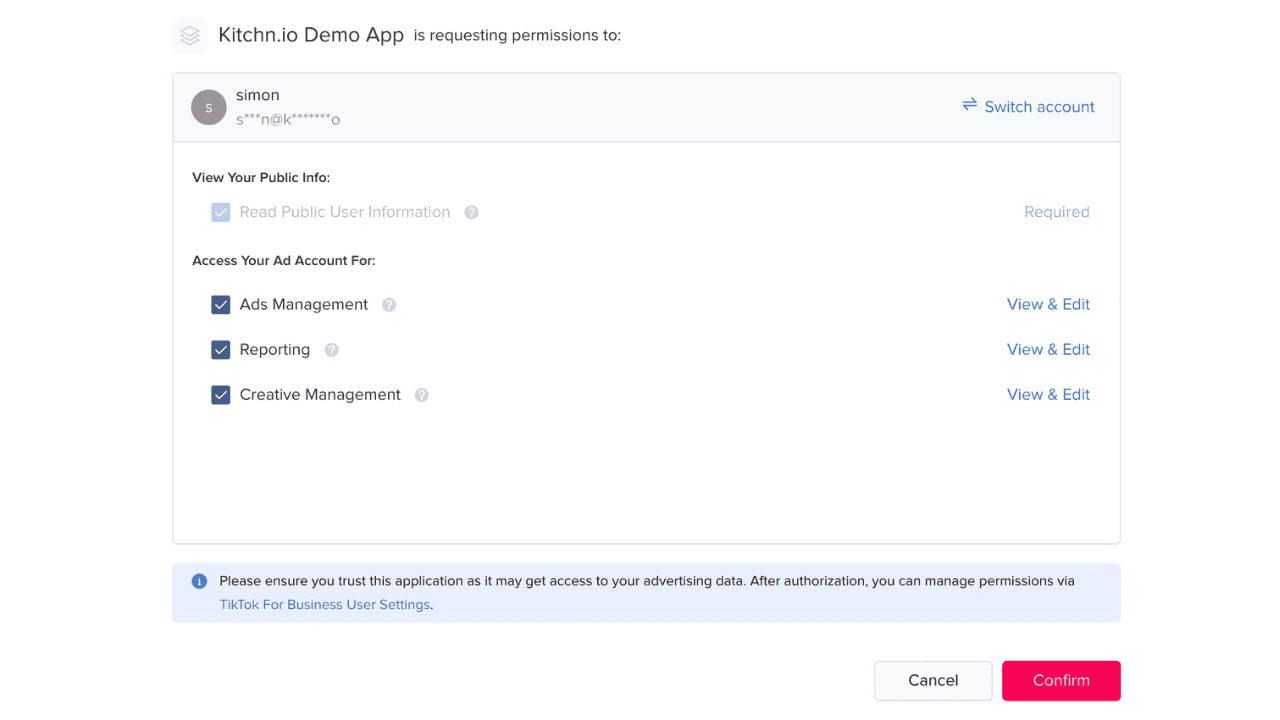
Request authorization from the advertiser account: The advertiser must grant permission for the application to access the advertising account. This step ensures that platforms cannot retrieve campaign data without account approval.
Exchange the authorization code for an access token: Once authorization is granted, the application exchanges the authorization code for an access token. This token is used to authenticate all API requests.
Send authenticated API requests: The access token is included in API calls when interacting with advertising endpoints such as campaign creation, reporting, or ad management.
Token Management and Access Control
Access tokens are valid only for a limited time and must be refreshed periodically to maintain access. This mechanism prevents long-term unauthorized access to advertiser accounts.
TikTok also allows users to disconnect applications at any time. When an advertiser revokes access, the integration loses permission to retrieve or modify account data.
Example revoke endpoint used for disconnecting integrations:
POST /v2/oauth/revoke/
How to Get Access to the TikTok Marketing API?
Access to the TikTok Marketing API requires approval through the TikTok for Developers portal. TikTok reviews applications before allowing software platforms to interact with its advertising infrastructure.
Developers typically follow this onboarding process.
Create a developer account: Register on the TikTok developer platform to access API documentation, developer tools, and application management features.
Register an application: Create an application that will connect to TikTok services. During registration, TikTok collects information about the platform, company, and intended API use.
Apply for Marketing API access: Submit a request for Marketing API permissions. TikTok evaluates the application to confirm that the integration follows its advertising policies and developer guidelines.
Receive client credentials: After approval, TikTok issues credentials such as a client key and client secret. These credentials identify the application when sending API requests.
Authorize advertiser accounts: Advertiser accounts must grant permission before the application can retrieve campaign data or manage advertising activity through the API.
Once authorization is complete, developers can authenticate requests and begin building campaign automation systems, reporting pipelines, and advertising management tools on top of the API.
How Businesses Use the TikTok Marketing API in Practice
1. Marketing Automation Platforms
Agencies that manage campaigns for multiple clients often rely on marketing automation systems connected to the API. These platforms coordinate campaign scheduling, adjust budgets based on performance signals, and update campaign status across advertiser accounts.
Instead of logging into each account individually, automation platforms can deploy campaign structures in bulk and apply consistent settings across campaigns. This makes it easier for agencies to handle large advertising portfolios while maintaining control over budgets, targeting rules, and campaign timing.
2. E-commerce Advertising Tools
E-commerce advertising platforms use the API to connect product catalogs with campaign management systems. When new products appear in a catalog or inventory levels change, the platform can trigger advertising workflows automatically.
Typical processes include syncing product feeds, generating product-focused ads, and collecting purchase data from conversion events. This allows ecommerce teams to monitor how individual products perform in advertising campaigns and adjust promotion strategies accordingly.
Ad intelligence platforms such as WinningHunter often complement these systems. By analyzing active TikTok advertisements and identifying trending creatives or products, these tools help advertisers decide which products to promote before launching automated campaigns.
3. Creative Testing Platforms
Creative testing platforms focus on identifying the ad variations that attract the strongest audience response. These systems usually run structured testing cycles designed to evaluate large numbers of creatives quickly.
A typical workflow begins with uploading multiple images or videos to the asset library. The platform then generates several ad variations using those assets and launches them across different ad groups. Reporting endpoints collect performance data as the campaigns run.
Underperforming creatives can be paused automatically, while stronger variations continue receiving budget. This process allows marketing teams to identify winning creatives without manually monitoring every test.
4. Advertising Analytics Dashboards
Analytics platforms connected to the API continuously collect campaign data from advertising accounts. Instead of exporting reports manually from Ads Manager, these systems retrieve metrics automatically and organize them into dashboards used by marketing teams.
Campaign indicators such as click-through rate, conversion rate, advertising spend, and return on ad spend help teams evaluate which campaigns deserve additional budget.
Creative intelligence tools like WinningHunter complement these dashboards by examining active advertisements across the platform and highlighting emerging creative patterns that marketers may want to test in future campaigns.
How Does the TikTok Marketing API Fit With Ads Library and Creative Center?
If you have ever explored the TikTok Ads Library or browsed trending ads inside TikTok Creative Center, you might assume those systems are connected to the TikTok Marketing API. They are not.
These tools belong to completely different parts of TikTok’s advertising environment. One group of systems exists to research ads and study creative trends. Another exists to create and manage campaigns programmatically.
Once you separate these roles, the structure becomes much clearer.
TikTok Ads Library - This public transparency tool shows advertisements currently running on the platform. Users can search by advertiser name and review active creatives, captions, and landing pages.
The data visible here does not come from the Marketing API. It is supplied through the TikTok Commercial Content API, which supports advertising transparency initiatives.
TikTok Creative Center - The Creative Center focuses on trend discovery. Marketers use it to explore popular ad formats, emerging content styles, and examples of campaigns gaining traction on the platform.
It functions as a research environment rather than a campaign management system.
Creative Library inside TikTok Business Center - Creative assets used in campaigns are stored in the internal asset library available within Business Center.
Images and videos uploaded through Ads Manager or through the Marketing API are stored here so they can be reused across campaigns and advertiser accounts.
In practice, advertisers often combine these systems. Research platforms reveal creative patterns and campaign ideas. Automation tools connected to the Marketing API then handle campaign creation and deployment.
Limitations of the TikTok Marketing API
The TikTok Marketing API provides extensive automation capabilities, but developers and marketing platforms must work within several operational constraints when building integrations.
Access approval requirements - Developers must apply for API access through the TikTok developer platform and clearly describe their intended product, business model, and use case before approval is granted.
Review and onboarding time - API access is not instant, and the review process can take several weeks, depending on the application and requested permissions.
Rate limits on API requests - TikTok enforces request limits on endpoints, so platforms must implement throttling and request management systems to avoid exceeding usage thresholds.
Restricted data scope - The API only returns data from advertiser accounts that authorize the integration, which means competitor campaign performance data cannot be accessed.
Technical implementation complexity - Integrating the API requires backend infrastructure for authentication handling, token management, server processing, and data storage, which often involves dedicated engineering resources.
What the TikTok Marketing API Means for Modern Advertising
Advertising on TikTok has moved far beyond manually launching a few campaigns inside Ads Manager. Brands now test dozens of creatives, run product experiments continuously, and analyze performance across multiple accounts. Managing that scale manually quickly becomes unrealistic.
This is where the TikTok Marketing API becomes critical. It allows marketing systems to operate advertising infrastructure programmatically, turning campaign management into a structured workflow that software can control.
For marketers, the real advantage appears when automation connects with insight. WinningHunter helps identify promising creatives and products, while API driven systems handle campaign deployment and performance monitoring.
Teams that combine these capabilities can move faster, test more ideas, and scale successful campaigns before trends disappear.


We already know what works before you even have the chance to blink!
© 2024 WinningHunter.com