dropship-io-review
Dropship.io Review (2026): Features, Pricing & Honest Verdict
Shopify product research tools are everywhere. Open YouTube, search on Google, scroll through e-commerce forums, and you will see the same promise repeated in different words. Find winning products faster. Scale quicker. Outsmart competitors.
We have tested enough of them to know one thing. Fast discovery sounds great in theory, but reliable data is a different story. Recycled listings, outdated trends, and bold revenue estimates often sit behind polished dashboards. Everything looks convincing until you try to make real decisions with it.
That tension pushed us to examine Dropship.io closely. We checked its store tracking, revenue estimates, TikTok coverage, and search functionality to see whether the insights feel dependable or just well presented.
Is Dropship.io truly worth paying for in 2026, or does it struggle once you expect consistent and reliable data?
Quick Verdict
6.8/10 - Clean interface and strong store tracking make it beginner-friendly, but weak metric reliability and recurring billing concerns reduce long-term trust in the data.
What we measured
Area | Score |
Ad Spy Features | 7/10 |
Database Accuracy | 5/10 |
Update Frequency | 6/10 |
Pricing & Value | 7/10 |
Ease of Use | 9/10 |
Support Quality | 6.5/10 |
Best for:
New Shopify dropshippers who want store-level research without complexity.
Skip if:
You need highly reliable real-time data or deep multi-platform ad intelligence.
What We Did to Test This
Before forming any conclusions about Dropship.io, our WinningHunter team evaluated it in practical research scenarios rather than just through a feature tour.
Here is exactly what we did:
Used the platform across different niches to observe performance across varied demand cycles
Analyzed user reviews from Trustpilot, Reddit discussions, YouTube reviews, and third-party review platforms to identify consistent strengths and recurring complaints
Cross-checked claims related to TikTok Shop tracking and tested the Magic AI search to assess real discovery value
Compared revenue estimates with known store performance benchmarks to evaluate realism and reliability
This review reflects hands-on testing of workflows, limitations, and data accuracy in real product research situations.
What is Dropship.io?
Dropship.io is a Shopify-focused product research and competitor intelligence platform built specifically for dropshippers. Its central promise is straightforward. Help you identify products that are already generating revenue by tracking live Shopify store data.
Instead of concentrating on ad creatives, it operates at the store level. When we explored the dashboard, the emphasis was clear. You analyze what stores are selling, estimate how those products perform, and monitor how competitors evolve.
Here is what the platform claims to focus on:
Store-level revenue estimates
Competitor product launches
Sales trend monitoring
Advanced product database filtering
TikTok Shop tracking
AI-powered reverse product search
It is important to understand what it does not do. Dropship.io does not build your store or launch ads. The platform positions itself strictly as a research tool.
What Real Users Say
To understand how Dropship.io performs beyond marketing claims, we reviewed feedback across Trustpilot, Reddit discussions, and broader ecommerce forums. Clear patterns started to appear.
What Users Love
1. The interface is genuinely easy to use
This is the most consistent compliment we saw in all the reviews.
On Trustpilot, it currently holds a 4.7 out of 5 rating based on more than 1,000 reviews, which signals strong overall satisfaction.
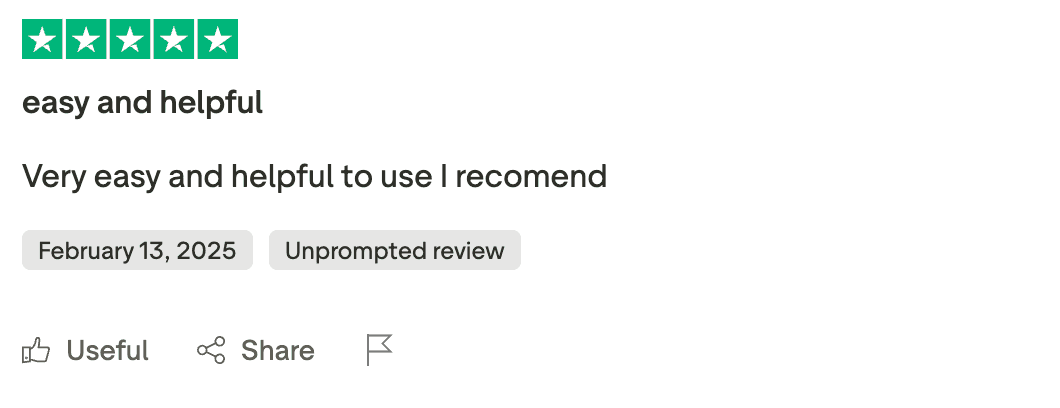
Many reviewers describe the dashboard as clean and beginner-friendly. Comments such as “easy and helpful” and “very easy and helpful to use, I recommend” appear frequently. The language is simple, but the pattern is clear. Users appreciate how quickly they can understand the tool.
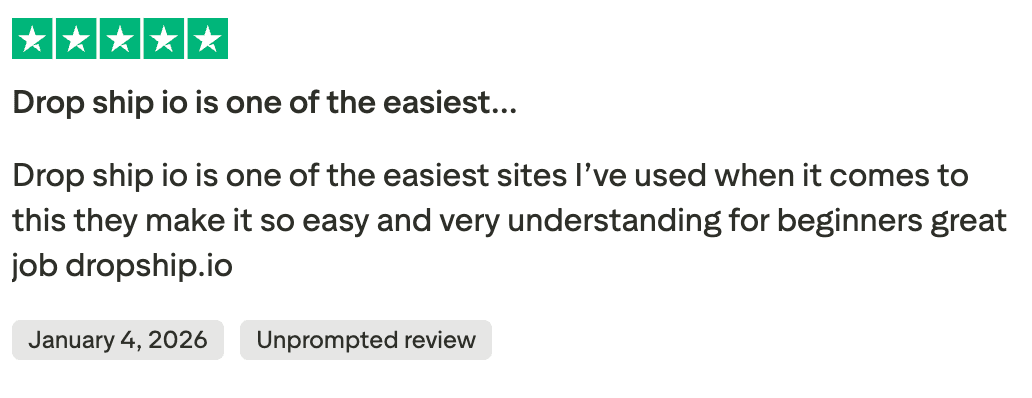
Reviews mention finding product ideas during their first session. That early win matters, especially for new sellers who feel overwhelmed by complex research platforms.
2. Competitor tracking is valuable
Across Trustpilot and e-commerce forums, users mention how helpful it is to monitor Shopify stores directly from the dashboard. Reviews often highlight the ability to track new product launches and observe performance trends without manually checking stores one by one.
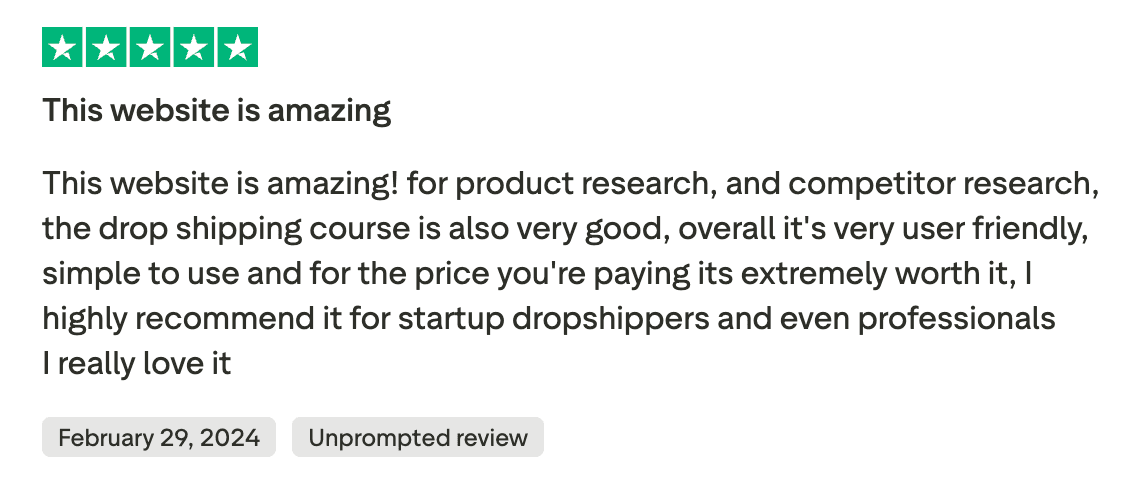
In one five-star review, a user described the platform as “amazing for product research and competitor research,” adding that it is user-friendly and worth the price for both beginners and professionals. Similar comments appear repeatedly, especially from sellers who focus heavily on analyzing competitors before launching products.
Caution Regarding Trustpilot Ratings
While reviewing Trustpilot feedback, we came across a platform-level notice that deserves attention.
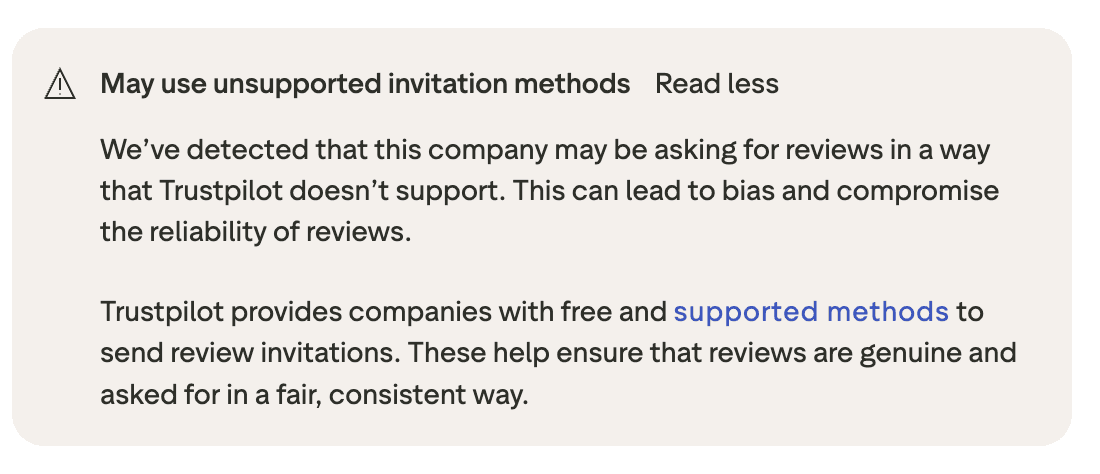
Trustpilot has a disclosure stating that the company may be using review invitation methods that are not fully supported by its guidelines. According to Trustpilot, this can sometimes lead to biased collection patterns or affect how consistently reviews are gathered.
Most of the reviews we saw were positive, and many users genuinely praised usability and competitor tracking. However, this disclosure adds important context to the 4.7 out of 5 rating.
We suggest that you look beyond the overall score. Reading detailed reviews, especially balanced and critical ones, gives you a clearer picture than relying on the star rating alone. Because those 5 stars do not reflect the full picture, especially when the review collection method is questioned, so beware, as we don’t want your money to go to waste.
What Users Complain About
1. Subscription and Refund Issues
We found many serious complaints that were about billing.
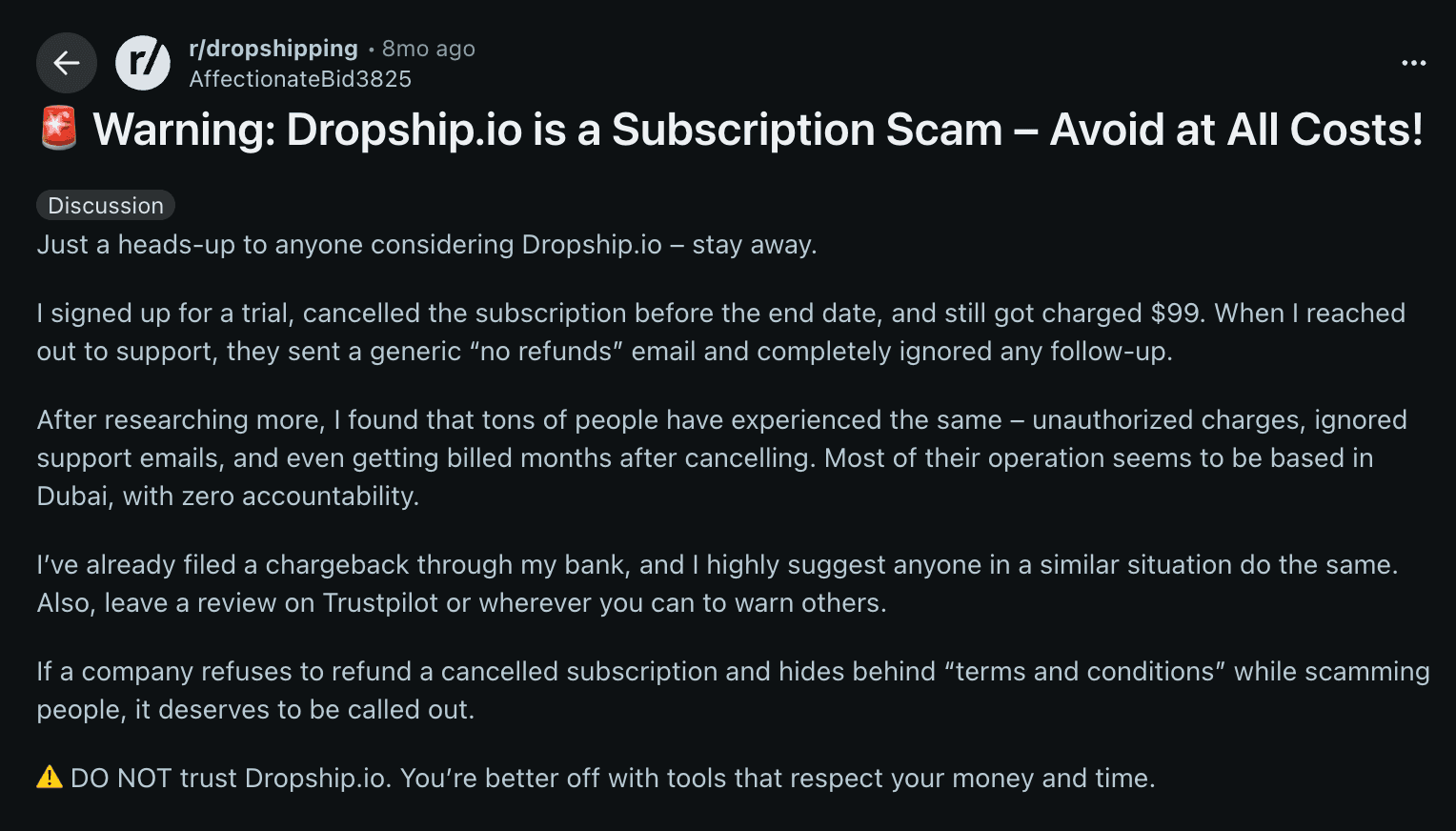
On Reddit, one post labeled the platform a subscription scam after the user claimed they canceled before the trial ended, but were still charged 99$. According to the thread, support replied with a no-refund response, and the user felt ignored afterward. Several commenters advised filing a chargeback through the bank. A few others said they had similar refund struggles.
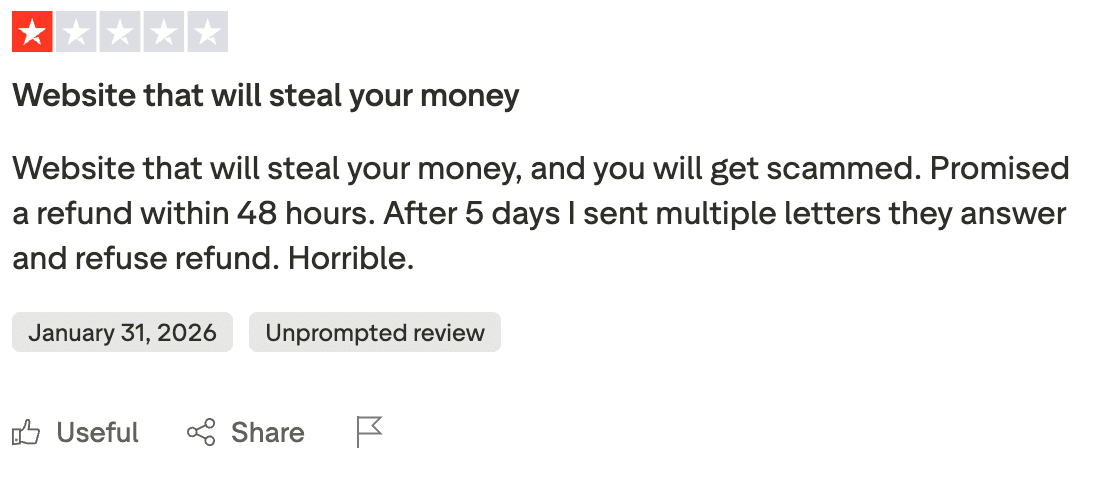
We came across more discussions mentioning unexpected charges or difficulty getting refunds processed. The pattern shows up often enough in forums to deserve caution afterall it’s your hard-earned money involved.
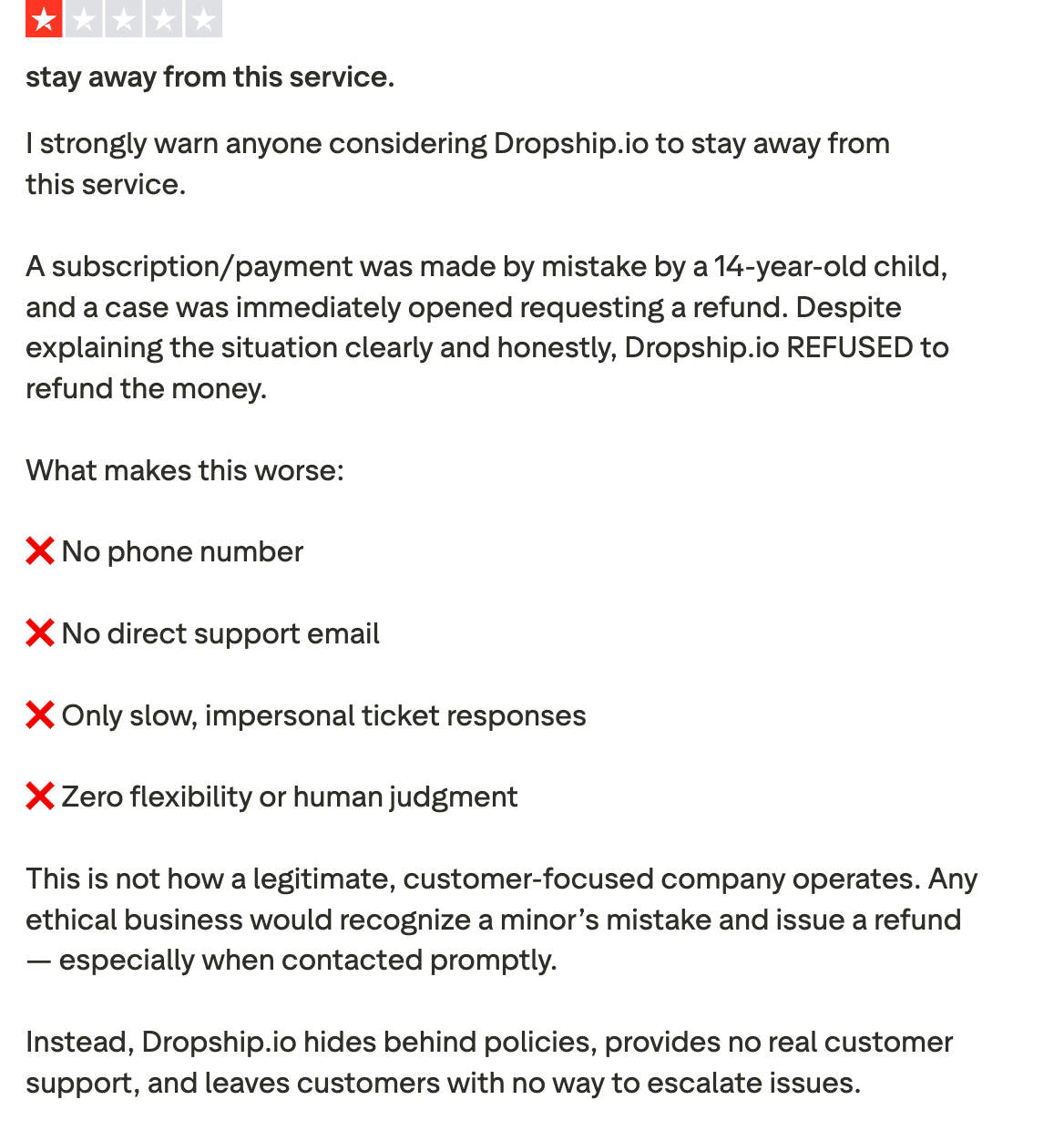
If you are considering a subscription, it is worth reviewing the cancellation terms carefully and keeping documentation of any changes you make to your plan.
2. Concerns About Review Authenticity and Billing Transparency
Some negative reviews question more than just features or refunds. They question trust.
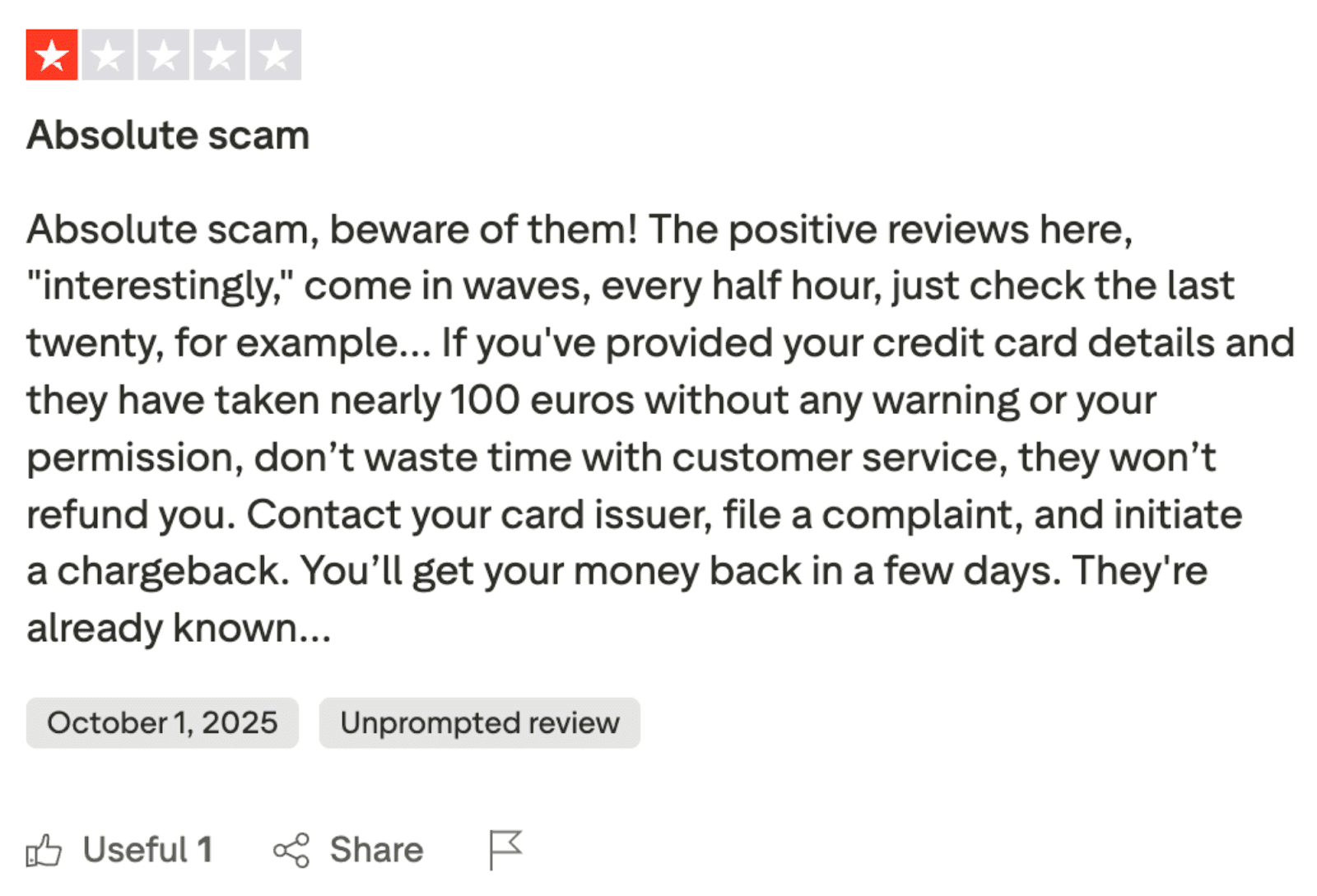
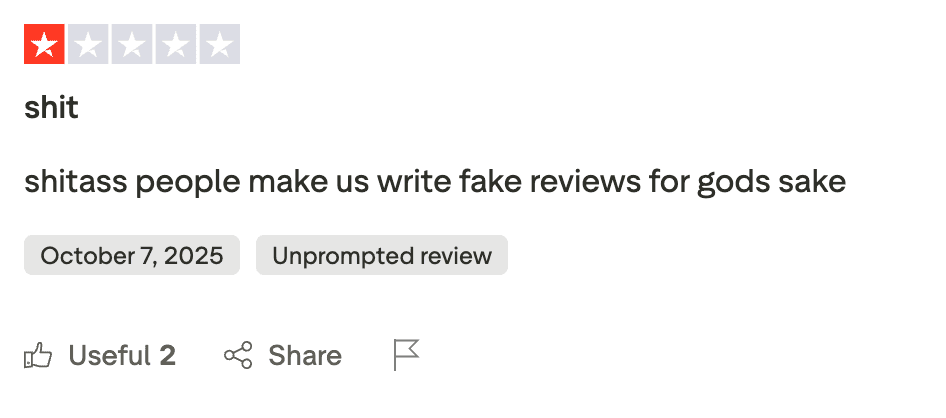
In one 1-star Trustpilot post, a user claimed that positive reviews appear in waves and suggested they may not be organic. Another review used blunt language and alleged that people were asked to write fake reviews. These are serious claims and cannot be independently verified, but they reflect skepticism that shows up in a small cluster of critical feedback.
As mentioned earlier, we also noticed the platform-level disclosure stating that the company may be using review invitation methods that are not fully supported by Trustpilot guidelines. Trustpilot notes that such practices can sometimes affect how reviews are collected and may introduce bias.
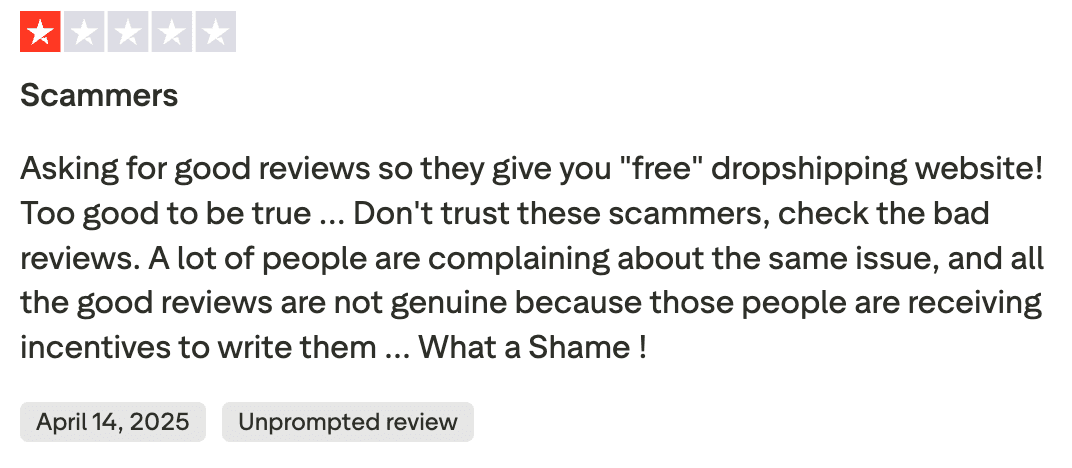
If you are evaluating the tool, it is worth reading detailed reviews carefully and considering both positive and critical perspectives before forming a conclusion.
3. Allegations of Outdated or Recycled Data
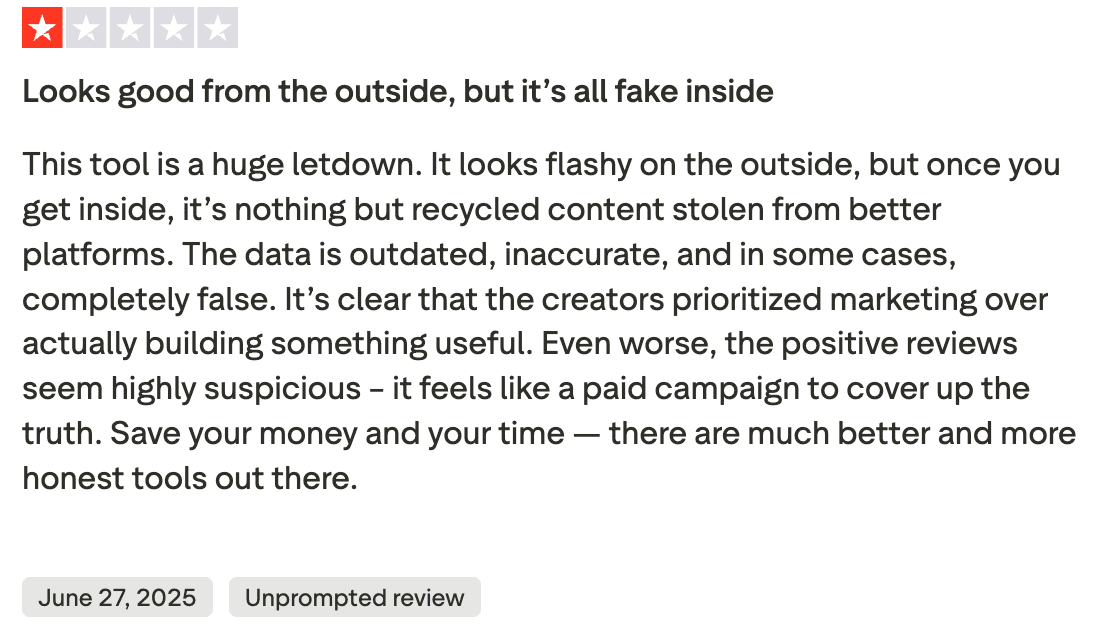
A review mentioned that the tool looks good at first, but feels disappointing once you start using it. It also claimed that some product listings seemed copied from other platforms and that parts of the data looked outdated or inaccurate. The issue was not how the tool works. The issue was whether the information inside it felt reliable.
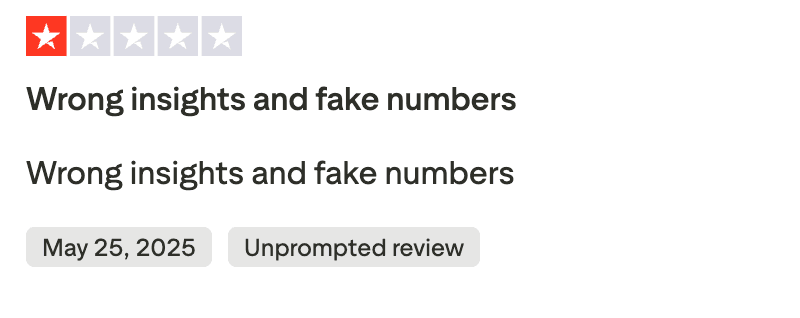
A few other negative comments share a similar concern. They question whether the data is fresh and unique. For a product research tool, that matters. If the information is not current or original, it becomes harder to trust the insights you are seeing.
4. Doubts About Metric Reliability
A few reviewers showed their frustration about how the data wasn’t reliable.
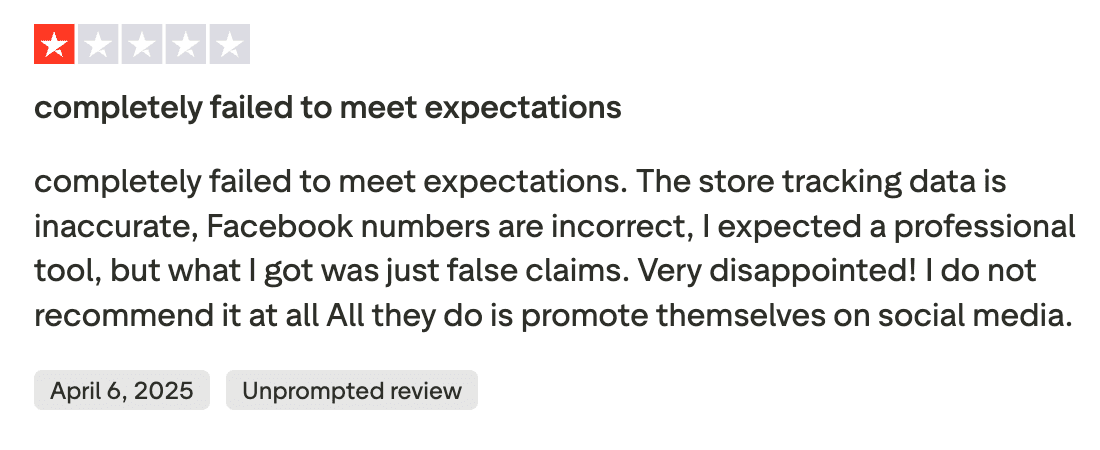
The frustration came from relying on those numbers and later feeling they did not reflect reality. The expectation was a professional research tool. The experience felt less dependable.
When a platform positions revenue estimates and performance data as decision-making tools, accuracy becomes the core promise. A few negative reviews suggest that, for them, that promise did not hold up.
Features Breakdown: What You Actually Get
1. Ad Library
The Ad Library inside Dropship.io functions as a searchable Facebook ad database. It allows you to explore active ads and see how products are being promoted across Shopify stores.
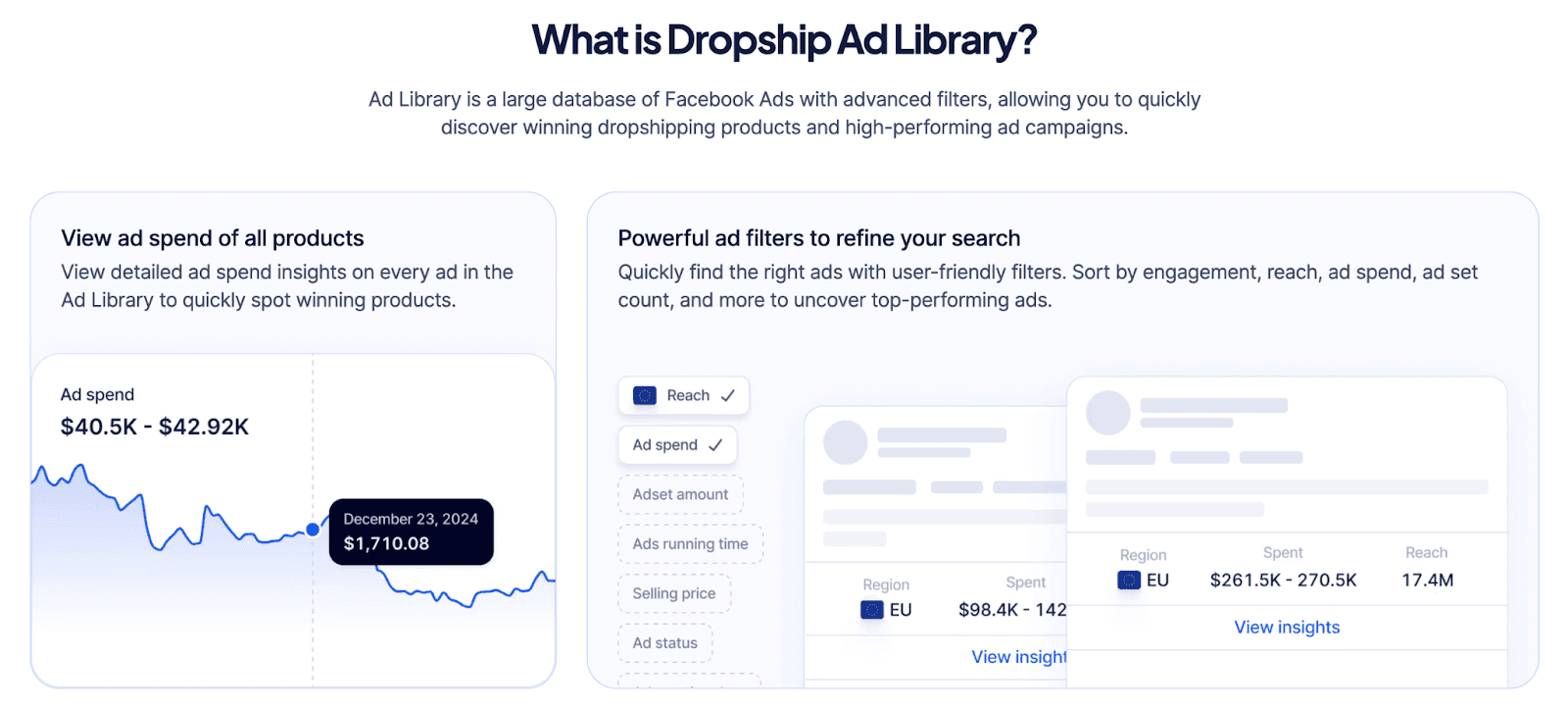
During testing, we could view:
Ad creatives
Ad copy
Engagement metrics such as likes, comments, and reactions
Performance-related indicators such as engagement and estimated reach
The interface makes it easy to scan ads quickly and identify which products are receiving traction. If you are validating an idea or checking how competitors position their offers, this feature gives you direct creative visibility inside the same dashboard.
However, we noticed that it does not match the depth of dedicated ad spy platforms. While filters exist, they are not as granular as advanced tools that allow detailed creative segmentation, targeting breakdowns, or extensive engagement threshold filtering.
If your strategy depends heavily on creative level analytics at scale, you may find it somewhat limited.
2. Product Library
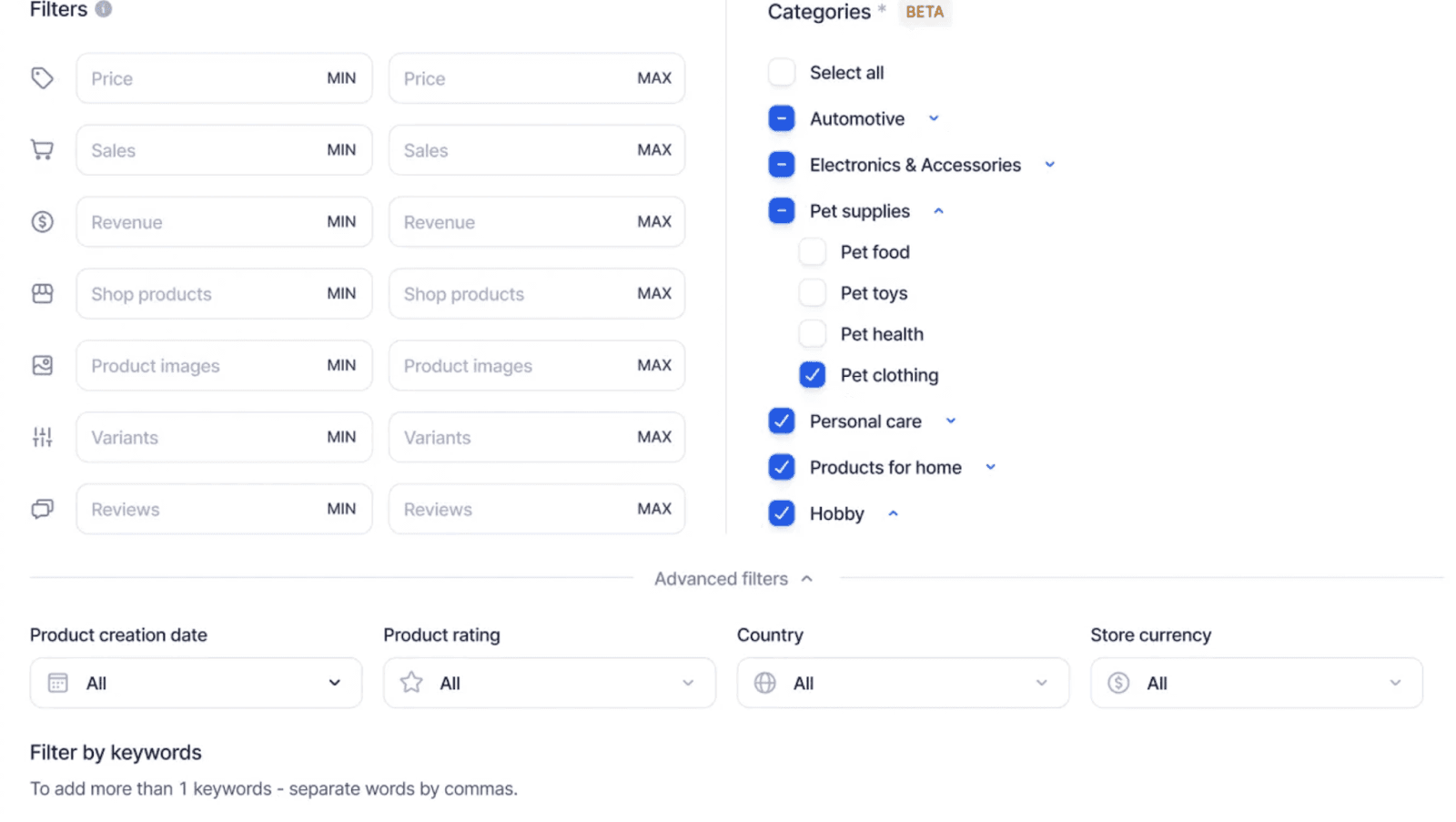
The Product Library is designed to help you discover products that are already being sold across Shopify stores. Unlike the Ad Library, which focuses on creatives, this section centers on product-level data.
When we explored it, the experience felt structured around filtering and narrowing down opportunities rather than scrolling endlessly. You can search products and apply filters based on different performance signals, pricing ranges, categories, and store activity.
From our testing, you can:
View product listings tied to active Shopify stores
See estimated revenue figures
Check pricing information
Analyze how many stores are selling the same product
Sort and filter based on performance-related metrics
This makes it useful for spotting patterns. If multiple stores are pushing the same item and revenue estimates look strong, it quickly surfaces as a signal. For beginners, especially, this reduces guesswork because you are not starting from a blank slate.
However, the usefulness depends heavily on how accurate and fresh the underlying data is. Revenue numbers are estimates, so keep that in mind while using the tool.
3. Magic AI Search
Magic AI Search is built as a reverse search feature, you don’t have to rely only on keywords. You can upload a product image or video and let the system identify related matches from its database.
We tested it using product screenshots and short clips taken from social media ads. The tool scanned the visual input and returned similar products that were already listed across tracked Shopify stores. This approach removes the usual friction of guessing product names or trying multiple keyword variations.
In practice, it helps in two main scenarios:
Finding suppliers or similar listings for a product you discovered elsewhere
Matching a trending item to stores that are already selling it
When the product exists within the platform’s database, results appear quickly and feel relevant. However, if the item is extremely new or not widely tracked, matches can be limited.
As part of the research workflow, Magic AI Search saves time during early validation. It does not eliminate the need for manual checking, but it reduces the effort required to connect a product idea to real store data.
4. Chrome Extension
The Chrome Extension allows you to analyze Shopify stores directly while browsing. Instead of copying store URLs into the dashboard, you can pull up store-level insights in real time from your browser.
We installed it and tested it across multiple active stores. With one click, it revealed estimated revenue, top products, and recently added listings. This makes quick competitor checks much smoother, especially when you discover a store through ads or social media.
The main benefit is convenience. You stay on the store page while accessing performance data, which keeps the research process fluid.
There are also short demo clips online that show the extension in action, including how quickly it surfaces store metrics during live browsing. That visual demonstration aligns closely with what we experienced during testing.
As with the main platform, the numbers shown here are estimates rather than verified sales data. The speed and accessibility are clear strengths, but accuracy still depends on how reliable those estimates are.
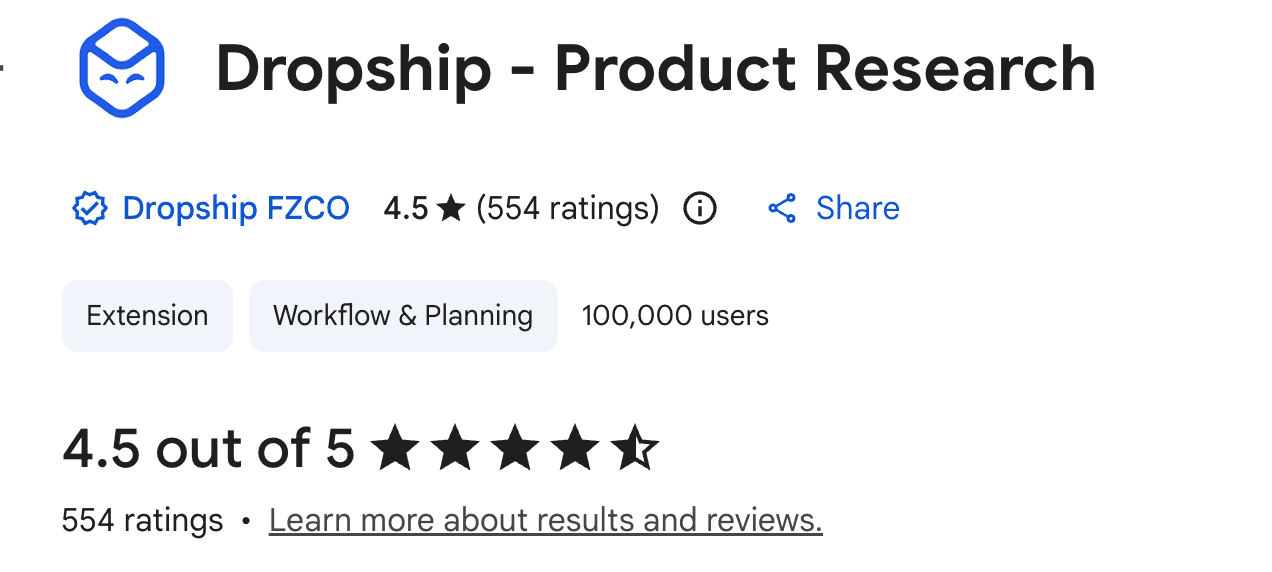
The extension itself also holds strong ratings on the Chrome Web Store, reflecting generally positive user feedback around usability and workflow efficiency.
5. Competitor Research
This section focuses on analyzing Shopify stores at a broader level. You are not just looking at single products. You are looking at how entire stores operate.
During testing, we searched by niche and keywords to surface active stores. Each store profile displayed estimated revenue, product listings, and recent additions. Opening a store gave a quick snapshot of what they are selling and how frequently they update their catalog.
The useful part is pattern spotting. When a store adds multiple items in a short time frame or shifts toward a new product category, that movement becomes visible. You do not need to manually revisit the same stores every week to catch those changes.
Like other areas of the platform, the figures shown are projections, so they function as indicators rather than confirmed sales reports. If you treat them as signals and not guarantees, the feature becomes more practical.
Pricing: What It Actually Costs
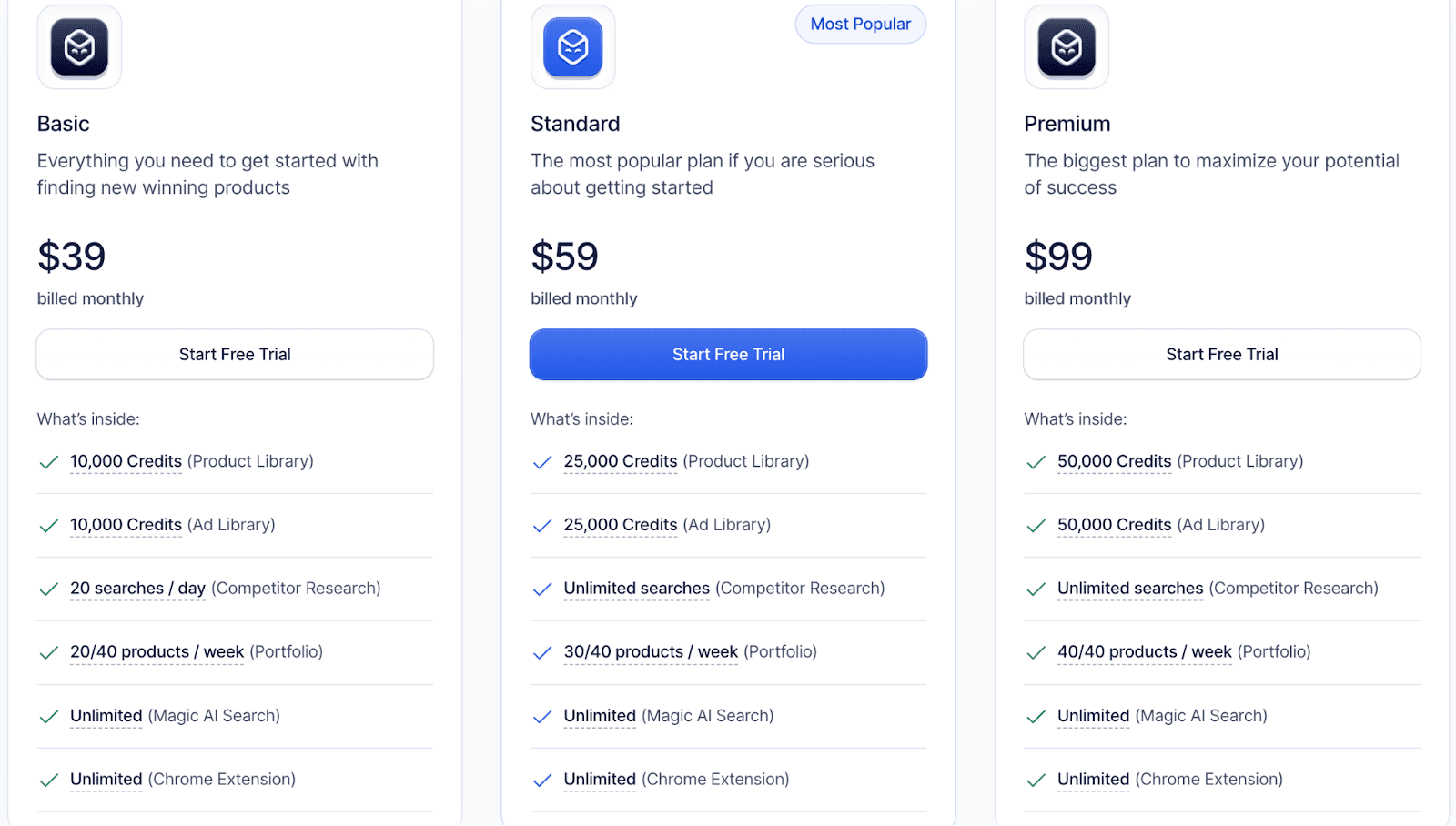
Dropship.io offers three plans: Basic, Standard, and Premium. All are billed monthly, with a lower effective rate if you choose annual billing. A 7-day free trial is available if you want to test the platform before committing.
Each plan runs on a credit system for both the Product Library and Ad Library. Basic includes 10,000 credits per library, Standard increases that to 25,000, and Premium goes up to 50,000. If you research frequently, those limits matter. Credits determine how deeply and how often you can explore product and ad data.
Search limits also shift across tiers. Basic caps competitor research searches per day, while Standard and Premium remove that restriction. Portfolio access expands as you move up, allowing you to review more curated products each week. Magic AI Search and the Chrome Extension remain available across all plans.
Basic suits for lighter usage or early-stage testing. Standard feels more practical for ongoing research without running into limits too quickly. Premium makes sense if you analyze stores and products daily at scale.
Most users consider the entry pricing reasonable. The real consideration is whether the credit allocation and data depth align with how often you plan to use the tool.
Who Should Use Dropship.io?
After testing the platform across different workflows, it became clear that Dropship.io serves a specific type of user well.
It is built around Shopify store analysis and structured dashboards. If that matches how you research products, it feels intuitive. If your strategy revolves around deep creative analysis across multiple ad platforms, it may feel limiting.
Here’s a clearer breakdown:
Good Fit If You | Not Ideal If You |
Are new to Shopify dropshipping | Rely heavily on TikTok ad creative research |
Prefer visual dashboards over complex filters | Need multi-platform coverage |
Focus on tracking stores rather than dissecting creatives | Want real-time viral trend detection |
Operate mainly within the Shopify ecosystem | Require advanced creative segmentation |
Want to keep your budget under 60 dollars per month | Depend on deep historical ad analytics |
What We'd Change
After using the platform in real research scenarios and reviewing both positive and critical feedback, we can clearly see improvement areas. These suggestions are based on patterns we observed during testing and recurring themes in user reviews.
If we were advising the product team, here is what we would suggest them to change:
Expand TikTok ad visibility beyond shop tracking so users can explore creatives more independently of store-level data
Improve database freshness to reduce repeated product surfacing and strengthen confidence in trend discovery
Broaden coverage beyond the Shopify ecosystem to support sellers operating across multiple platforms
Add deeper creative filtering inside the Ad Library, including more granular engagement thresholds and clearer performance segmentation
Improve billing transparency and subscription communication, especially around trial cancellations and refund handling, to reduce disputes and build stronger trust
The platform already has a clear structure and purpose. Addressing these areas would not change its direction. It would simply make the experience more dependable and aligned with user expectations.
Support: What to Expect
There’s mixed feedback on support. It is positive when it comes to response speed. Many users describe the team as quick to reply and helpful in resolving routine questions. Some mention receiving clear guidance without long waiting periods, which builds confidence for new users navigating the platform.
There are many frustrations as well, mostly tied to subscription cancellations or refund disputes. In those cases, the dissatisfaction seems connected more to billing outcomes than to communication delays.
One important detail to note is the support structure itself. Contact is handled through email only. There is no public phone number and no live chat option available. If you prefer instant support channels, that may feel limiting.
If you are comfortable with email-based communication, the experience appears straightforward. But, as per our opinion, there should be more ways to connect with the customer support.
The Bottom Line
Dropship.io scored 6.8/10 in our analysis.
It delivers a clean and structured research experience. The dashboard is easy to navigate, store tracking is straightforward, and product discovery does not feel overwhelming. If you are entering Shopify dropshipping and want visibility into what other stores are selling, the platform lowers the learning curve.
Where it feels limited is in depth. Creative filtering inside the Ad Library is not as advanced as dedicated ad intelligence tools. Multi-platform coverage is narrow. Revenue and performance numbers function as estimates, not verified reports. Billing clarity has also been a point of friction in some user discussions, which affects trust and credibility.
For store-focused research inside the Shopify ecosystem, it performs well. For aggressive creative testing or multi-platform ad analysis, it is not built to stand alone.
Our Recommendation: If you are new to Shopify and want an organized way to study competitors and products, Dropship.io works as a practical starting point. And if you are scaling with paid ads and rely heavily on creative level analysis, you will likely need a more advanced ad intelligence platform alongside it.
FAQs
Is Dropship.io worth it?
If you are new to Shopify dropshipping, it can be a solid starting point. The interface is easy to navigate, and the store tracking system helps you study competitors without complexity. If you already run paid ads at scale, you may outgrow its creative depth.
Is Dropship.io legit?
Yes. It is an active Shopify-focused research platform with paying users and public reviews across multiple sites. It provides working tools for product discovery and store analysis. That said, like any SaaS tool, user experiences vary, especially around billing.
Does Dropship.io have a free trial?
Yes, a 7-day free trial is generally available. This allows you to explore features before committing to a subscription. Always review the current trial terms and cancellation process on the pricing page before entering payment details.
What is the best Dropship.io alternative?
If your focus is deeper on intelligence and creative analysis, tools such as WinningHunter offer broader ad-level filtering. If you mainly want store tracking within Shopify, other Shopify-centered research platforms provide similar functionality.
Can I cancel anytime?
Subscriptions are typically billed month to month unless you choose annual billing. Cancellation is handled through your account settings. If you are on a trial, make sure you cancel before the billing date to avoid automatic charges. According to user reviews, it’s best to check your billing for any charges after the trial ends so you can cancel the subscription.


We already know what works before you even have the chance to blink!
© 2024 WinningHunter.com