shophunter-review
ShopHunter Review: Can You Trust Its Revenue Data?

What if the revenue numbers you trust are only educated guesses?
Store intelligence tools promise clarity. They show you competitor earnings, growth charts, and product performance as if the data comes straight from the source. Yet very few explain how those figures are actually calculated.
Many sellers base niche entry, product replication, and budget allocation on those very numbers.
So the real question is simple. Can you rely on ShopHunter’s revenue intelligence to make business decisions in 2026, or should you treat it as rough market noise?
In this review, we do hands-on testing across multiple niches, compare estimates with observable external signals, and evaluate features, pricing, and support quality to determine whether the subscription cost makes practical sense.
Quick Verdict
5.8/10 - A usable Shopify store research tool with fine browsing capabilities, but revenue modeling gaps and trust-related friction hold it back from being a dependable decision-making platform.
What we measured
Area | Score |
Ad Spy Features | 6/10 |
Database Accuracy | 4/10 |
Update Frequency | 6/10 |
Pricing & Value | 5.5/10 |
Ease of Use | 8.5/10 |
Support Quality | 4.5/10 |
Best for:
New dropshippers who want a simple dashboard for browsing stores and generating product ideas.
Skip if:
You rely heavily on projected revenue for scaling decisions or expect highly responsive billing support.
What We Did to Test This
Before publishing this review, our WinningHunter team tested ShopHunter as active users and documented everything we observed.
Here is exactly what we did:
Used ShopHunter across different niches to monitor revenue fluctuations and store tracking behavior
Compared its revenue estimates with publicly visible indicators and cross-tool benchmarks to evaluate directional accuracy
Analyzed user reviews from Trustpilot, Reddit, YouTube comments, and forum discussions to identify recurring patterns
Reviewed repeated complaints related to billing and cancellation experiences
Evaluated filtering systems and overall store tracking logic
What is ShopHunter?
ShopHunter is a Shopify-focused store intelligence platform built to help you analyze competitor stores, monitor product trends, and estimate sales performance from a single dashboard.
Its core promise is that you can see what other Shopify stores are selling and how much revenue they are generating.
We noticed during testing that ShopHunter does not position itself as a traditional ad spy tool. Instead, it centers its value around store-level insights. The platform leans heavily into revenue estimation models, structured product tracking, historical trend visualization, ranked store listings such as Top 100 style views, and projected sales velocity metrics.
What Real Users Say
We analyzed sentiment from Trustpilot (avg. ~1.8/5 rating), Capterra, Reddit discussions, and YouTube reviews.
What Users Love
Easy Store Comparison and Clean Interface
A small number of users mention that adding stores for comparison feels quick and uncomplicated. The copy and paste workflow allows you to move directly into analysis without extra setup, and the interface is often described as clean and easy to navigate.

That said, positive feedback is limited in volume. Across public platforms, favorable reviews appear far less frequently than critical ones, which makes the overall sentiment lean towards caution.
What Users Complain About
1. Revenue and Sales Data Accuracy
This is the most dominant concern across public discussions.
On Trustpilot and Reddit, users frequently question the reliability of the revenue estimates. Several reviewers shared personal comparisons between ShopHunter projections and their own Shopify dashboards, claiming the numbers were significantly inflated.
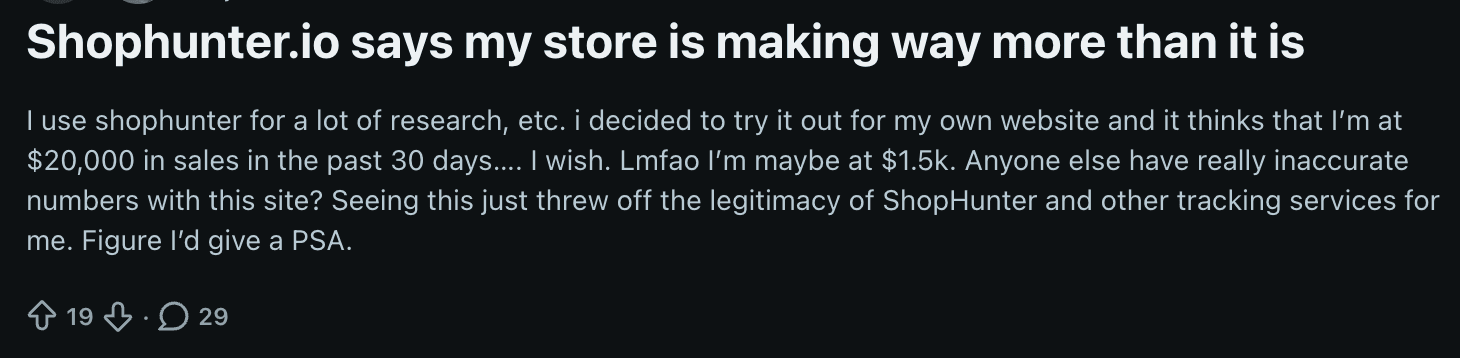
Common patterns we observed in complaints include:
Revenue figures that appeared disproportionately high compared to visible store activity
Traffic to revenue ratios that did not align logically
Sudden spikes in projected sales without corresponding ad activity or product launches
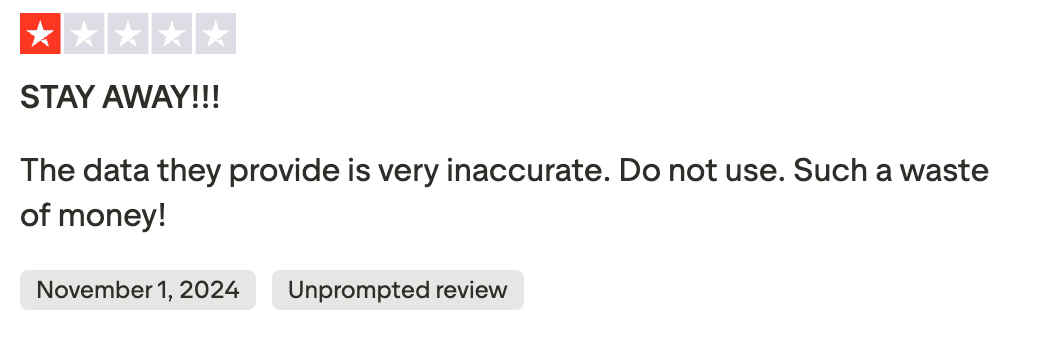
A reviewer also pointed out that no external tool can access a Shopify store’s actual backend revenue. They emphasized that every number shown is a modeled estimate, not verified sales data pulled directly from Shopify.

2. Billing & Trial Complaints
Another area that draws criticism is subscription handling.
Across reviews on Trustpilot, some users report being billed after they believed they had already canceled their trial. A few mention starting with a low entry offer and later noticing a larger deduction from their account. There are also complaints about delayed responses when contacting support regarding refunds or disputed charges.
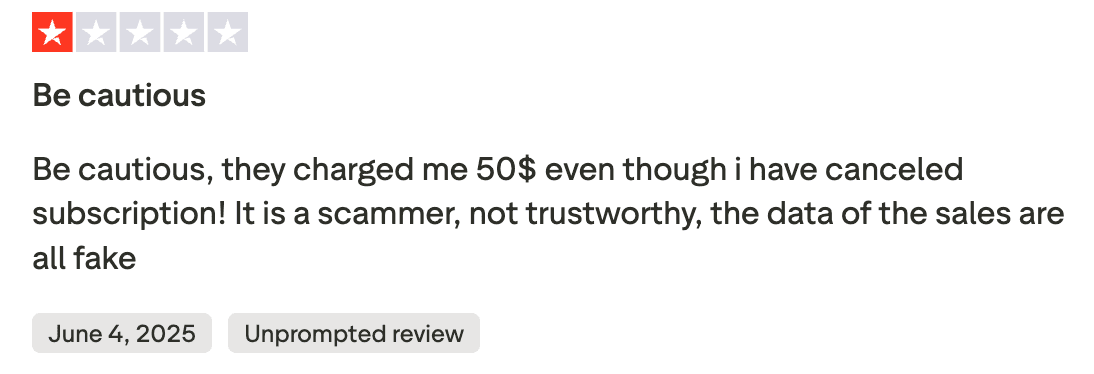
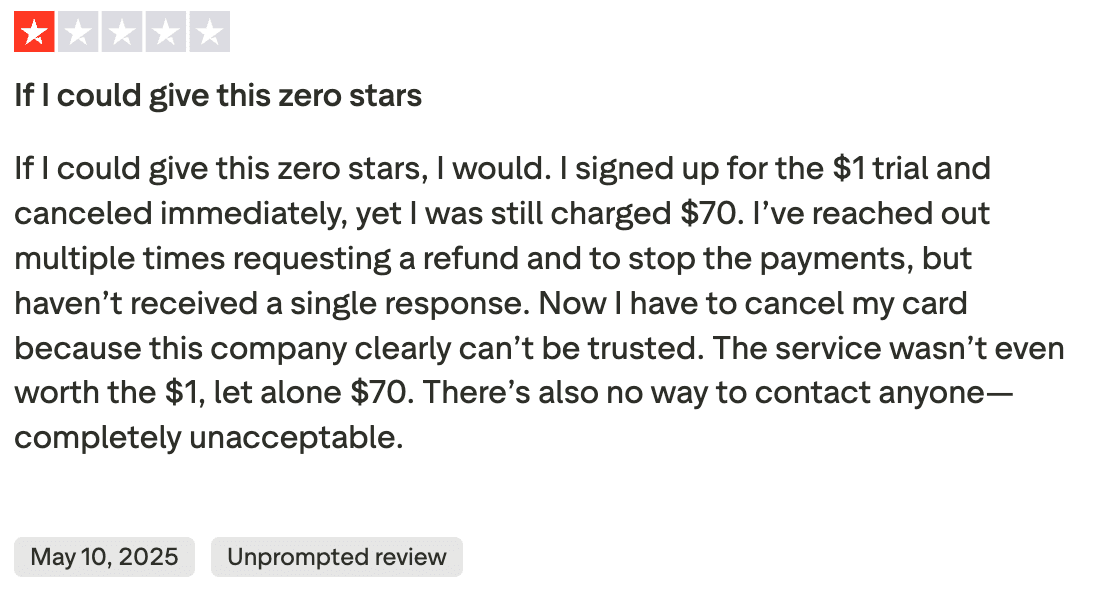
When payment experiences feel unclear or difficult to resolve, it overshadows the rest of the product experience. Even users who found certain features useful express frustration once billing becomes a point of tension.
3. Customer Support
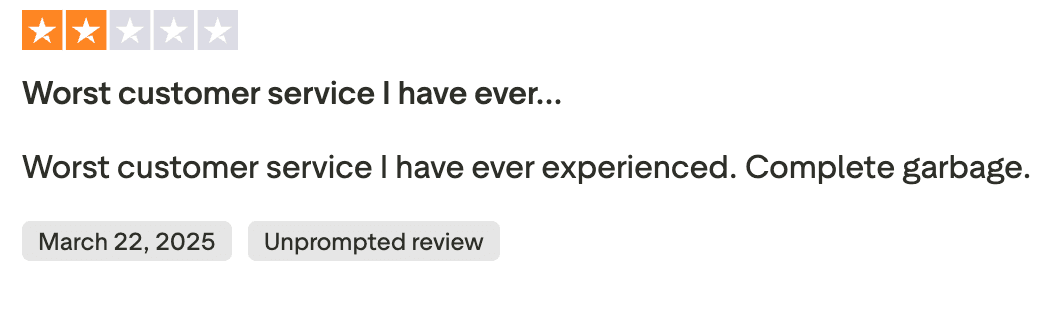
One reviewer called it the worst customer service they had ever experienced and described the interaction as complete garbage. The complaint was not about features but about feeling ignored when trying to resolve an issue.
When a subscription tool does not provide clear and timely communication, frustration builds quickly. For users already dealing with billing or data concerns, weak support becomes the final reason they decide not to continue.
Features Breakdown: What You Actually Get
1. Product and Store Research
We tested the Winning Products Finder inside ShopHunter to understand how practical the research tools feel during actual use.
The filtering system lets you sort stores and products based on estimated store revenue, product price range, niche category, visible sales growth trends, and store ranking lists such as top-performing stores. You can combine multiple filters at once, which makes narrowing down results fairly simple.
During our testing, the interface felt structured and easy to move through. Adjusting filters was quick, and the results refreshed without lag. From a usability standpoint, the workflow feels organized.
2. Competitor & Sales Tracking
We spent time testing the competitor analysis section since this is clearly positioned as the platform’s strongest feature.
Inside the dashboard, you can track individual Shopify stores and view their estimated historical performance over time. The system displays projected revenue, order volume, and average product pricing. You can also monitor top products within a store and observe how offerings change, which helps you identify possible scaling patterns.
From a usability perspective, the tracking flow feels straightforward. Once you add a store, the interface organizes performance metrics into visual charts and structured summaries. It becomes easy to scan trends and compare different stores side by side.
However, the foundation remains the same. Every revenue and sales figure is based on modeled estimates rather than verified backend data. If those projections are directionally accurate, the tracking feature becomes useful for spotting momentum. If they are inflated, the conclusions you draw about scaling patterns may not reflect reality.
3. Real-Time Data and Insights
We paid close attention to how often the data updates and whether those updates feel meaningful.
Revenue and order projections seem to refresh frequently. Historical charts adjust as new data points appear, and product-level tracking reflects changes in pricing or catalog additions without noticeable delay. From a technical aspect, the system feels active.
But frequency does not automatically equal reliability. When we compared short-term spikes in projected sales with visible activity such as product launches or promotional pushes, the correlation was not always clear. Some jumps appeared without an obvious external trigger.
So while the interface gives you the impression of live momentum, the real value still depends on how close those projections are to actual store performance.
It’s good for spotting active stores but not reliable for precise revenue forecasting.
Pricing: What It Actually Costs
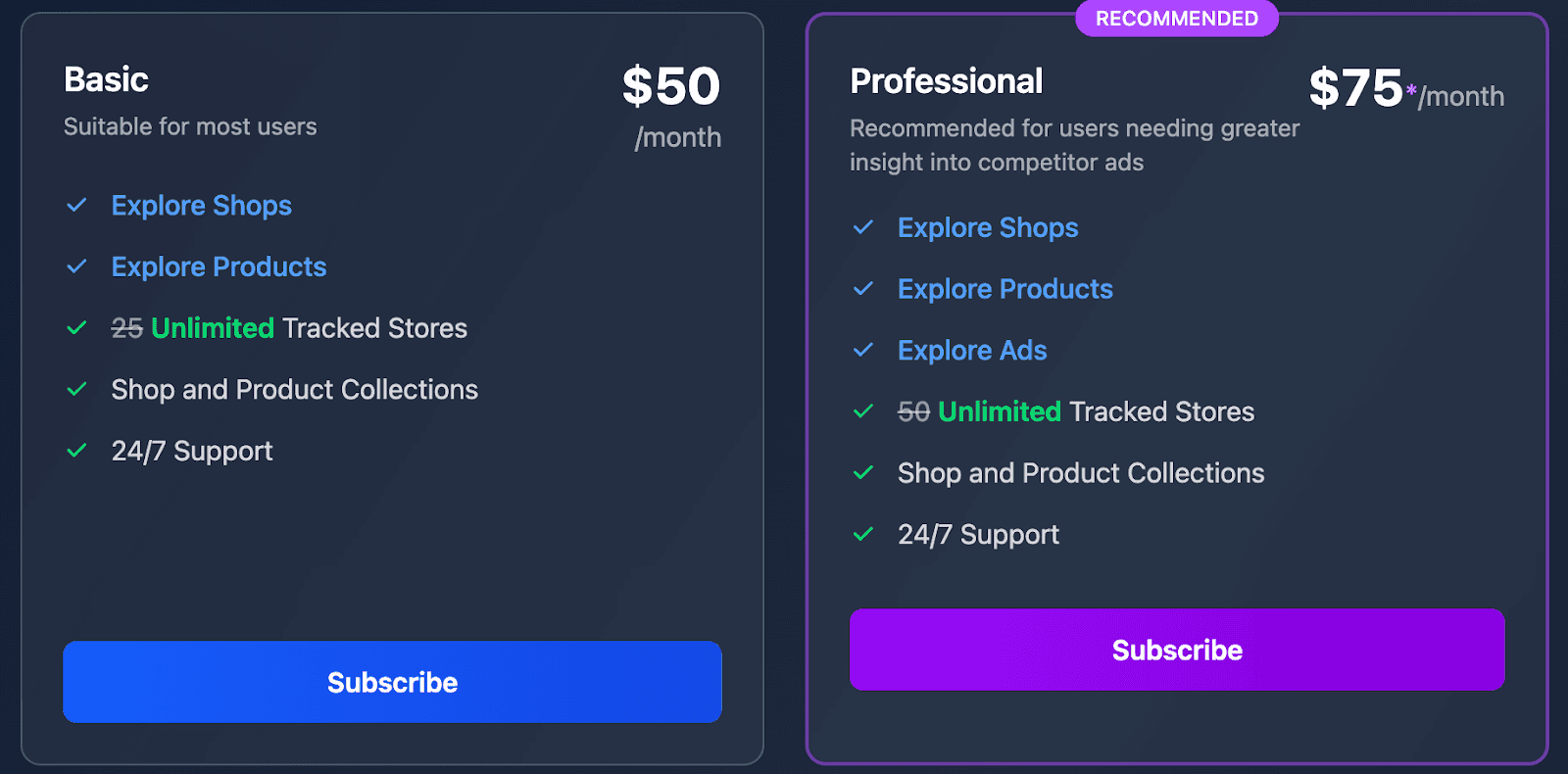
At the time of testing, ShopHunter listed two main monthly plans.
The Basic plan costs 50$ per month. It includes shop exploration, product research, unlimited tracked stores, collections, and support access.
The Professional plan costs 75$ per month and is labeled as recommended. It adds an exploration while keeping all research and tracking features included in the Basic tier.
The pricing sits in the mid-range for Shopify competitor research tools. At 50$ to 75$ per month, you are paying for revenue estimates, store tracking, product discovery, and filtering systems built around projected performance data.
Pricing can be justified if the data is reliable, which is debatable in this case.
Who Should Use ShopHunter?
After testing the platform across niches and reviewing user feedback, it is clear that ShopHunter works better as a discovery and monitoring tool than as a financial decision engine.
Here is where the tool fits and where it does not.
Good Fit For You If You | Not a Good Fit For You If You |
Are new to dropshipping and want a straightforward dashboard | Make scaling decisions based primarily on projected revenue numbers |
Prefer a clean and simple interface without complex setup | Need high-confidence financial data for investment-level decisions |
Use the tool mainly for brainstorming product or store ideas | Run campaigns focused heavily on TikTok and require deep creative-level insights |
Cross-check store data with other research tools before acting | Expect detailed ad breakdowns beyond basic store and product tracking |
Treat revenue figures as directional signals rather than verified data | Require fast and highly responsive billing support |
What We’d Change
While testing ShopHunter, we kept noting small friction points that directly affect how much you trust the platform.
Here is what we would recommend to the ShopHunter team:
Make Revenue Modeling Transparent - The dashboard shows confident revenue figures, yet it does not clearly explain how those numbers are generated. A visible explanation of inputs, assumptions, and a realistic margin of error would immediately improve credibility.
Tighten Revenue Projections - Some projected sales patterns do not reflect how most Shopify stores behave in real conditions. Refining the modeling logic to better mirror realistic order flow would make filtering and store comparison more dependable.
Clarify Trial and Renewal Terms - Subscription terms should be impossible to misunderstand. Clear renewal timelines and billing reminders would reduce disputes and negative reviews.
Upgrade Support Responsiveness - Faster replies and a more structured support system would prevent minor issues from escalating. Reliable communication is critical for any recurring subscription tool.
Support: What to Expect
Support feedback is mixed, but the negative side is more visible.
Some users say they were able to get started without confusion and did not face issues during onboarding. Basic usage questions do not appear to be a major problem.
Most complaints were around billing disputes. Reviews describe slow replies, no clear follow-up, or difficulty getting refunds after trial cancellations. When payment is involved, response delays create frustration quickly.
Right now, support is one of the weaker parts of the platform, largely because of how billing issues are handled.
The Bottom Line
ShopHunter scored 5.8/10 in our analysis.
It makes competitor browsing simple. You can explore stores, scan products, and move through the dashboard without feeling lost. For beginners, ease of use matters.
The concern lies with the revenue numbers. Since those projections drive filtering and store comparisons, doubts around accuracy affect how confidently you can act on the data. Support delays and billing complaints add another layer to that hesitation.
Our recommendation: Use ShopHunter to spot stores, observe trends, and gather ideas. Do not treat the revenue figures as confirmed financial data. When you validate findings through other sources, the tool becomes more useful. On its own, it should not be the basis for high-risk scaling decisions.
FAQs
Is ShopHunter worth it?
ShopHunter can help you discover stores and gather product ideas quickly. Where users hesitate is in revenue accuracy. If you use it for browsing and early research, it can be useful. If you expect dependable financial projections, feedback suggests caution.
Is ShopHunter legit?
Yes, it is a real subscription product used by e-commerce sellers. The debate is not about legitimacy. It revolves around how revenue estimates are calculated and how billing experiences are handled.
Does ShopHunter have a free trial?
At the time of writing, it offers a 3-day trial for 1$. Trial structures can change, so always read the current terms carefully and review cancellation instructions before entering payment details.
What is the best ShopHunter alternative?
If you care more about ad validation than store-level revenue projections, tools like WinningHunter focus more heavily on creative tracking and ad-level insights.
Can I cancel ShopHunter anytime?
Plans are subscription-based. You can cancel, but review the renewal timing and billing terms in advance. It’s better to know about the cancellation window, which helps you avoid unexpected charges.


We already know what works before you even have the chance to blink!
© 2024 WinningHunter.com