how-to-test-products-for-dropshipping
How to Test Products for Dropshipping in 2026
By
Kinnari Ashar
Everybody wants a winning product until it is time to test one.
That is usually when the chaos starts. Ten tabs open. Five “viral” TikTok products saved. Somebody on YouTube calling a garlic chopper a million-dollar opportunity for the fourth year in a row.
Meanwhile, your ad spend quietly disappears on products people were never going to buy in the first place.
Good dropshippers are not psychic. They just know how to spot weak signals early, test faster than everyone else, and avoid getting emotionally attached to products with zero real demand.
In this guide, you will learn how to test dropshipping products in 2026 using smarter validation methods, better creatives, cleaner data, and clear decision-making before a bad product drains your budget.
What Does Product Testing Mean in Dropshipping?
Product testing in dropshipping means validating whether a product can generate profitable sales before scaling budgets aggressively. The goal is not to “hope a product works.” The goal is to collect enough performance data to decide whether the product deserves more investment.
Testing includes much more than launching ads. You are evaluating the product itself, the creative, the audience response, the offer, the landing page experience, and even supplier reliability. Paid ads, organic content, customer behavior, and competitor analysis all help reveal whether real demand exists.
Many beginners treat testing like a guessing game focused entirely on finding “winning products.” Strong dropshippers focus on building repeatable testing systems that help them identify opportunities faster and cut weak products quickly before they damage cash flow.
Even strong products can fail because of weak creatives, poor positioning, bad hooks, low trust offers, or slow shipping. That is why product testing is really about validating the entire buying experience, not just the product alone.
Step-by-Step Product Testing Framework for Dropshipping
Step 1: Validate Demand Before Spending Money
Use Ad Libraries to Detect Active Products
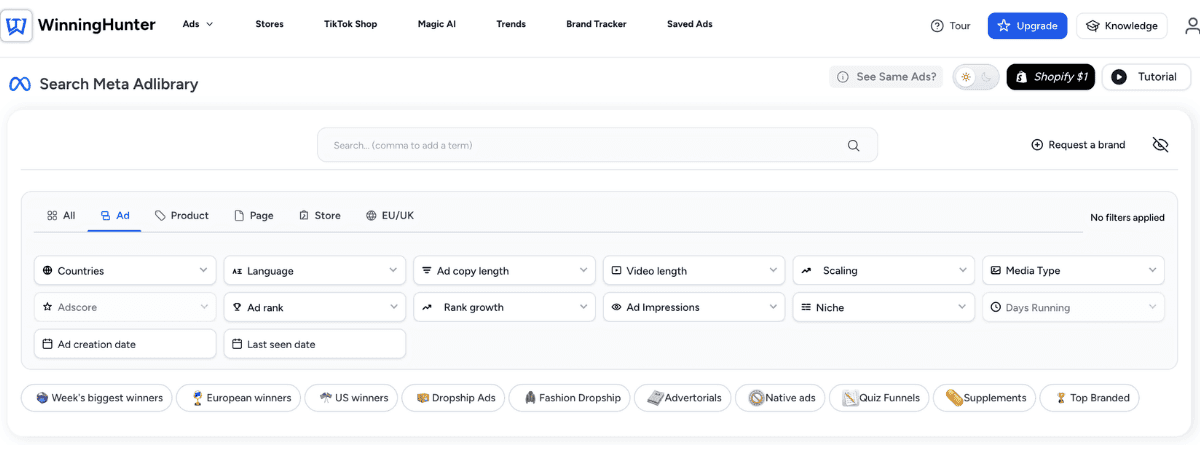
Before testing a product yourself, check whether advertisers are already spending money on similar offers. Active ads often signal existing market demand because brands rarely keep funding products that consistently lose money.
Tools like the Meta Ad Library and TikTok Creative Center help you analyze products currently running across paid traffic channels.
Pay close attention to signals like:
High engagement on ads
Multiple creative variations for the same product
Campaigns running for long periods
Several stores are promoting similar offers
Long-running campaigns usually indicate that the advertiser is seeing profitable results. If brands continue refreshing creatives around the same product, there is a strong chance the product still converts.
Analyze Market Demand Outside Social Platforms

Social platforms can create hype very quickly, but hype alone does not confirm long-term demand. You need to check whether people are actively searching for, buying, discussing, and reviewing the product outside short-form content feeds.
Start with platforms like Amazon Best Sellers, Etsy Trends, Google Trends, Reddit discussions, and TikTok search results. These sources help you understand whether interest exists across multiple channels instead of one temporary viral moment.
Customer reviews are especially valuable because they reveal what people actually care about after purchasing. Pay attention to frustrations, desired features, emotional buying triggers, and repeat complaints. Those patterns often become your strongest creative angles later.
Reddit discussions can be even more useful because people speak honestly there. E-commerce blogs usually present polished success stories, while Reddit threads expose real customer opinions, buying frustrations, skepticism, and unmet demand.
Many advertisers now use AI tools to summarize customer reviews, extract recurring pain points, and identify stronger creative angles faster during product validation.
Validate Trend Longevity
Some products spike because of temporary social media hype, while others keep selling because they solve everyday problems people constantly deal with. Evergreen categories usually scale more sustainably since demand stays consistent longer.
You should also watch for seasonal buying windows. Travel products may surge before vacations, while certain home items perform better during colder months.
Common evergreen examples include:
Posture correctors
Pet hair removers
Kitchen organizers
Travel accessories
Step 2: Score the Product Before Testing
A product can look promising on social media and still fail once real numbers enter the picture. Before spending money on campaigns, you should evaluate whether the product actually makes sense from a business standpoint.
Evaluate Product Margins
Healthy margins give you room to survive rising advertising costs, creative testing, refunds, and inconsistent conversion rates. Thin margins leave almost no space for mistakes, especially when CPMs increase or conversion rates drop unexpectedly.
Your calculations should include:
Product cost
Shipping expenses
Payment processing fees
Refund risk
Ad spend
Low ticket products often struggle because the margin disappears too quickly once traffic costs rise. Even impulse buy items need enough contribution margin to absorb testing costs and still remain profitable after fulfillment.
Evaluate Creative Potential
Some products naturally perform better in ads because they create an immediate visual reaction. If the benefit becomes obvious within seconds, the product usually has stronger testing potential across TikTok and Meta.
Products with strong creative potential often include:
Clear transformations
Emotional reactions
Visual “wow” moments
Problem-solving demonstrations
Boring products are not impossible to sell, but they usually require stronger branding, better copy, and more expensive advertising to hold attention.
Evaluate Shipping Simplicity
Shipping problems can destroy a profitable campaign very quickly. Fragile items, oversized packages, or products with inconsistent fulfillment increase operational risk and customer complaints.
Common problems are:
Damaged shipments
Long delivery windows
Customs delays
Refund spikes
Reliable fulfillment is part of product testing from the beginning. A product that converts well but creates constant delivery issues becomes difficult to scale sustainably.
Product Factor | Importance Level | What to Evaluate |
Profit Margin | Extremely High | Ability to stay profitable as ad costs rise |
Creative Potential | Extremely High | Visual storytelling and scroll-stopping potential |
Problem-Solving Ability | High | Clear pain point and emotional buying trigger |
Shipping Simplicity | High | Product size, fragility, and delivery speed |
Supplier Reliability | High | Consistency, communication, and order accuracy |
Trend Longevity | Medium | Evergreen demand versus short trend cycles |
Upsell Potential | Medium | Bundles, accessories, and higher AOV opportunities |
Saturation Level | Medium | Competition pressure and market crowding |
Step 3: Build Product Creatives Before Running Ads
A product can completely change performance depending on the creative angle behind it. One version gets ignored instantly, while another pulls strong engagement from the exact same audience.
Before launching campaigns, prepare several concepts around different buyer motivations and emotional triggers. Testing only one angle gives very little insight into the actual market response.
Creative directions worth testing:
Problem and solution demonstrations
Gift-focused messaging
Before and after transformations
UGC style testimonials
Side-by-side comparisons
The quality of your creatives heavily influences:
CTR
CPC
Watch time
Engagement
Conversion rates
Bad presentation destroys promising campaigns every day. Many advertisers blame the item too quickly when the real issue is weak hooks, poor pacing, or unconvincing visuals.
Types of Creatives to Test:
Creative Type | Purpose |
Problem and Solution | Shows the frustration first, then positions the item as the fix |
UGC Testimonial | Builds trust through authentic customer style content |
Product Demo | Explains how the item works through visuals |
Before and After | Creates interest through visible transformation |
Gift Angle | Triggers emotional buying behavior |
Comparison Creative | Separates the item from competing alternatives |
Reaction Style | Pulls attention through curiosity and emotional response |
How Many Creatives Should You Test?
Experienced advertisers rarely depend on one video and a single hook. Most campaigns begin with several variations, so weak angles can be removed quickly while stronger concepts receive more attention.
A normal testing cycle may involve:
3 to 10 hooks
Different ad copies
Multiple thumbnails
Several CTAs
This matters because creative velocity directly affects how long campaigns stay competitive. The faster you produce and test fresh concepts, the easier it becomes to adapt when engagement drops or audiences stop responding.
TikTok especially rewards constant iteration. Fresh content tends to hold attention better, while creative fatigue appears much faster than it did in older Facebook-focused environments. A winning video can slow down within days once viewers repeatedly see the same format.
You can also shorten the research process by studying what already performs well in the market. With WinningHunter, you can analyze competitor creatives, monitor ad engagement, study scaling patterns, and identify messaging angles brands continue pushing across TikTok and Facebook.
Step 4: Test Products Organically Before Paid Ads
Many dropshippers now validate items organically before touching paid traffic. A few TikTok posts can reveal audience interest faster than spending money blindly on ads.
The process is simple. Post several videos around the same item, test different hooks, study audience behavior, then turn the best performers into ads. This lowers testing costs, reduces creative risk, and helps you discover stronger angles before scaling budgets.
While reviewing performance, pay attention to:
Watch time
Completion rate
Saves
Shares
Comments
Profile clicks
Comments usually reveal buying intent very quickly. Reactions like “Where can I buy this?”, “I need this” or “Link?” matters far more than passive likes because they show direct purchase curiosity.
Research across TikTok analytics platforms also shows that watch behavior, completion rates, shares, and engagement quality heavily influence content distribution and visibility.
A lot of beginners fail organic testing because they post one video, get weak traction, and then quit immediately. Others copy exhausted hooks everybody has already seen or upload videos with slow intros that lose attention within seconds.
Step 5: Run Paid Product Tests
Meta Ads Testing Structure
Most beginners start with simple Meta setups using broad targeting, interest targeting, ABO campaigns, or small validation campaigns designed to collect early data without risking large budgets.
Testing budgets usually sit between $20 and $100 per day, depending on your target CPA and margins. Smaller budgets can still work, but extremely low spending slows down data collection and makes evaluation harder.
Patience matters during this stage. Most campaigns need at least 48 to 72 hours before performance patterns become reliable. Early fluctuations are normal during Meta’s learning phase, especially while the algorithm adjusts delivery and audience matching.
Important Metrics to Monitor
These metrics help you understand whether the issue comes from the creative, audience, offer, or the product itself.
Attribution data across Meta and TikTok is never perfectly accurate, which is why experienced advertisers evaluate overall performance trends instead of relying on one isolated metric.
KPI | Why It Matters |
CTR | Reveals how well the creative grabs attention |
CPC | Shows how strongly the audience responds |
CPM | Reflects auction competition and traffic costs |
Add to Cart Rate | Indicates buying interest |
Conversion Rate | Measures how well the store and offer convert visitors |
CPA | Determines whether the campaign stays profitable |
ROAS | Helps evaluate scaling potential |
Common Testing Benchmarks
Benchmarks help you evaluate early performance, but they should never be treated as fixed rules. Results vary heavily depending on niche, pricing, audience quality, creatives, and traffic competition.
Metric | Common Benchmark |
CTR | 1.4% to 2%+ |
Testing Window | 48 to 72 hours |
Testing Budget | 3 to 5 times target CPA |
Add to Cart Rate | 5% to 10%+ |
Statistical Confidence | Around 95% target |
Meta advertising data also shows that CTR, conversion rates, and CPCs fluctuate significantly across industries and campaign types, which is why context matters more than blindly following averages.
Step 6: Decide Whether to Kill, Iterate, or Scale
Signs a Product Should Be Killed
Some campaigns fail quickly and continue showing weak signals even after enough spending and testing time. Poor CTR, expensive clicks, weak retention, negative comments, or zero add to carts usually point toward low market interest or ineffective positioning.
Extremely high CPMs without meaningful engagement can also make scaling unrealistic because traffic costs rise faster than buyer intent.
Signs the Product May Need Iteration
Not every weak campaign deserves to be abandoned immediately. Sometimes the item attracts attention but loses momentum later in the buying journey.
Good CTR with weak conversions may point toward pricing, landing page, or trust issues. Strong engagement with low purchases can signal mismatched targeting. High add to cart activity followed by checkout abandonment usually exposes concerns around shipping, delivery time, or the offer itself.
Signs the Product Is Ready to Scale
Some campaigns become much easier to identify once performance stabilizes across multiple days. Consistent conversions, stable CPA, and several profitable creatives usually indicate stronger long-term potential.
Strong revenue numbers can still collapse during scaling if advertising costs, fees, and shipping expenses start eating too much of the profit.
How Long Should You Test a Dropshipping Product?
Ending a campaign after one weak attempt usually creates worse decisions than bad products do. Early results can get distorted by poor hooks, weak editing, unclear offers, or product pages that fail to build trust.
Extra testing makes sense when certain signals still look healthy:
Strong CTR
Good watch time
Positive engagement
Active comments
Weak landing page performance despite strong ad response
Those patterns suggest people are interested, but something later in the funnel is breaking the momentum.
Meta campaigns also fluctuate during the learning phase before performance settles.
Some items never generate meaningful traction regardless of the angle. If several creative variations fail to produce clicks, engagement, add to carts, or buying intent, continuing the test usually wastes more money than it saves.
Common Product Testing Mistakes That Waste Money
1. Testing Oversaturated Products Too Late
Some products are already dying by the time beginners discover them. TikTok compilation pages accelerate saturation extremely fast because thousands of people copy the same “viral” item within days.
Trend-based products depend heavily on timing. Early sellers usually benefit from lower competition, cheaper traffic, and fresher audience attention. Once the product spreads across repost pages, ad libraries, and creator accounts repeatedly, engagement quality starts dropping while CPMs rise.
Experienced testers monitor platforms like TikTok Ad Library and competitor ad trackers constantly to spot momentum before products become mainstream. Watching ad frequency, creative duplication, and scaling behavior helps reveal whether an item still has room left or if the market has already moved on.
2. Choosing Products With Weak Margins
Low-margin products collapse quickly once CPMs rise and extra costs start stacking up through refunds, shipping, and payment processing fees. Even strong sales volume may not protect profitability. Products with higher perceived value usually survive longer because they leave more room for advertising and operational costs.
3. Ignoring Supplier Quality
A weak supplier can destroy a profitable campaign very quickly. Delayed orders, inconsistent quality, damaged shipments, and refund issues usually get worse once order volume increases.
Scaling only works when delivery consistency keeps up with customer expectations. Persistent shipping and product quality problems also increase refund requests, negative reviews, and chargebacks.
4. Treating Product Testing Like Gambling
Random product launches usually burn budgets because there is no structure behind the decisions. Experienced sellers rely on:
Data collection
Repeatable workflows
Creative iteration
Structured testing systems
Many successful dropshippers also stay focused within specific niches instead of jumping between random categories daily. Familiarity with the audience usually leads to better creatives, faster decision-making, and cleaner testing data.
Better Testing Creates Better Stores
Product testing in 2026 has very little to do with luck. The stores growing consistently are built on structured decision making, faster iteration, stronger creatives, and cleaner validation systems.
Winning products still matter, but the real advantage comes from how quickly you can evaluate opportunities, identify weak signals, improve angles, and move before trends become overcrowded. Strong margins, reliable suppliers, and disciplined testing now matter more than chasing random viral products.
If you want to research products faster and validate ideas with real market data, WinningHunter gives you access to competitor ads, engagement signals, spend patterns, store tracking, and creative insights across TikTok and Facebook. You can study what brands are scaling right now, monitor trend momentum, and find stronger testing opportunities before saturation catches up.
FAQs
How much money should you spend testing a dropshipping product?
Testing budgets depend on your niche, pricing, and target CPA. Many dropshippers spend around 3 to 5 times their target acquisition cost before deciding whether a campaign deserves more budget. Ending tests too early usually creates misleading conclusions because the platform has not gathered enough performance data yet.
How many products should you test before finding a winner?
There is no universal number because results depend heavily on research quality, creatives, positioning, and timing. Some stores find traction quickly, while others test dozens of products first. Consistent testing systems and better decision-making usually matter far more than aggressively launching random items every day.
Is TikTok or Facebook better for product testing?
TikTok works well for viral reach, organic validation, and discovering strong hooks quickly. Meta performs better for stable scaling, stronger purchase intent, and long-term optimization. Many dropshippers validate products through TikTok first, then move successful campaigns into Meta once conversion data becomes more reliable and consistent.
Should you order product samples before testing?
Product samples improve content quality, supplier validation, and customer experience research. Filming your own UGC usually creates stronger ads than using recycled clips from suppliers. Some sellers still validate demand organically before ordering samples, especially during early testing stages when they want to reduce upfront costs.
What metrics indicate a winning dropshipping product?
Winning products usually show stable CPA, healthy CTR, profitable ROAS, strong add to cart activity, positive customer feedback, and several creatives performing consistently across multiple days. Reliable performance matters more than one temporary spike because sustainable campaigns depend on repeatable buying behavior and scalable economics.


We already know what works before you even have the chance to blink!
© 2024 WinningHunter.com