tiktok-product-research-tool
TikTok Product Research Tool: How to Find Winning Products With WinningHunter
By
Kinnari Ashar

TikTok can make a product famous before breakfast. Sales are another story.
A video may pull in millions of views while the product behind it barely moves. To see the difference, you need more than likes, comments, and a crowded For You feed. You need to know which ads are running, which stores are gaining traction, and whether buyers are actually spending.
Checking all of that manually can turn product research into hours of tab-switching and half-answers. WinningHunter brings those signals together through TikTok ad discovery, competitor research, store tracking, and estimated sales and ad spend data.
In this guide, you will learn how to use those features to spot promising products before the hype disappears.
What Is a TikTok Product Research Tool?
A TikTok product research tool is software that helps e-commerce sellers discover and assess products attracting attention across TikTok.
Depending on the platform, you may be able to review:
Active TikTok ads
Trending or fast-growing products
Advertisers and competing stores
Views, likes, comments, and other engagement signals
Estimated sales or revenue
Product creatives and promotional angles
Similar items sold by competitors
Dropshippers, Shopify sellers, agencies, affiliates, and ecommerce brands use these insights to compare opportunities before spending money on advertising or inventory.
Some platforms concentrate mainly on TikTok Shop sales and creator activity. WinningHunter covers that area while also connecting TikTok advertising data with Shopify stores, competitor activity, product discovery, and estimated business performance.
How WinningHunter Helps With TikTok Product Research
1. Find Products Through TikTok Ads
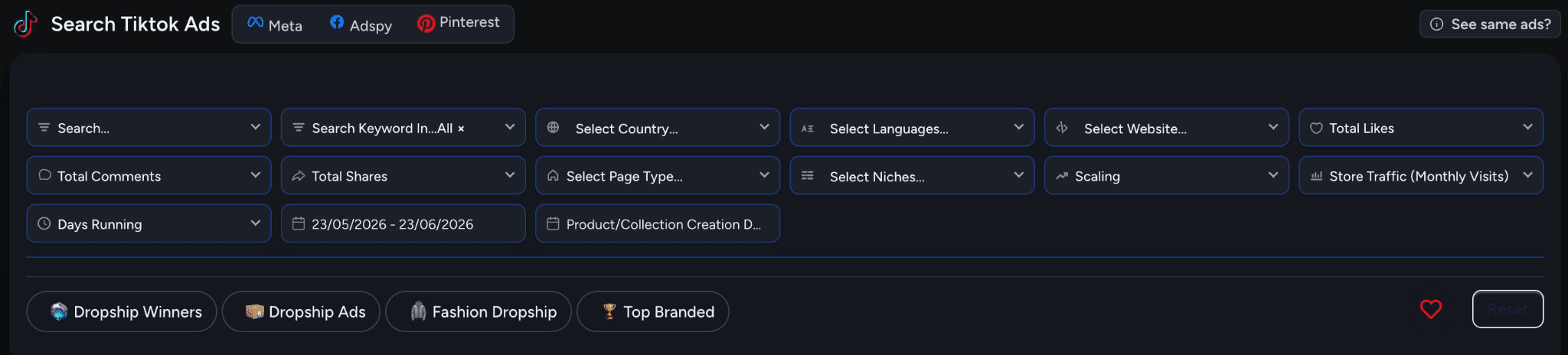
A viral creative can flatter a weak product. WinningHunter helps you look past the applause by showing which TikTok ads have attracted sustained advertiser investment.
Search by product, problem, advertiser, or ad copy, then compare signals such as estimated spend, reach, days running, store traffic, and Adscore. A posture product with modest engagement but steady spend and a long runtime may deserve more attention than one viral video that disappeared after two days.
Open the connected product page and store to see what the seller is charging, how the offer is framed, and whether similar products appear elsewhere.
The aim is to find products advertisers keep funding, not clips people watched once and forgot. That distinction produces a far stronger shortlist for deeper sales and competitor research.
2. Check Product Sales and Revenue Estimates
Heavy advertising proves that a seller is spending. It does not prove the product is paying them back.
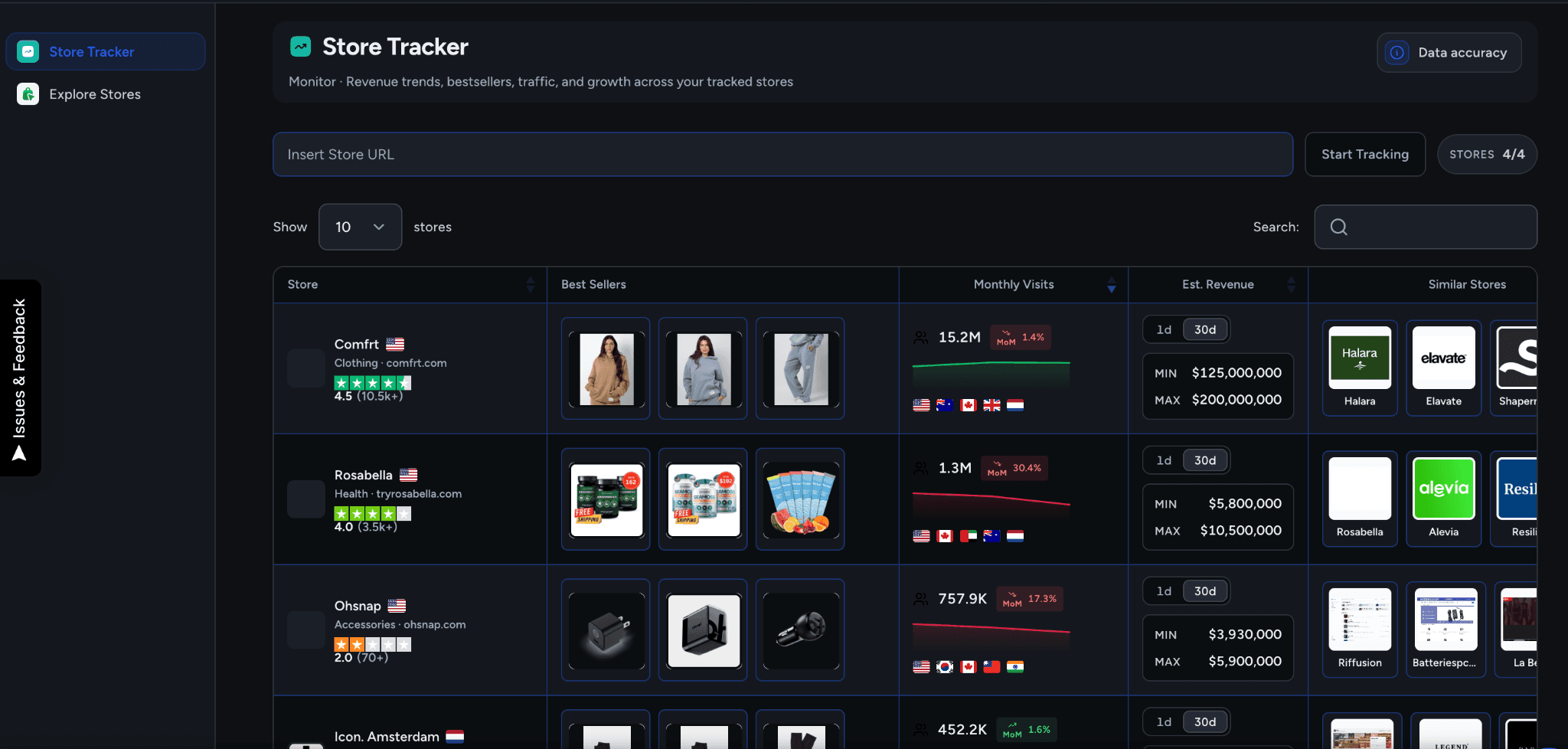
Our Sales Tracker adds the missing commercial clue. You can review a store’s estimated revenue, sales activity, traffic, and best-selling products, then compare those results with product-level ad spend where that data is available.
That comparison helps you spot the difference between a heavily promoted experiment and a product that appears central to the store’s revenue. When one item keeps appearing among the best sellers while receiving sustained ad investment, it deserves closer attention.
Treat every figure as a directional signal, not a private bank statement. Revenue and sales estimates work best for comparing products, watching movement, and identifying patterns alongside active ads, store traffic, pricing, and offer quality.
3. Analyse the Store Selling the Product
The ad earns the click. The store decides whether that click becomes an order.
WinningHunter lets you move from an ad to the associated e-commerce store, where you can inspect how the seller has built the offer.
Look beyond the headline product and check:
Price and discount structure
Quantity bundles and upsells
Reviews and product page quality
Shipping time and delivery claims
Refund terms or guarantees
Related products across the catalogue
These details reveal the seller’s commercial strategy. A low entry price may lead into a larger bundle, while complementary products can raise the value of each order.
Weak points matter too. Thin reviews, unclear delivery information, generic copy, or a confusing offer may leave room for you to compete more effectively.
Research the structure, then build your own advantage. Copying the store gives customers no reason to choose yours.
4. Find Competitors With Magic AI Search
One competitor proves little. Ten nearly identical stores tell a different story.
Magic AI lets you search with a keyword or product image to uncover sellers promoting the same or visually similar items.
Compare their:
Prices and bundles
Product images and video concepts
Customer groups and messaging
Shipping claims and guarantees
Discounts and offer structure
The results help you judge whether sellers are genuinely differentiating the product or recycling the same page, creative, and audience angle.
Competition alone should not end your research. Several active sellers may confirm demand. The real warning appears when every offer looks interchangeable and leaves little room for price or positioning.
Look for an opening you can defend, such as a clearer use case, a neglected audience, a stronger bundle, or a more credible buying experience.
5. Review Ads Across Other Platforms
TikTok may introduce the product, but Meta and Pinterest can reveal whether sellers have found reasons to keep promoting it.
Search for the same item across WinningHunter’s supported ad sources and study what changes. An older Meta campaign may use a detailed demonstration, while a Pinterest ad presents the product as a lifestyle purchase. You may also uncover sellers targeting parents, travellers, pet owners, or another audience absent from the original TikTok creative.
Pay attention to:
How far back the campaigns go
Which benefits appear repeatedly
Whether fresh advertisers are entering
How offers change between platforms
Whether the same creative is being recycled everywhere
Repeated promotion across several channels can support wider demand, but it can also expose a crowded market. The useful question is whether advertisers are still finding new angles or merely copying one another.
6. Track Stores and Brands
A strong store today may look very different two weeks later. WinningHunter lets you save selected stores and follow their estimated revenue, traffic, best-selling products, and growth from one place.
Check the tracked store regularly to see whether it launches new products, runs fresh ads, changes prices, introduces bundles, or promotes a different bestseller.
This makes product research less dependent on a single busy day. If estimated revenue keeps rising and the same product remains prominent, interest may still be growing. Falling sales estimates, fewer active ads, or a change in the store’s leading products can suggest that demand is weakening.
Use the tracker to follow directions and patterns. WinningHunter states that its sales data provides an estimate rather than an exact financial record.
How to Find Products With WinningHunter
Step 1: Choose Your Target Market
Decide who you want to sell to before opening the TikTok Ads dashboard. Set the country, customer type, niche, product category, and acceptable selling price so your search reflects the store you are actually building.
Then remove products that create avoidable fulfilment problems.
Check:
Product size and weight
Likely shipping cost
Fragility and packaging needs
Expected delivery time
Safety or compliance requirements
Whether the selling price leaves room for advertising and returns
A bulky kitchen item may attract strong engagement but become unprofitable once shipping is added. A cosmetic or electronic product may require extra checks before you can advertise or sell it in your chosen country.
This preparation keeps your shortlist relevant. You will spend less time analysing attractive products that do not suit your audience, budget, or fulfilment setup.
Step 2: Search TikTok Product Ads
Open the TikTok Ads section and search from several angles. Use the product name first, then try niche terms, customer problems, and desired outcomes. A desk accessory, for example, may also appear under “neck pain,” “work posture,” or “comfortable home office.”
Narrow the results by country, ad date, engagement, ad spend, days running, or store traffic. Keep the first search broad, since stacking too many filters can remove useful campaigns.
Save several relevant ads rather than picking the one with the biggest view count. A stronger clue appears when the same product surfaces through different advertisers, creatives, or selling angles.
Repeated activity suggests that sellers are still testing or funding the item. It earns a place on your shortlist, but the store and sales checks come next.
Step 3: Check Whether the Campaign Still Has Momentum
Now check the dates behind each saved ad.
The creation date tells you when the campaign began. The last seen date tells you when WinningHunter most recently detected it. Read them together. An older ad seen recently carries more weight than an older ad that vanished soon after launch.
Next, check whether the seller has released fresh versions, expanded into other countries, or continued promoting related creatives. These changes suggest the campaign is still being developed rather than left untouched.
Do not treat longevity as proof of profit. It simply tells you that the advertiser has kept the campaign alive. Use that clue to decide which products deserve closer sales and store analysis.
Step 4: Study the Product Creative
Play the ad once without pausing. Could you explain the product afterwards?
A workable creative usually answers three questions quickly: What is it? Who needs it? Why should they care? Then watch again and note the hook, demonstration, proof, benefit, and call to action.
Now count the possible stories around the product. A portable blender could be sold through convenience, fitness, travel, meal preparation, or easy cleaning. That gives you several concepts to test instead of one recycled video.
Be cautious when the entire appeal depends on a single reveal or visual trick. Once competitors repeat it across the feed, the product may struggle to hold attention.
WinningHunter helps you collect the existing creatives. Your task is to decide whether the product has enough ideas left to advertise convincingly.
Step 5: Open the Store and Review the Offer
Follow the ad to its landing page and check whether the promise survives the click.
Compare the creative with the product page. The price, main benefit, product details, and delivery terms should support what the video claimed. A dramatic ad followed by vague copy or missing information can quickly weaken trust.
Work out how the seller wants customers to view the item. Is it presented as an inexpensive impulse purchase, an everyday solution, a premium product, or a gift? That positioning should make sense across the page.
Review the offer carefully:
Price, discounts, and quantity bundles
Reviews and supporting proof
Shipping times and return terms
Guarantees and payment options
Upsells or related products
Watch for unclear policies, exaggerated claims, poor images, weak reviews, or surprise costs. These problems may explain why an engaging ad still struggles to convert.
Step 6: Review Estimated Product Performance
Now compare what the advertiser spends with what the store appears to sell.
Use WinningHunter to review estimated revenue, product sales, bestselling items, and advertising spend. Check several days rather than reading one result in isolation. A sudden jump may come from a promotion, tracking fluctuation, or an unusually busy sales period.
Look for a clear direction:
Rising figures may suggest growing demand
Stable results can indicate consistent sales
Falling estimates may point to declining interest
Strong ad spend with weak product sales deserves caution
Also, check whether the advertised item remains among the store’s leading products. If another product generates a larger share of estimated sales, the ad you found may be a test rather than the seller’s main revenue source.
Use these figures for comparison and trend analysis. They are estimates, not verified store accounts.
Step 7: Research Competing Stores
Upload the product image to Magic AI Search or enter a relevant keyword. Open several matching stores and compare the complete offer, including price, bundles, page quality, shipping claims, audience, and advertising angle.
Supplier media deserves special attention. When every seller uses the same photos, videos, copy, and discount, customers have little reason to prefer one store. That sameness also makes price competition more likely.
Your research should uncover a specific improvement before you test the product. It might be:
Original demonstrations
A bundle built for one use case
Clearer delivery information
Better product education
Positioning for an overlooked customer group
Several competitors can confirm that a market exists. Proceed only when you can explain how your offer will look and feel meaningfully different.
Step 8: Confirm Demand Outside TikTok
Before testing the product, look for evidence beyond the TikTok feed.
Use Google Trends to check whether search interest is sustained, seasonal, or driven by a brief spike. TikTok Creative Center and Facebook ads can reveal additional campaigns, while Pinterest may show whether the product appeals to visual planning or lifestyle audiences.
Amazon reviews and Reddit discussions serve a different purpose. Read them to uncover repeated complaints, desired features, buying objections, and the words customers use to describe the problem.
Supplier order counts may add context, but treat them cautiously. Large totals can include old purchases and do not reveal current demand, refunds, or advertising costs.
No single source settles the decision. Stronger candidates leave several footprints: ongoing search interest, active advertising, genuine customer discussion, and recent marketplace activity. Products visible only through one TikTok trend carry a greater risk of fading before your test gains traction.
Step 9: Estimate Profit Before Testing
A product can sell well and still leave very little money behind. Before funding a test, calculate what remains from each expected order:
Selling price
- product cost
- shipping and packaging
- payment and platform fees
- expected returns and refunds
- the target advertising cost
= estimated profit
Use average order value rather than the price of one unit when bundles or upsells form part of the offer. A $30 product may produce a $45 average order when buyers commonly add accessories or choose a quantity deal.
Run the calculation with cautious assumptions. Advertising costs can rise, returns may exceed expectations, and payment fees reduce with every completed sale. If the margin only works under ideal conditions, the product is too fragile financially.
The strongest candidate leaves enough room to acquire a customer, handle normal operating costs, and still produce an acceptable profit.
Step 10: Run a Controlled Product Test
Research earns a product the chance to compete. The test decides whether it stays.
Set a fixed budget, prepare several distinct creatives, and decide your success criteria before launching. Changing the rules midway makes weak results easier to excuse.
Monitor:
Click-through rate to assess creative interest
Conversion rate to assess the offer and product page
Cost per acquisition against your profit target
Average order value from bundles and upsells
Refund rate and reasons for returns
Customer questions, objections, and complaints
Read the metrics together. Strong clicks with few purchases may expose a weak offer or landing page. Sales with an unsustainable acquisition cost still fail the profitability test.
Stop when the economics remain poor, improve the element causing friction, or increase spending gradually when results remain profitable across more than one creative.
What to Look for in a TikTok Product
A strong TikTok product needs more than an eye-catching video. Use these checks to decide whether the opportunity can support reliable advertising, fulfilment, and profit.
Easy to demonstrate: The purpose, problem, and result should be clear within seconds. You should also be able to reproduce the demonstration honestly across different videos.
Relevant customer need: Look for a recognisable problem or desire that customers discuss outside TikTok. Novelty may earn attention, but lasting demand usually has a clearer reason behind it.
Several creative possibilities: The product should work with demonstrations, comparisons, routines, testimonials, customer scenarios, and different audiences. Depending on one surprising reveal makes creative fatigue harder to manage.
Enough profit room: Include the product cost, shipping, fees, discounts, advertising, refunds, and replacements. Sales volume means little when each order leaves almost no margin.
Dependable fulfilment: Check product quality, packaging, stock, tracking, and realistic delivery times. Order a sample before making firm claims or increasing ad spend.
Competition you can challenge: Compare active sellers, pricing, store quality, and supplier media. Continue only when you can improve the creative, audience, bundle, branding, or customer experience.
TikTok Product Research Metrics to Check
No single metric identifies a winning product. Compare several signals across at least three to five ads, multiple sellers, and consistent 7 or 30-day periods.
Views: Treat views as reach. Compare the number with ad duration, estimated sales, store traffic, and continued advertiser activity. A humorous or controversial video can attract millions of views without creating purchase demand.
Likes and comments: Calculate engagement in context, such as comments per 1,000 views, rather than reading the total alone. Buying questions about price, delivery, sizing, availability, or use carry more research value than emojis. Complaints can expose product quality or fulfilment risks.
Ad duration: Review the creation date, last seen date, and total days running. An ad active for 30 days deserves more investigation than one detected for 2 days, but neither duration confirms profit.
Creative variations: Count how many distinct hooks and videos support the product. 5 original concepts from one established seller mean something different from five stores reposting the same supplier clip.
Estimated revenue and ad spend: Compare both figures over the same seven or thirty-day window. Revenue is not verified profit, while spend reflects advertiser commitment rather than return. Assess both alongside selling price, margins, refunds, and fulfilment costs.
WinningHunter vs TikTok Creative Center
TikTok Creative Center and WinningHunter answer different research questions. Creative Center helps you see what is gaining attention on TikTok, while WinningHunter adds the store and sales context needed to assess whether that attention may have commercial value.
Feature | WinningHunter | TikTok Creative Center |
TikTok ad research | Yes | Yes |
Trending product discovery | Yes | Yes |
External e-commerce store research | Yes | No |
Estimated product or store revenue | Yes | No |
Estimated advertising spend | Yes, where available | No |
Competitor store research | Yes | No |
Research across Meta and Pinterest ads | Yes | No |
Price | Paid plans, with a free trial | Free |
TikTok Creative Center is useful for checking Top Ads, product insights, trending hashtags, creators, songs, and creative patterns. It provides a direct view of what is performing across TikTok regions and industries.
WinningHunter continues the research after you find an interesting product. You can examine associated stores, competing sellers, estimated revenue, advertising spend, sales activity, and campaigns appearing across additional platforms.
Use the Creative Center to confirm TikTok trends and gather creative ideas. Use WinningHunter when you need to judge the business activity behind the product. They work better as complementary research sources than as identical alternatives.
Turn Research Into a Smarter Product Test
TikTok can make almost any product look promising for a few seconds. The real question is whether the opportunity still makes sense after you examine the store, competition, estimated sales, advertising activity, margins, and fulfilment.
WinningHunter helps you bring those checks together. TikTok Adspy uncovers active campaigns, Sales Tracker adds estimated revenue and product performance, Magic AI Search reveals competing sellers, and Store Explorer helps you study the businesses behind the ads. You can also compare activity across Meta and Pinterest before committing a larger budget.
Use WinningHunter to research current TikTok product opportunities and build a shortlist based on commercial evidence rather than views alone.
Better research can remove weak ideas earlier. The final verdict still comes from a controlled test, realistic costs, and genuine customer response.
FAQs
What is the best TikTok product research tool?
The best choice depends on the evidence you need. TikTok Creative Center works well for free trend and creative research. WinningHunter suits sellers who also want to inspect external stores, competing sellers, estimated revenue, product advertising spend, and activity across additional platforms before deciding whether a product deserves a test.
Is WinningHunter only a TikTok ad spy tool?
No. TikTok ad research forms one part of WinningHunter. The platform also includes Sales Tracker, Store Explorer, Magic AI Search, Trends, Store Tracker, Brand Tracker, Meta ad research, Pinterest ads, and product discovery features. Together, these tools connect individual advertisements with the stores, competitors, and estimated commercial activity behind them.
Is TikTok Creative Center good for product research?
Yes. TikTok Creative Center is a useful free source for exploring popular products, Top Ads, audience insights, hashtags, creators, and creative patterns. Its scope remains largely within TikTok. It does not provide the same external store tracking, estimated ecommerce revenue, competitor store analysis, or broader advertising research available through a specialist platform.
Does high TikTok engagement mean a product will sell?
No. High engagement confirms that the content attracted attention, but viewers may be reacting to humour, controversy, or an unusual demonstration. Check the campaign timeline, connected store, estimated sales, competing sellers, pricing, margin, and fulfilment requirements. A controlled advertising test ultimately reveals whether interest turns into affordable customer acquisitions and completed orders.
How do I know if a TikTok product is saturated?
Look for numerous active sellers using identical supplier videos, similar prices, matching product pages, and constant discounting. Weakening engagement or falling estimated sales may add another warning. Competition remains manageable when you can serve a distinct audience, create original demonstrations, improve the bundle, strengthen branding, or offer a noticeably better customer experience.
Are TikTok product revenue estimates accurate?
Revenue estimates are modelled figures based on available signals rather than access to a store’s verified accounts. Their usefulness lies in comparison. Review the same store or product across several days and watch the direction of sales, traffic, and revenue. Do not treat one estimate as confirmed turnover, profit, or financial reporting.


We already know what works before you even have the chance to blink!
© 2024 WinningHunter.com