what-is-dropshipping
What Is Dropshipping? The Complete 2026 Guide
By
Kinnari Ashar
You’ve probably come across dropshipping while scrolling through YouTube or Facebook. Someone claiming they built a store in a week, ran a few ads, and started getting sales.
At first, it sounds unclear. No inventory, no warehouse, no product in hand. So what exactly is being sold, and how does it even work?
Dropshipping is a retail model where you sell products without holding inventory. When a customer places an order, a supplier ships it directly to them, and you keep the margin.
That simple setup is what made the model spread quickly, especially as e-commerce expanded. The global dropshipping market is already estimated between $365 billion and $476 billion and continues to grow, which explains why so many new sellers keep entering the space.
This guide explains what dropshipping is, how it works in practice, and what defines it today.
What Is Dropshipping?
Most people describe dropshipping as a way to sell products without holding inventory. That is true, but it only explains the surface.
What you are actually running is a coordination game.
You bring in the customer, set the price, and control how the product is presented. The supplier handles storage and shipping. The customer never sees that handoff. From their perspective, your store is the business.
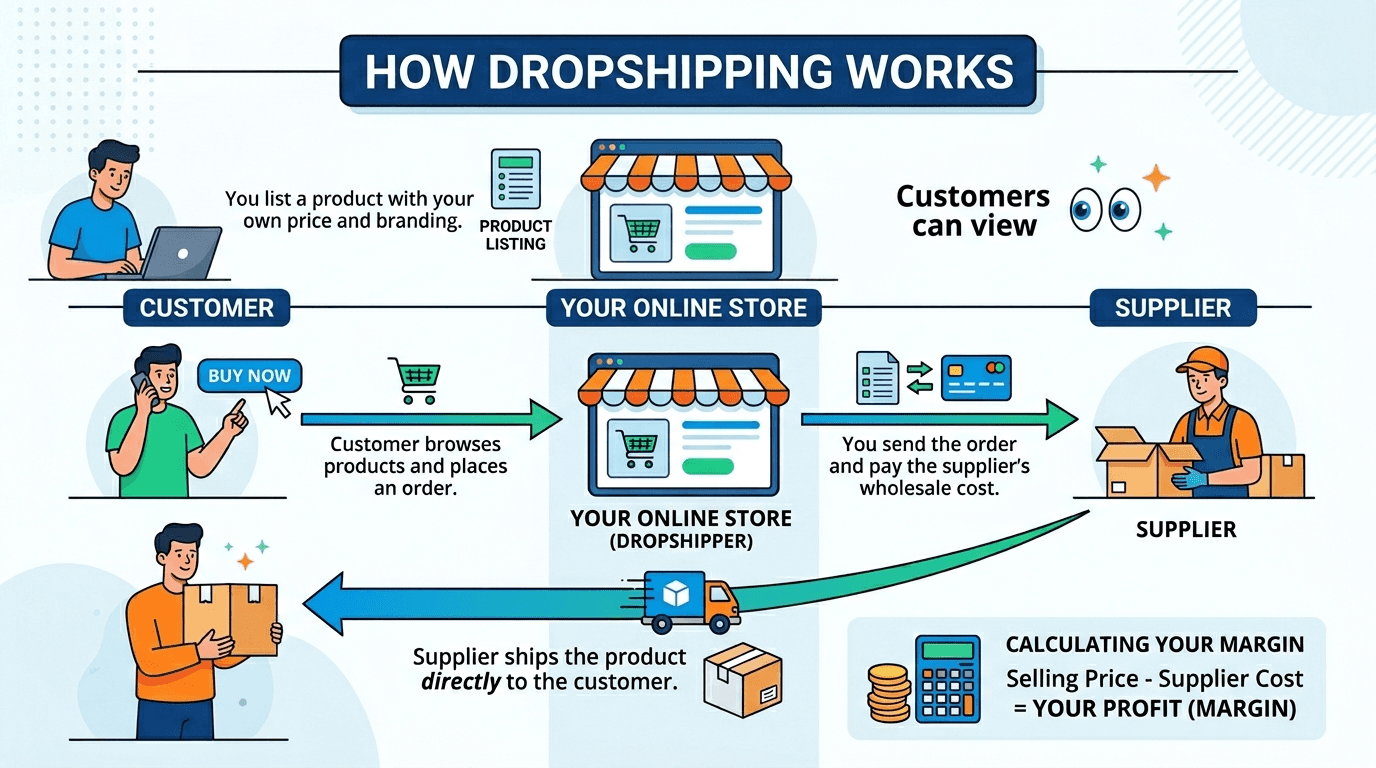
The flow itself is simple:
You list a product
A customer places an order
You send that order to your supplier
The supplier ships it directly to the customer
You keep the remaining margin
That simplicity is what attracts people. It is also what misleads them. Because nothing in that process guarantees profit.
Every order only works if the numbers hold.
Your selling price has to cover product cost, shipping, payment fees that usually sit between 2 - 5%, and the cost of acquiring the customer. Out of all these, the acquisition cost is the most unpredictable.
For example, if you sell a product for $35, spend $15 on sourcing, around $10 on ads, and about $3 on fees, you are left with roughly $7 in profit.
That margin can disappear quickly. If your ad costs rise, your profit drops with it.
How Dropshipping Works
Dropshipping runs through a connected system. You handle demand and customer experience, while suppliers, manufacturers, and logistics providers handle everything behind the scenes.
1. Product Selection
The starting point is not picking a product at random. It is identifying demand that already exists. Products that keep appearing in ads, run for 7 to 14 days, and use multiple creatives are usually backed by real spend.
At this stage, you are reading signals, not guessing. Suppliers are already sourcing these products from manufacturers or exporters. Your role is to decide whether the product can attract attention, convert through visuals, and leave enough margin after ad costs.
2. Store Setup
Your store acts as the front end of the system. It is where the customer interacts, even though the product and fulfillment sit elsewhere.
Platforms like Shopify and WooCommerce make setup quick, but the function of the store is to translate the product into something a customer understands immediately. Pricing, positioning, and presentation all sit here, and tools like a QR Code Generator can further improve accessibility and customer interaction.
The customer never sees the supplier or manufacturer. The store becomes the business in their eyes.
3. Customer Acquisition
This is the part of the system that drives everything forward. Without demand, nothing else activates.
Platforms like Meta and TikTok are used to test and scale products by pushing them in front of large audiences. What matters here is not just traffic, but how that traffic behaves. Clicks, engagement, and purchases tell you whether the product is working or needs to be dropped.
You are not just running ads. You are constantly filtering. Products that fail to convert are replaced. Products that show consistent response get more budget and better creatives. This feedback loop is what keeps the system moving.
Organic content can support this, but paid distribution is what drives consistent volume and faster testing.
4. Order Fulfillment
Once an order is placed, it moves to the supplier. The supplier sources the product, packs it, and hands it over to the shipping network.
Logistics providers handle delivery and tracking. These tracking systems can be integrated into your store so customers can follow their orders. Even though multiple parties are involved, the customer does not interact with them directly.
5. Payment Processing
Before fulfillment begins, the transaction is handled through a payment gateway integrated into your store. This layer manages how customers pay and how funds move through the system.
Gateways support multiple payment options such as cards, wallets, and regional methods, which reduces drop-offs at checkout. For customers shopping online, online shopping cards can also provide a familiar card-based payment option at checkout. They also handle refunds, failed transactions, and payment security. While it runs in the background, this layer directly affects conversion and trust.
6. Post Purchase Handling
After the order is shipped, communication comes back to you. Customers reach out for tracking updates, delivery timelines, or product issues.
This stage reveals how well the system holds up. Slow shipping, product quality issues, or mismatched expectations all surface here. While suppliers and logistics affect the outcome, the responsibility of handling refunds, support, and communication stays with you.
Dropshipping Business Models
Different store structures serve different stages of growth. The model you choose depends on whether you are testing, scaling, or trying to build something more stable.
Model | What It’s Used For | When It Works | Main Risk |
General Store | Testing multiple products quickly | Running frequent product tests | Low trust and weak conversion |
Niche Store | Focusing on a single category | 1-2 products show consistent sales | Limited flexibility |
One Product Store | Scaling a single winning product | Strong demand and clear product appeal | Short lifespan due to competition |
Print on Demand | Selling customized products | Unique designs or branding angle | Slower setup and production |
Each setup solves a different problem. Testing needs speed, scaling needs focus, and long-term growth needs control over the offer. Problems usually start when the structure does not match the goal.
Advantages and Disadvantages of Dropshipping
Advantages
Low upfront cost: You are not buying inventory in advance, so there is no money tied up in stock. If a product does not work, you move on without carrying unsold inventory.
Fast product testing: You can launch a product, run traffic, and know within days whether it has potential. This makes it easier to test multiple ideas without long commitments.
Operational scalability: Fulfillment is handled by suppliers, so growth does not add operational complexity. More orders mainly mean more traffic, not more logistics.
Product flexibility: You can switch products quickly based on performance, which allows you to adapt to changing demand.
Location flexibility: The business runs online, so it can be managed from anywhere without physical constraints.
Disadvantages
Low margins: A large part of your revenue goes into acquiring customers. As ad costs increase, profit margins shrink quickly.
Supplier dependency: You rely on suppliers for product quality and delivery. Any issue on their end affects your store directly.
Shipping delays: Longer delivery times often lead to customer complaints, refunds, and lower trust.
High competition: The low barrier to entry means many sellers offer similar products, which puts pressure on pricing.
Limited control: You do not control the product or fulfillment, which makes branding and consistency harder.
How to Start Dropshipping in 2026?
1. Niche and Market Selection
The first decision is the market, not the product. Some niches give you repeat demand and easier conversions, while others rely on one-time impulse and fade quickly.
Look for niches that naturally support ongoing demand:
Pet care → grooming tools, health products, toys that need replacement
Skincare → products tied to routines and continued use
Fitness → home workout gear, recovery tools, accessories
Problem-driven niches usually convert faster because the value is clear:
Posture correction and back pain relief
Kitchen tools that save time
Car accessories that fix everyday annoyances
Emotional categories also perform well, such as:
Baby products
Pet accessories
Personal safety items
Avoid products that rely only on appearance. They may attract attention, but they struggle to sustain consistent sales.
2. Product Validation
After choosing a niche, the next step is checking whether a product inside it is already converting, not just getting attention.
Ad activity is the first filter. If a product has been running ads consistently for 7 to 14 days, it usually means the numbers are working. One ad is not enough. Multiple creatives for the same product signal active testing and scaling.
Engagement gives a clearer read. A click-through rate below 2% usually means weak interest. Around 3–5% is testable. Anything above 5% shows a strong response, especially when ads continue running.
Competition needs context. Too many identical stores with similar pricing leads to margin pressure, which makes it harder to sustain profit. Looking at competitor stores helps confirm this. Pricing consistency, branding quality, and offer structure usually reveal whether the product is being scaled seriously or just copied across stores.
Using WinningHunter makes this faster. You can track active ad spend trends, see which creatives are scaling, and identify products backed by real demand.
3. Supplier Selection
A product can perform well in ads and still fall apart during delivery. That usually comes down to the supplier.
Three things decide how smoothly this stage runs. Shipping time affects how long customers are willing to wait. Once delivery crosses 10 days, complaints and refund requests start increasing. Product quality shows up through reviews, especially customer photos and repeated issues. Refund handling determines how quickly problems get resolved when something goes wrong.
Before choosing a supplier, check:
Shipping time, ideally under 10 days
Product reviews, focusing on consistency and real usage
Refund handling and response speed
Most stores begin with global suppliers during testing. As orders increase, shifting to a local warehouse or faster fulfillment option helps stabilize delivery and reduce customer friction.
4. Product Page Design
With the product and supplier sorted, the product page becomes the point where decisions are made. If it fails to convince or build trust within a few seconds, the visitor leaves without buying.
Clarity comes first. The product page heading should communicate what the product does or fixes, not just state its name. Everything that follows should reinforce that value through clean visuals and short, easy-to-scan explanations. Avoid clutter, vague descriptions, or anything that forces the visitor to think too much.
Trust is what pushes the decision forward. Grammatical errors, low-quality images, or excessive emojis reduce credibility instantly. The page should feel reliable at a glance. Use small visual highlights to show key assurances like fast delivery, easy returns, or secure checkout without overwhelming the layout.
Strong pages also show the product in use. Videos, GIFs, and user-generated content help people understand what to expect and reduce uncertainty. Reviews with real images add another layer of confidence.
Every element on the page should work toward one goal: making the product easy to understand and safe to buy. When that happens, conversions follow.
For setting up your store, platforms like Shopify or WooCommerce with WordPress are widely used because they make it easier to build, customize, and manage product pages without complex setup.
5. Pricing Strategy
A common starting point is simple. Take your product cost and price it at 2 to 3 times that amount. This gives you room to work with, but it does not guarantee profit.
What actually decides whether a product works comes down to two numbers: customer acquisition cost and average order value. If these are not in your favor, the pricing breaks, no matter how good the margin looks on paper.
Take a basic example. A product costs $12 and sells for $30, leaving an $18 gap. After fees and shipping, your break-even point usually sits around $10 to $12 in ad spend. Once the acquisition cost crosses that range, the product stops making sense.
Before scaling, check:
How much room is left after all costs
Whether the price can handle rising ad costs
If the product allows bundles or upsells to increase order value
Pricing works only when it holds under real traffic conditions. Check out these pricing strategies to get a deeper idea of how to price your dropshipping products.
6. Marketing Launch
This phase is about putting the product in front of people and seeing how it performs under real conditions.
Start with a small test. Launch 3 to 5 creatives, each built around a different angle. One can focus on the problem, another on how the product works, and another on the result. This gives you a clearer view of what people respond to without relying on a single approach.
Keep the budget controlled in the beginning. You are testing response, not trying to scale immediately.
As traffic comes in, track a few key signals:
CTR shows if the creative is catching attention
CPC reflects how expensive that traffic is
The conversion rate shows whether the page is converting
These numbers help you understand whether the setup is working or needs adjustment before increasing spend.
7. Scaling Decision Framework
Scaling only makes sense when demand, margins, and operations hold together under pressure. A few sales are not enough. You need consistency you can rely on.
Scale when the product shows repeatable performance. This usually means steady order flow, often in the range of 20–30+ orders per day, with margins still intact after ad spend. Profitability should not depend on a single ad or a short spike. You should see a stable CPA within your acceptable range and a positive return across multiple creatives.
Operational readiness matters just as much. Suppliers should be able to handle higher volume without delays, and shipping timelines should remain consistent. If fulfillment starts slipping, scaling will amplify refunds and complaints.
Marketing signals should also be clear. High engagement, strong CTR, and stable conversion rates indicate that the product is not just attracting clicks but converting reliably. More importantly, you should understand why it is working, not just see that it is.
Do not scale when the foundation is unstable. Low or inconsistent conversion rates, rising acquisition costs, or thin margins make scaling risky. The same applies when customer support is already struggling to keep up, or when fulfillment is unreliable.
Best Platforms and Suppliers to Start Dropshipping in 2026
Best Platforms
The platform you choose affects how quickly you can launch and how much control you have as you grow.
Platform | What It Does | Where It Works Best | Key Advantages | Limitations | Best Choice When |
Shopify | Hosted platform that handles hosting, checkout, and integrations | First-time sellers, fast product testing, one product, or niche stores | Quick setup, large app ecosystem for product import, automation, and upsells | Monthly cost ($39+), added app costs, limited backend control | You want speed, simplicity, and minimal setup |
WooCommerce | A WordPress plugin that turns a site into an e-commerce store | Long-term stores, SEO-focused setups, WordPress users | No fixed platform fee, full control over design and data | Requires hosting, setup, and ongoing maintenance | You want control and flexibility long term |
BigCommerce | Hosted platform similar to Shopify with more built-in features | Growing stores that want fewer external apps | Strong built-in features, scalable | Less intuitive than Shopify, pricing increases with growth | You want built-in functionality with less reliance on apps |
Wix eCommerce | Website builder with e-commerce features | Simple stores, beginners testing basic setups | Easy setup, drag-and-drop builder | Limited flexibility and scalability for serious stores | You want a simple store without a technical setup |
Suppliers
Suppliers affect delivery, conversion, and refunds, so the choice should match the stage your store is in.
Supplier | Where It Fits | Shipping Speed | Quality Signals | Refund Handling | Trade Off |
AliExpress | Testing phase | 7–20+ days | Varies, depends on seller reviews | Inconsistent, seller-dependent | Low cost, but slower and less reliable |
CJdropshipping | Testing to scaling | 5–12 days (varies by warehouse) | More controlled sourcing | Better support and handling | Higher cost than AliExpress |
Spocket | Scaling and branding | 3–7 days (local suppliers) | Higher consistency, vetted suppliers | More reliable policies | Higher product pricing |
A simple way to think about this is margin vs experience. Lower-cost suppliers give you room to test without risk, but they come with weaker delivery and support. As soon as you start getting consistent orders, delays and quality issues begin to affect conversions, not just refunds. At that point, paying more for faster shipping and better handling often protects revenue instead of reducing it.
What Actually Defines Dropshipping Today
Dropshipping is still a simple retail model. You sell a product, the supplier fulfills it, and you operate without holding inventory. That structure is what makes it easy to start and widely adopted.
What has changed is how that structure performs in practice. The model now operates in a faster and more competitive environment, where product demand shifts quickly, acquisition costs fluctuate, and fulfillment directly affects customer experience. Understanding dropshipping today means looking beyond the basic definition and seeing how these factors interact.
Stores don’t succeed because of the model alone. They work when demand is real, costs stay within range, and delivery meets expectations.
Having visibility into what is already working makes this easier. With WinningHunter, you can track active ads, see which products are gaining traction, and validate ideas with more clarity.
Dropshipping is simple in structure, but performance depends on how well you read what is happening around it.
FAQs
Is dropshipping still profitable in 2026?
Dropshipping can still be profitable, but margins are tighter and depend heavily on execution. Profit now comes from accurate product selection, controlled acquisition costs, and reliable fulfillment. Entering too late or relying on weak creatives usually leads to losses. Stores that work are the ones identifying demand early and keep costs within a sustainable range.
How much money do you need to start dropshipping?
You can start with a few hundred dollars, but most of that goes into testing, not setup. Store costs are relatively low, while ad spend determines how quickly you get results. A realistic starting budget covers product testing, creatives, and initial traffic, since finding a working product often requires multiple attempts.
How do you find winning products?
Winning products usually show clear demand signals before you test them. Look for products running ads consistently, multiple creatives for the same item, and strong engagement. Instead of guessing, using tools like WinningHunter helps you track what is already being scaled, which reduces trial and error and speeds up validation.
What are the risks of dropshipping?
The main risks come from low margins, supplier dependency, and inconsistent fulfillment. Rising acquisition costs can remove profit quickly, while delays or quality issues lead to refunds and disputes. Since you don’t control inventory or shipping, maintaining a stable customer experience becomes critical as order volume increases.


We already know what works before you even have the chance to blink!
© 2024 WinningHunter.com